I see this mistake in beginners because bonsai invites action before it teaches patience. Can direct summer sun kill your tree? Yes, it can, especially when heat, dry roots, shallow bonsai pots, and a sudden change in exposure come together. Summer sun is not automatically the enemy, but uncontrolled midday sun on a stressed bonsai can scorch foliage, overheat the root mass, and weaken the tree enough to cause dieback.
I have seen this most often not in neglected trees, but in trees that were otherwise healthy and then moved too quickly into harsher conditions. A bonsai pot is a very small landscape. In July and August, that small landscape can become far hotter than the air around it.
The important question is not simply whether your bonsai gets sun. The real question is which sun, for how long, on what species, in what climate, and in what stage of health. Once you learn to read those factors together, you can give strong light without gambling with the tree.
When summer sun becomes dangerous
Direct sun becomes dangerous when the tree cannot cool itself fast enough through transpiration, or when the roots become too hot to function normally. In practice, that usually means one of four things: the species prefers softer light, the rootball is drying too fast, the tree was not acclimated, or the weather is hot enough that even sun-loving species need protection during the harshest hours.
In my own benches, I watch the period from late morning to mid-afternoon more closely than the rest of the day. Morning sun is usually constructive. It builds energy, strengthens internodes, and keeps foliage compact. But a still, bright afternoon after a hot morning can feel very different. The leaves stop looking lively. Needle tips dull. The pot itself becomes unpleasantly warm to the hand. When I see that shift, I do not argue with the weather.
One quiet lesson from long practice is this: leaf damage often appears before the more serious root stress is understood. People react to the scorched foliage, but the true problem may be that the entire root zone spent several days heating and drying beyond the tree?s comfort. By the time the leaves mark the mistake, the stress has already settled deeper.
How bonsai die from too much sun
Summer sun rarely ?kills instantly? unless the tree was already very weak. More often, the damage happens in layers.
- Leaf scorch: The leaf surface burns, especially on thin-leafed species. You see pale patches, crisp edges, or browned tips.
- Root overheating: Dark pots and shallow containers absorb heat quickly. Fine feeder roots can be damaged even when the top still looks acceptable.
- Water stress: The tree loses moisture faster than the roots can replace it, particularly in a coarse mix on windy days.
- Loss of vigor: Repeated stress reduces energy reserves, weakens buds, and makes the tree more vulnerable to pests, fungal issues, and branch dieback.
This is why a tree may survive one brutal weekend, then decline slowly over two or three weeks. The sun did not ?finish it? in one afternoon. It pushed the tree into a weaker state, and the following days completed the damage.
Which bonsai are most at risk?
Not all bonsai read summer the same way. Junipers, many pines, and some broadleaf deciduous trees can take a great deal of sun when healthy and properly acclimated. Others are far less forgiving.
| Tree type | Summer sun tolerance | Best approach |
|---|---|---|
| Tropical bonsai such as ficus, schefflera, jade | Moderate to high, depending on heat | Strong morning sun; protect in severe afternoon heat if temperatures spike |
| Juniper and pine | High, but not unlimited in extreme heat | Full morning sun; afternoon protection during heat waves or in very hot inland climates |
| Maple, hornbeam, beech | Moderate | Morning sun and bright afternoon shade are usually safer |
| Azalea, satsuki, camellia-like flowering material | Low to moderate | Filtered light or gentle morning sun; avoid harsh midday exposure |
| Freshly repotted, collected, or weak trees | Low regardless of species | Bright shade until vigor clearly returns |
Species matters, but condition matters just as much. A healthy juniper established in its pot is one thing. A recently repotted juniper with reduced roots is another. People sometimes rely too heavily on species charts and forget the tree?s present state.
I also pay attention to leaf texture. Thin, tender foliage tells the truth quickly. Thick, waxy leaves can hide stress a little longer. That does not always mean they are safer, only that the warning comes later.
Signs your tree is getting too much summer sun
If you catch the stress early, the remedy is usually simple. If you ignore it for a week, recovery becomes much slower.
Early signs
- Leaves droop by midday even when the soil is not dry
- New growth looks limp or slightly faded
- Leaf edges begin to pale
- The pot becomes very hot by early afternoon
More serious signs
- Brown, crisp leaf margins or bleached patches
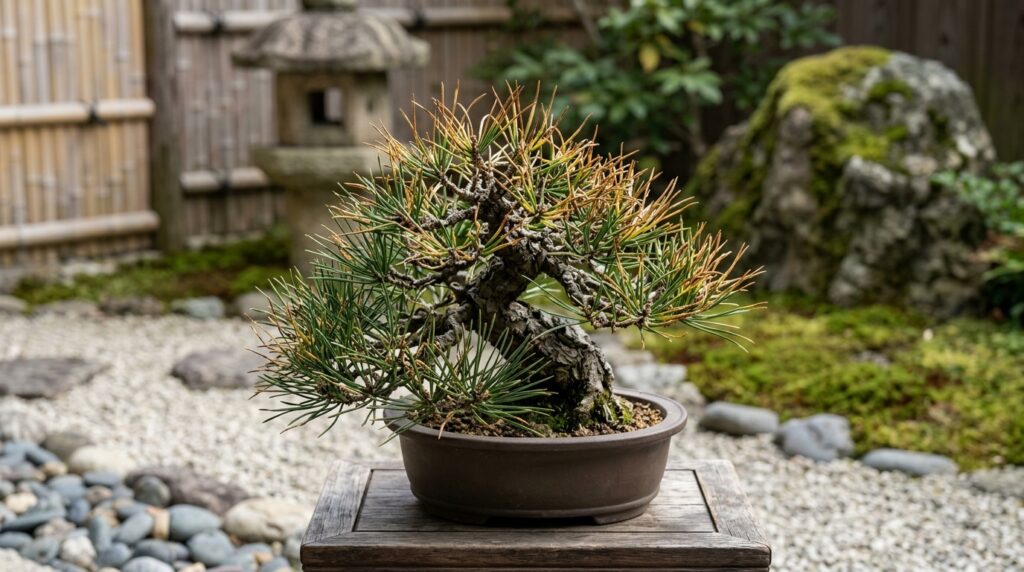
- Needle tip burn on conifers
- Sudden yellowing followed by leaf drop
- Dry, shrinking rootball that is hard to re-wet
- Dieback on fine twigs after several hot days
One of the most useful habits is to observe the tree twice: once in the cool of morning, and again around the hottest part of the day. Many bonsai look perfect at 8 a.m. and troubled at 2 p.m. If you only look once, you miss the conversation entirely.
How to decide between full sun, partial sun, and shade
For most bonsai keepers, a rigid rule like ?full sun always? or ?bright shade only? is too crude. A better approach is to think in time blocks.
- Full morning sun: Usually the safest high-light window. It supports compact growth and strong energy with less heat load.
- Filtered midday light: Useful for species with delicate leaves, flowering bonsai, recently repotted trees, and trees in shallow dark pots.
- Afternoon shade: Often the difference between vigorous summer growth and chronic leaf damage in hot climates.
In coastal or mild climates, a tree may tolerate much more direct exposure than the same species would inland. In a dry inland garden with reflected heat from walls, pavement, or gravel, even sun-loving trees can struggle. Microclimate is not a small detail. It is often the deciding factor.
I learned early in Kyoto that placement can be more refined than ?sun bench? and ?shade bench.? Even a lattice panel, the shadow line from a fence, or the cooler airflow near a bench leg can meaningfully change how a tree experiences the day. Bonsai teaches this kind of small attention. The tree does not live in our labels. It lives in the exact place we set it down.
What to do if your bonsai is getting scorched
If you suspect too much summer sun, act gently but promptly. Do not swing from one extreme to another. A tree that has been stressed by sun does not need darkness. It needs reduced strain.
- Move the tree to bright shade or a place with only morning sun.
- Check the rootball carefully and water thoroughly if needed.
- Do not fertilize a stressed, scorched tree immediately.
- Do not prune heavily just because the leaves look ugly.
- Watch new growth and moisture retention for the next 7 to 14 days.
If your setup needs a practical fix, simple shade support is usually more useful than constant relocation. A piece of 50% shade cloth for plants can soften the harshest hours without putting the tree into deep shade. For trees that dry very quickly in midsummer, a fine-rose bonsai watering can gives more even soaking than a hard spray, and a basic bonsai chopstick set is useful for testing moisture deeper in the rootball rather than guessing from the surface.
If the leaves are badly burned, leave them alone unless they are fully dead and brittle. Partially damaged foliage still contributes something while the tree recovers. The first goal is not appearance. It is restoring stable function.
Watering and pot temperature matter as much as sunlight
Many sun problems are really heat-and-water problems wearing a sun-shaped mask. A healthy bonsai in a well-managed watering routine can take much more light than the same tree in a rootball that repeatedly swings from wet to bone dry.
Pay attention to these factors:
- Pot color and material: Dark ceramic heats quickly. Thin containers heat faster than deeper training pots.
- Soil particle size: Very open mixes drain beautifully, but they can dry with surprising speed in midsummer.
- Wind exposure: Wind strips moisture even when temperatures are not extreme.
- Bench surface and surroundings: Stone, metal, and pale walls can reflect and amplify heat.
When a tree is near the edge in summer, I often adjust the environment before I blame the species. Raising humidity slightly around the benches, spacing pots so air can move, and using afternoon shade can solve the issue without changing the whole cultivation plan.
Another quiet observation from teaching beginners: many people water on schedule instead of by need, then assume sun was the sole problem. Summer bonsai reward presence more than routine. Two days that look identical on a calendar may not be similar at all in heat, wind, or evaporation.
Do flowering bonsai need more light than normal bonsai?
Sometimes yes, but not in the simple way people imagine. Flowering bonsai usually need enough light to set buds and bloom well, but that does not mean they want the harshest direct summer sun all day.
Azalea is the clearest example. It benefits from good light, but its foliage and roots can suffer in hot, intense afternoon exposure. A bright position with morning sun and protection from peak heat is often better than forcing full-day summer sun. Bougainvillea is different. It generally wants stronger light and warmth to flower well, though even there, a recently repotted or dehydrated tree can burn.
So the answer is this: flowering bonsai often need careful light management, not necessarily more punishing light. The goal is enough energy for buds and bloom without compromising foliage quality, root health, or seasonal balance.
When direct summer sun is actually beneficial
It is important not to overcorrect. Many bonsai become weak, leggy, and coarse when protected too much. Conifers especially lose character when they are grown too softly. Needles lengthen, interior growth weakens, and the tree stops looking disciplined.
Direct sun is beneficial when the tree is healthy, established, well-watered, and suited to that exposure. It improves vigor, shortens internodes in many deciduous species, and strengthens the dense growth we value in bonsai. If your climate is mild and your tree is acclimated, direct summer sun may be exactly right for much of the day.
The mistake is not giving sun. The mistake is assuming all direct summer sun is equal. June morning sun and August reflected afternoon heat are not the same event.
FAQ
Should I mist a sun-stressed bonsai?
Misting can cool foliage briefly, but it does not replace proper watering or shade management. Use it as a minor support, not as the main solution.
Can a scorched bonsai recover?
Usually yes, if the roots remain healthy and you correct the exposure quickly. Recovery is slower when the root zone was repeatedly overheated.
Is afternoon sun always bad for bonsai?
No. In mild climates many species do well with it. The risk rises with high temperatures, dry wind, reflected heat, shallow pots, and delicate species.
Should I repot after sun damage?
Usually no. Repotting adds another stress. First stabilize the tree, restore hydration, and wait for clear signs of renewed vigor.
When people ask me whether direct summer sun can kill a bonsai, I answer yes, but I also try to make the question more precise. Sun is only one part of the event. Heat, roots, water, species, and timing complete the story. If you learn to read those together, your trees become easier to protect, and your decisions become much calmer.