The first time I held a bonsai in my hands — a small juniper no taller than a paperback novel — I felt something I could not immediately name. It was not just the beauty of its twisted trunk or the delicate arrangement of its foliage. It was the unmistakable sense that I was holding something alive with meaning. Over two decades of practice have only deepened that feeling.
The question I hear most often from students and visitors is simple but profound: What does a bonsai tree mean? The answer weaves together etymology, centuries of cultural history, Zen philosophy, and the quiet wisdom of wabi-sabi. This article is my attempt to share all of it.
What Does “Bonsai” Actually Mean?
The word bonsai is Japanese, composed of two kanji characters: bon (盆), meaning tray or shallow container, and sai (栽), meaning planting or cultivation. Literally translated, bonsai means “planted in a tray” or “tray planting.”
But the word itself is only half the story. Bonsai derives from the older Chinese term penjing (盆景), sometimes written as pun-sai or penzai, which means “tray scenery” or “tray landscape.” That distinction matters: where the Chinese tradition emphasized recreating entire landscapes in miniature — mountain scenes, forests, riverside views — the Japanese tradition that would become bonsai shifted focus toward the individual tree and its inner spirit.
The etymology itself signals meaning. A bonsai is not simply a small tree. It is a tree held in relationship — contained, attended to, shaped over years. That relationship between the practitioner and the living tree is where the true meaning resides.
A Brief History: From Chinese Penjing to Japanese Bonsai
To understand what bonsai means, we must understand where it came from. The art has roots stretching back over a thousand years.
Origins in China (600–1200 CE)
The earliest documented penjing appear during China’s Tang Dynasty (618–907 CE). Chinese artists and scholars cultivated miniature landscapes as expressions of philosophical ideals — recreating in a tray the grandeur of nature that the Taoist tradition held sacred. These were not merely decorations; they were meditative objects, invitations to contemplate the vastness of the natural world from a single contemplative vantage point.
By the Song Dynasty (960–1279 CE), penjing had become a refined court art, associated with cultivated taste and spiritual depth. Monks and scholars kept them as living companions for meditation.
The Journey to Japan (1200–1600 CE)
Buddhist monks carried the art of container-grown trees from China to Japan during the Kamakura period (1185–1333 CE). In Japan, the practice merged with native Shinto reverence for natural forms and the emerging influence of Zen Buddhism. Where penjing often celebrated abundance and landscape complexity, the Japanese aesthetic moved toward simplicity, restraint, and the expression of essential nature.
The Japanese term bonsai began to distinguish itself from its Chinese ancestor. Instead of elaborate landscapes, a single tree — gnarled, aged, shaped by invisible forces — became the focus. The Japanese saw in the solitary tree a mirror of the human condition: resilient, shaped by hardship, beautiful precisely because of its imperfections.
Refinement and Codification (1600–1900 CE)
During the Edo period (1603–1868), bonsai became widely practiced across Japanese society, no longer confined to temples and imperial courts. Styles were codified: the formal upright (chokkan), the slanting (shakan), the cascade (kengai), the windswept (fukinagashi). Each style carried its own expressive and philosophical weight.
By the Meiji era (1868–1912), bonsai exhibitions were held publicly in Tokyo, and the art began its journey toward the international stage it occupies today.
The Symbolism of Bonsai: What It Represents
Across cultures and centuries, bonsai has accumulated a rich vocabulary of symbolic meaning. These are not arbitrary associations — each grows naturally from the nature of the art itself.
Harmony and Balance
A well-designed bonsai achieves visual and energetic balance. The asymmetrical balance — never perfect symmetry, always dynamic equilibrium — reflects the Japanese aesthetic principle of ma: meaningful space, the beauty found in the relationship between things rather than in the things themselves. When you tend a bonsai, you are practicing balance as a living discipline, not just admiring it from a distance.
Patience and Time
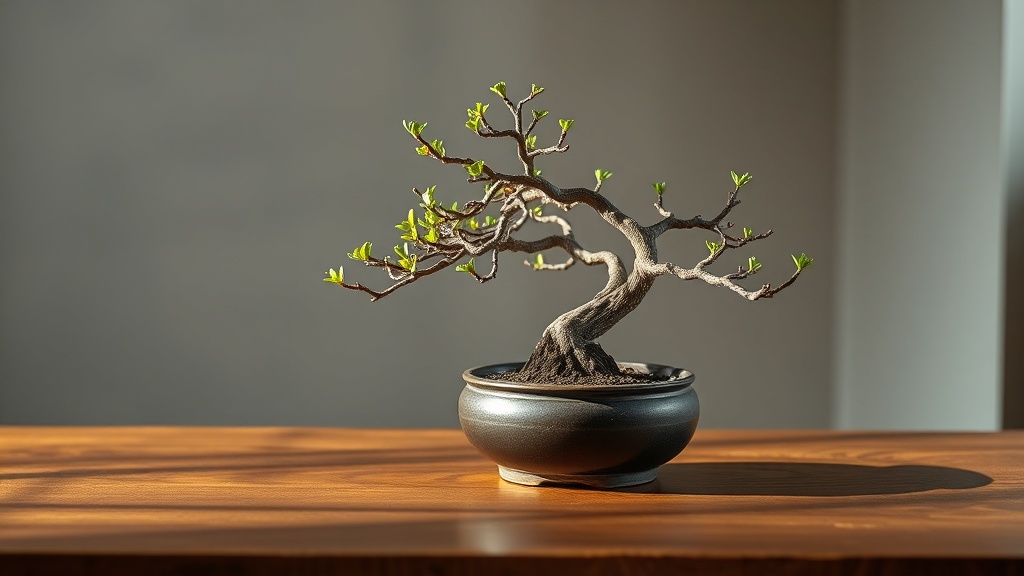
Nothing reveals the virtue of patience quite like a bonsai. A tree that will take thirty years to mature cannot be hurried. Every branch wire removed too early, every repotting done out of season, teaches the same lesson: nature moves on its own schedule, and wisdom means learning to move with it rather than against it.
In a culture of instant results, a bonsai on your desk is a daily reminder that some of the most meaningful things in life develop slowly.
Resilience and Endurance
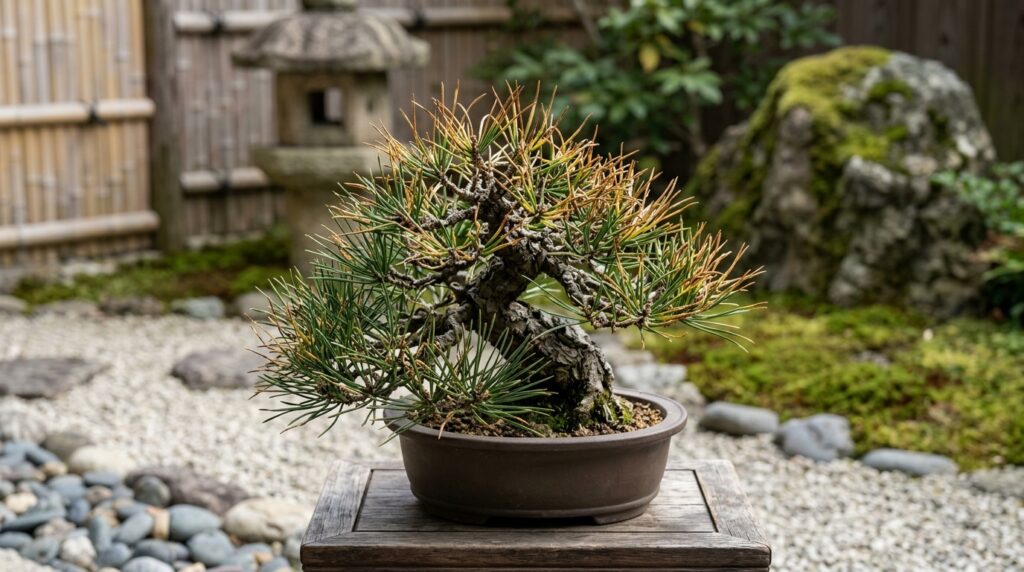
The most revered bonsai often show their age through hardship: deadwood (jin and shari) carved by lightning and disease, trunks twisted by decades of wind, roots gripping rock with determined fingers. This is yamadori wisdom — the wild-collected tree that has survived everything nature threw at it. A bonsai shaped to show this kind of endurance symbolizes strength built not despite hardship but through it.
Peace and Contemplation
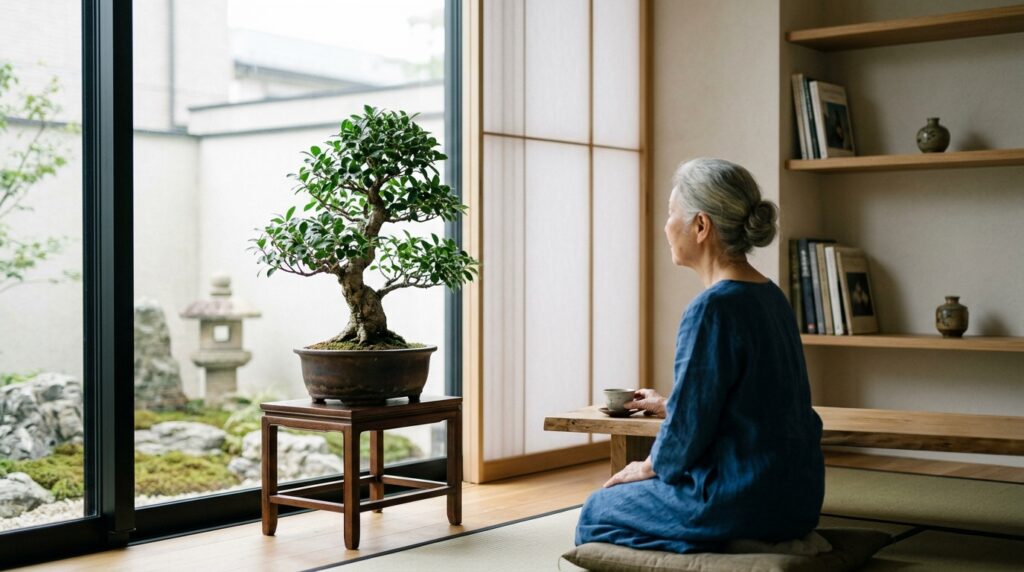
There is a reason bonsai are placed in meditation rooms, on altars, and in spaces of quiet reflection. Their presence invites stillness. The act of simply sitting with a bonsai — observing it, noticing subtle changes — is itself a contemplative practice. Bonsai create a kind of living silence.
Positive Energy and Good Fortune
In many East Asian traditions, living plants are considered carriers of positive chi (life energy). A healthy, well-tended bonsai is believed to bring good fortune, longevity, and abundance to a home or workspace. This is particularly true of species like the jade plant bonsai and the lucky bamboo-inspired ficus varieties.
Wabi-Sabi: The Philosophical Heart of Bonsai
No discussion of bonsai meaning is complete without wabi-sabi — and yet wabi-sabi is notoriously difficult to translate. It is less a concept than a felt sense of reality.
Wabi originally referred to the loneliness and simplicity of living alone in nature, away from society. Over centuries it evolved to mean a kind of rustic, unadorned beauty — the beauty of the imperfect, the incomplete, the humble.
Sabi refers to the beauty that comes with age and use — the patina on old copper, the texture of weathered wood, the imperfections accumulated through time.
Together, wabi-sabi is the acceptance — and celebration — of impermanence, imperfection, and incompleteness as the truest expressions of beauty. A moss-covered bonsai pot with a small chip in its rim. A trunk that grew crooked because of a scar. A tree that is not symmetrical but is undeniably alive. This is wabi-sabi.
Bonsai is perhaps the most complete living embodiment of wabi-sabi. Every tree is imperfect. Every tree changes. Every tree will eventually die. And in this, every tree is beautiful.
“The bonsai does not pretend to be perfect. It shows its scars, its asymmetry, its age. In doing so, it teaches us something we often forget: that beauty lives in truthfulness, not in flawlessness.”
—
Meaning by Species: What Different Bonsai Trees Symbolize
Different tree species carry their own symbolic weight. Part of choosing a bonsai — or receiving one as a gift — involves understanding what that particular tree means.
Pine (Matsu)
The pine is perhaps the most revered bonsai species in Japan. It symbolizes longevity, steadfastness, and undying loyalty. Pines remain green through winter — a visual symbol of endurance through adversity. A pine bonsai given as a gift expresses the wish for a long and resilient life.
Juniper
Juniper bonsai symbolize strength, protection, and purification. In Shinto tradition, juniper was used in purification rituals. Its dense, cloud-like foliage and dramatic deadwood make it one of the most expressive of all bonsai subjects, and its meaning reflects that drama: resilience expressed through beauty.
Cherry (Sakura)
The cherry blossom holds a special place in Japanese culture as a symbol of impermanence, renewal, and the beauty of transience. A cherry bonsai blooms briefly and spectacularly, each flower lasting only days. This is the very essence of mono no aware — the bittersweet awareness that nothing lasts, which makes each moment more precious.
Japanese Maple (Momiji)
Japanese maple bonsai symbolize grace, serenity, and seasonal transformation. Their stunning autumn color — from green to gold to crimson — makes them living calendars, reminding us that change is not loss but beauty in motion.
Ficus
Ficus bonsai are among the most accessible for beginners, and they symbolize harmony, abundance, and unity. In many Asian traditions, the ficus (or fig) is considered a sacred tree, associated with wisdom and enlightenment. The Bodhi tree under which the Buddha is said to have achieved enlightenment was a sacred fig.
Jade Plant Bonsai
The jade plant bonsai, with its thick succulent leaves and sturdy trunk, symbolizes prosperity, good luck, and friendship. It is often called the “money tree” in Feng Shui traditions and is a popular gift for new businesses and homes.
Bonsai as a Gift: What It Means to Give and Receive One
Giving a bonsai is not like giving flowers. A bonsai is a living commitment — it requires ongoing care, attention, and relationship. When you give someone a bonsai, you are giving them not just an object but a practice, a presence, a responsibility that deepens with time.
Traditionally, bonsai were given to express deep respect, lasting friendship, and wishes for a long and balanced life. They remain meaningful gifts for:
- New homeowners — bringing harmony and positive energy to a new space
- New businesses — symbolizing growth, patience, and long-term thinking
- Retirement — honoring a life well-lived and offering a contemplative companion
- Milestone birthdays — expressing wishes for longevity and continued flourishing
- Recovery and healing — the bonsai as a companion through difficult seasons
The species matters when giving as a gift. For a close friendship, consider a pine for its symbolism of loyal endurance. For a new creative venture, a ficus speaks to harmonious growth. For someone who needs peace, a juniper carries quiet strength.
If you’re looking for a starter bonsai to give as a gift, I often recommend the Brussel’s Bonsai Live Ginseng Grafted Ficus — it’s forgiving, meaningful, and beautiful enough to inspire the recipient to continue learning.
What Tending Bonsai Teaches Us
After twenty years, the most important thing bonsai has taught me is not technique. It is attention.
Every morning I walk past my trees. I do not always stop. But I always look. I notice which trees need water, which ones have pushed new growth overnight, which ones are quietly struggling. This daily practice of noticing — of truly seeing what is in front of you without judgment — is a form of mindfulness that extends far beyond the garden.
Bonsai teaches us:
- To work with nature, not against it. You cannot force a pine to grow like a maple. You can only understand what this tree wants to become and help it get there.
- To accept impermanence. Trees get sick. Trees die. The great trees I have lost over the years are part of my practice as much as the ones that thrive.
- That small actions compound. A tiny adjustment today, a gentle wire turn, a well-timed repotting — these small acts accumulate into something extraordinary over years and decades.
- That the practitioner is also shaped by the practice. I am different because of my bonsai. More patient. More observant. More comfortable with slow, uncertain outcomes.
Recommended Tools for Serious Practitioners
For those deepening their practice, quality tools make a genuine difference. I have used the same set of professional bonsai tools for over a decade — stainless steel concave cutters and knob cutters are the most important investments. For soil, I recommend a quality akadama and pumice blend that drains well and supports healthy root development.
The Meaning Is in the Practice
Bonsai tree meaning is not a fixed thing you look up in a reference book. It is something you discover through years of relationship with living trees. The etymology gives us “planted in a tray.” The history gives us a thousand years of human beings finding something essential in the act of tending small trees with great care. The philosophy of wabi-sabi gives us a framework for understanding why imperfect, impermanent, humble things can be the most meaningful of all.
But the meaning I carry most deeply is simpler than any of these. It is the meaning I feel on a quiet morning, standing in my garden before the day begins, watching light move across the foliage of trees I have known for years. In those moments, the bonsai means this: that presence is enough. That attention is a form of love. That small things, tended with care over time, become extraordinary.
If you are new to bonsai, you may begin with technique — the right soil mix, the right tools, the right species for your climate. But if you stay with it, what you find will be meaning far beyond horticulture. You will find a practice that changes how you see time, beauty, and the living world around you.
That is what bonsai means to me. And after twenty years, I believe it can mean the same to you.