Affiliate Disclosure: This post contains affiliate links. As an Amazon Associate, I earn from qualifying purchases at no extra cost to you.
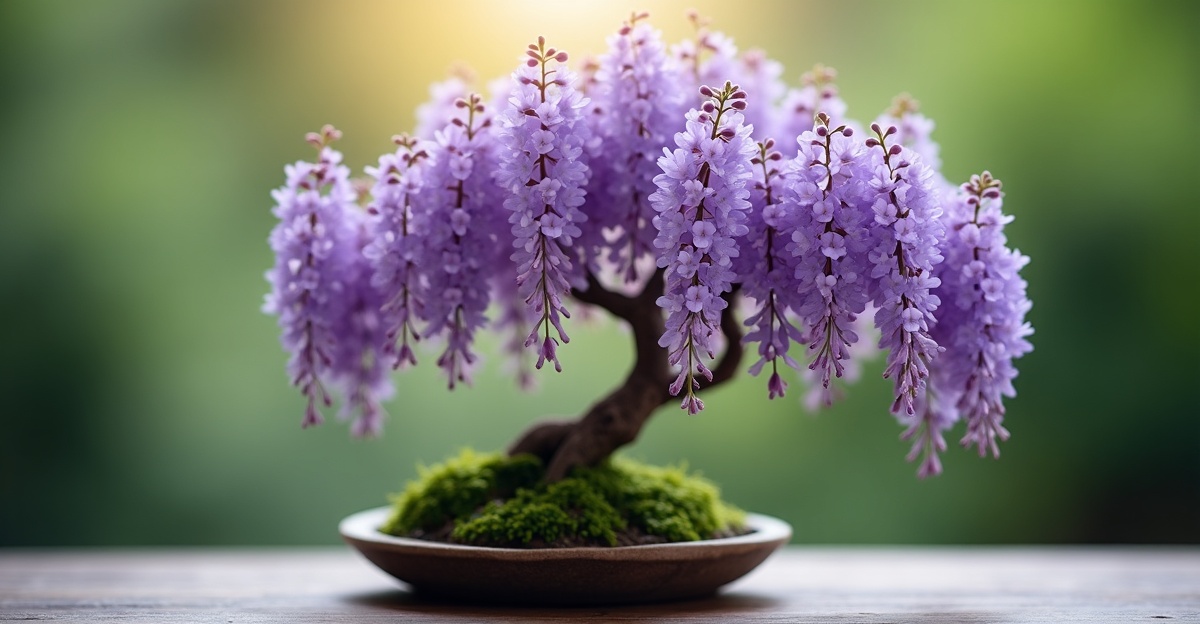
Every spring in Japan, people travel hundreds of miles to stand beneath a blooming wisteria. The curtains of violet, lavender, and white flowers—each cluster as long as your arm—create a spectacle that stops time. I have watched visitors weep at Ashikaga Flower Park. I understand why.
In bonsai form, wisteria achieves something extraordinary: that same breathtaking flower display compressed into a tree you can hold in both hands. A mature wisteria bonsai in full bloom is, without question, one of the most dramatic sights in the art. It is also one of the most misunderstood plants to cultivate as bonsai, which explains why so many practitioners try it once, fail to get flowers, and abandon the attempt.
This guide covers everything you need for wisteria bonsai care—from species selection and soil through the pruning calendar that is the key to reliable flowering every year.
Species: Japanese vs. Chinese Wisteria
Two species dominate bonsai cultivation:
- Japanese Wisteria (Wisteria floribunda) — longer flower clusters (up to 20 inches), twines clockwise, slightly more cold-tolerant, wider color range including white, pink, and deep purple. The showier species.
- Chinese Wisteria (Wisteria sinensis) — shorter clusters (6–12 inches) that open all at once rather than progressively, twines counterclockwise, slightly more vigorous growth. Easier to get into flower as bonsai.
For bonsai beginners, I recommend Wisteria sinensis. Its aggressive vigor helps establish trunk girth faster, and its tendency to bloom before leafing out in spring makes the floral display even more dramatic—bare branches hung with cascading flowers.
Both species share identical care requirements. Everything in this guide applies to both.
Starting Material: What to Buy and What to Avoid
Wisteria grown from seed can take 15–20 years to bloom. Always start from a cutting-grown or grafted plant—these are genetically identical to the parent and will bloom in 3–5 years under proper care.
When purchasing starting material, look for a plant with:
- Already-established nebari (surface root spread) or obvious trunk movement
- Graft union that is fully healed and inconspicuous if grafted
- Evidence of prior pruning (not a whip with no branching)
Nursery wisteria sold as landscape plants can be excellent starting material. They’re often cheap, already mature enough to flower, and their large trunks give you substantial material to work with immediately. The challenge is reducing the root mass for bonsai culture, which must be done gradually over 2–3 repotting cycles.
A good bonsai-ready wisteria pre-bonsai from a reputable seller saves years of development. Wisteria bonsai starter trees on Amazon range from small cuttings to developed pre-bonsai with significant trunk girth—choose based on how much development work you want to do yourself.
Light: Full Sun, No Compromises
Wisteria is emphatically an outdoor, full-sun plant. This cannot be softened. A wisteria that does not receive at least 6–8 hours of direct sun daily will not flower reliably, and its growth will be weak and etiolated.
Place your wisteria bonsai in the sunniest position you have—ideally against a south-facing wall that reflects additional heat. In climates with cool summers, the extra heat accumulation makes the difference between a plant that flowers and one that merely survives.
Do not grow wisteria indoors. Even bright indoor light is insufficient. If you live in an apartment without outdoor space, wisteria is not the right species for your situation.
Watering: Consistent Moisture Without Waterlogging
Wisteria has higher water needs than most bonsai species. In summer, established trees in shallow pots may need watering twice daily in hot weather. The signs of underwatering appear quickly: leaves wilt by midday and the tree loses vigor in ways that affect next year’s bloom.
At the same time, the roots must never sit in stagnant water. The combination of frequent watering and fast-draining soil—which I’ll describe below—solves this apparent contradiction.
From autumn through winter dormancy, reduce watering significantly. Water enough to prevent the root ball from completely desiccating, but the tree does not need constant moisture when it is dormant and leafless.
Soil Mix for Wisteria Bonsai
Wisteria is more tolerant of soil variation than species like pine or juniper, but it performs best in free-draining mix that still retains reasonable moisture:
- 40% akadama (retains moisture, feeds roots as it breaks down)
- 30% pumice (drainage, aeration)
- 30% lava rock (structure, drainage)
Avoid heavy organic-rich soils. They retain too much moisture around the roots and promote rank vegetative growth at the expense of flowers. Wisteria flowers on wood that experienced some moisture stress in late summer—rich, wet soil encourages leaves, not blooms.
For repotting, a quality bonsai-specific substrate removes guesswork. Pre-mixed akadama-pumice-lava bonsai soil is available in several particle sizes; use 2–6mm for wisteria.
The Pruning Calendar: The Secret to Annual Flowering
This is where most growers fail. Wisteria flowers on short spurs that develop on older wood. If you allow the plant to grow freely, it puts all its energy into long vegetative shoots that shade out the flowering spurs and exhaust the tree’s resources. The result: a spectacular vine, no flowers.
The solution is a two-stage annual pruning calendar that has been standard in Japanese wisteria bonsai practice for generations:
Summer Pruning (June–July)
This is the critical cut. After flowering, new vegetative shoots grow vigorously from every node. When these new shoots have 5–7 leaves, cut them back to 2–3 leaves. Do this systematically across the entire tree. This forces the plant to develop fat, flower-bud-producing spurs rather than long whips.
You will likely need to repeat this cut 2–3 times through summer as the tree continues to push new growth. Each time, cut back to 2–3 leaves from the base of the new growth.
Winter Pruning (December–January)
Once the tree is fully dormant and leafless, prune back the summer spurs further—to just 2–3 buds. You can now see the structure of the tree clearly, and you’ll notice that many of these short spurs have developed distinctly fat, round buds: these are flower buds. Long, pointed buds are vegetative. Learn to distinguish them.
Remove any crossing branches, overly long extensions, and structural elements that compromise the design. This is also the best time to wire, since the leafless structure is fully visible.
The Rule
Never let wisteria grow freely for an entire season. Unchecked growth produces no flowers. The discipline of the summer cut is what converts vegetative energy into flowering potential.
Fertilizing for Flowers, Not Leaves
Standard high-nitrogen fertilizer schedules, appropriate for most developing bonsai, will produce lush wisteria foliage and no flowers. Nitrogen drives vegetative growth. To encourage flowering:
- Spring (bud break through flowering): Light balanced fertilizer at half strength. The tree needs support but not excess nitrogen at this stage.
- Post-flowering through midsummer: Switch to low-nitrogen, high-phosphorus and potassium fertilizer (e.g., 0-10-10 or a bloom-booster formula). Phosphorus is directly implicated in flower bud initiation.
- Late summer into autumn: Continue low-nitrogen. The tree is hardening off and setting flower buds for next year. Excess nitrogen now disrupts this process.
- Winter: No fertilizer while fully dormant.
Research confirms the role of phosphorus in flowering: studies in ornamental horticulture have demonstrated that phosphorus availability at critical windows correlates strongly with floral bud differentiation in woody plants (Marcelis & Heuvelink, 2007). This is not folk wisdom—it is plant physiology.
Low-nitrogen bloom fertilizers designed for bonsai take the guesswork out of this; look for formulas with high middle and last numbers on the NPK label.
Repotting Wisteria Bonsai
Repot every 2–3 years in early spring, just before bud break—when you can see the buds swelling but before they open. Wisteria tolerates root pruning well and recovers quickly in warm spring conditions.
Reduce the root mass by about one-third, removing circling roots and encouraging outward-spreading nebari. At each repotting, work toward a flatter, more radial root structure.
Do not repot in the same year you intend to see maximum flowering. Root disturbance redirects energy to recovery. Plan repotting on a 2–3 year cycle that allows one or two full flowering seasons between root work.
After repotting, keep the tree shaded and wind-protected for 2–3 weeks while new root hairs re-establish. Water carefully—the reduced root mass is vulnerable to both drying out and waterlogging until it recovers.
Wiring and Styling Wisteria
Wisteria’s natural habit is a vigorous, twining vine with coarse, heavily furrowed bark on mature wood and long, whippy young growth. For bonsai, we typically aim for styles that honor this character:
- Informal upright (moyogi) — the most common approach, emphasizing trunk movement and a strong nebari
- Semi-cascade (han-kengai) — suits wisteria’s natural downward flower-draping habit
- Twin trunk (sokan) — allows two distinct flowering presentations
Wire in winter when the tree is dormant and structure is fully visible. Use copper wire, which holds well on wisteria’s fast-thickening wood. Check wired branches every 3–4 weeks as the tree comes into growth in spring—wisteria can embed wire rapidly once growth begins.
The trunk’s natural coarseness is an asset: mature wisteria develops deeply furrowed, ancient-looking bark surprisingly quickly. A 10–15 year old wisteria bonsai with good development can look genuinely old.
Cold Hardiness and Winter Care
Both major species are cold-hardy to around −15°C (5°F) for the roots when in the ground. As bonsai, where the roots have less insulation, protect from hard freezes below −5°C (23°F) by moving to an unheated greenhouse, cold garage, or burying the pot in the garden.
Wisteria needs a genuine winter dormancy period of cold temperatures. If you over-protect it—bringing it into heated space—you risk interfering with dormancy and, by extension, flowering. It should be cold enough to be fully dormant, not so cold the roots freeze solid.
In USDA zones 5–9, outdoor protection with simple wind-blocking is usually sufficient. In zones 3–4, an unheated structure is advisable.
Common Problems and Solutions
No Flowers
The most common complaint. Causes, in order of likelihood: (1) insufficient summer pruning—the plant grew freely without the 2–3 leaf cutback; (2) too much nitrogen fertilizer; (3) insufficient sun; (4) seed-grown plant (verify your source was cutting- or graft-grown); (5) tree is too young.
Leaf Yellowing
Wisteria is prone to chlorosis—yellowing from iron or manganese deficiency—especially in alkaline soils or when overwatered. Test soil pH; wisteria prefers slightly acidic conditions (pH 6.0–7.0). Iron chelate supplements can correct deficiency quickly.
Pests
Scale insects are the primary pest concern. Check the bark of older wood for brown or white encrustations, especially in the branch crotches. Treat with horticultural oil in early spring before growth begins. Aphids may appear on new growth in spring; they’re easily managed with a strong water jet or diluted neem oil.
Failure to Break Dormancy
If buds fail to open in spring, the tree may have been too warm through winter (insufficient chilling hours) or experienced root damage. Check the roots and provide better cold dormancy next year.
The Patience Equation
I have been growing wisteria bonsai for eighteen years. My best specimen—a Wisteria floribunda in a pale celadon pot—took six years to produce its first significant bloom and twelve years to become something I would consider exhibiting. It is now, in my view, worth the wait twenty times over.
What I have observed in those eighteen years is that the gardeners who succeed with wisteria are disciplined about the summer pruning and uncompromising about sun. Those who fail usually made one of those two errors. Follow the calendar. Place the tree where light is never a question. Everything else is refinement.
Frequently Asked Questions
How often does wisteria bonsai bloom?
Once per year, in spring, on properly maintained trees. The summer and winter pruning calendar ensures that energy is directed into flower bud production each year rather than vegetative growth.
Why is my wisteria bonsai not flowering?
The most likely cause is insufficient summer pruning. New growth must be cut back to 2–3 leaves repeatedly through June–July to force the development of flowering spurs. Too much nitrogen fertilizer and insufficient direct sun are the other common culprits.
Can wisteria bonsai be kept indoors?
No. Wisteria requires full outdoor sun and genuine winter dormancy. It cannot thrive long-term indoors and will not flower without adequate light and cold.
How do I get wisteria bonsai to flower?
Apply the two-stage pruning calendar: cut new growth back to 2–3 leaves in June–July, then cut spurs back to 2–3 buds in December–January. Fertilize with low-nitrogen, high-phosphorus formula from post-flowering through autumn. Provide maximum sun.
When should I repot wisteria bonsai?
Every 2–3 years in early spring, just as buds begin to swell before opening. Remove approximately one-third of the root mass and repot into fresh, free-draining bonsai soil.
Is wisteria bonsai difficult?
The tree itself is robust and tolerates pruning, repotting, and occasional neglect. The challenge is specifically in getting reliable annual flowering, which requires following the pruning calendar consistently. Once you understand the pattern, it becomes routine.
Citations:
Marcelis, L.F.M. & Heuvelink, E. (2007). Modelling fruit set, fruit growth and dry matter partitioning. Acta Horticulturae, 718, 121–134.
Dirr, M.A. (2009). Manual of Woody Landscape Plants. Stipes Publishing. (Species characteristics and cultural requirements for Wisteria floribunda and W. sinensis.)

About Kenji
Bonsai Practitioner & Teacher — 20 Years
Kenji has practiced bonsai for over 20 years, training under master practitioners in Osaka and Kyoto before bringing his craft to Seattle. He approaches bonsai as a meditative discipline rooted in patience, observation, and deep respect for the natural world. Read more about Kenji