Affiliate Disclosure: This post contains affiliate links. As an Amazon Associate, wabibonsai.com earns from qualifying purchases at no extra cost to you. These commissions help support the site and allow Kenji to continue sharing his knowledge.
The Language of Form: Understanding Bonsai Style Classification
Every bonsai tells a story. The way a trunk leans into imagined wind, the way branches reach toward unseen light, the way roots grip their pot as if clutching a mountainside — these are not accidents. They are the result of deliberate choices, grounded in a centuries-old Japanese classification system that gives practitioners a shared language for understanding and creating living art.
I have been working with bonsai for over twenty years, and I can say with certainty that understanding the classical style system transformed the way I see trees. Not just bonsai trees — all trees. When you walk through a forest and begin to notice Moyogi tendencies in a weathered oak, or recognize the Fukinagashi silhouette of a coastal pine, you understand that the bonsai masters were not inventing forms. They were observing and distilling what nature had already perfected.
In this guide, I will walk you through both the five primary bonsai styles and the important secondary styles. For each, we will explore the defining characteristics, the species that lend themselves naturally to the form, the visual and emotional effect it creates, and an honest assessment of the difficulty involved. And throughout, I want to return to a deeper question: not just what style to choose, but why.
The tools matter too. A good bonsai styling tool set — including concave cutters, knob cutters, and fine scissors — will serve you across all styles described here.
The Five Primary Bonsai Styles
Japanese bonsai tradition identifies five foundational styles, known collectively as the go-hon no ki, or “five basic trees.” These are defined primarily by the angle of the trunk relative to the pot’s surface, and they represent the spectrum from perfect vertical dignity to dramatic downward cascade.
Chokkan — Formal Upright
Characteristics: The trunk grows straight and vertical from the soil to the apex. It tapers evenly from a broad, flared base to a fine tip. Branches are arranged in a triangular pattern — the lowest and longest on one side, alternating as they ascend — creating a classical, symmetrical silhouette.
Best species: Pine (Pinus), Spruce (Picea), Larch (Larix). These naturally grow with strong vertical energy and develop the taper and branch structure that Chokkan requires.
Visual effect: Strength, dignity, and order. Chokkan evokes a solitary tree in an open field, untouched by wind, growing toward the sky with quiet authority.
Difficulty: Intermediate to advanced. The formal upright looks simple but demands true taper, precise branch placement, and a trunk that is genuinely straight — any subtle bend reads as a flaw rather than character.
Moyogi — Informal Upright
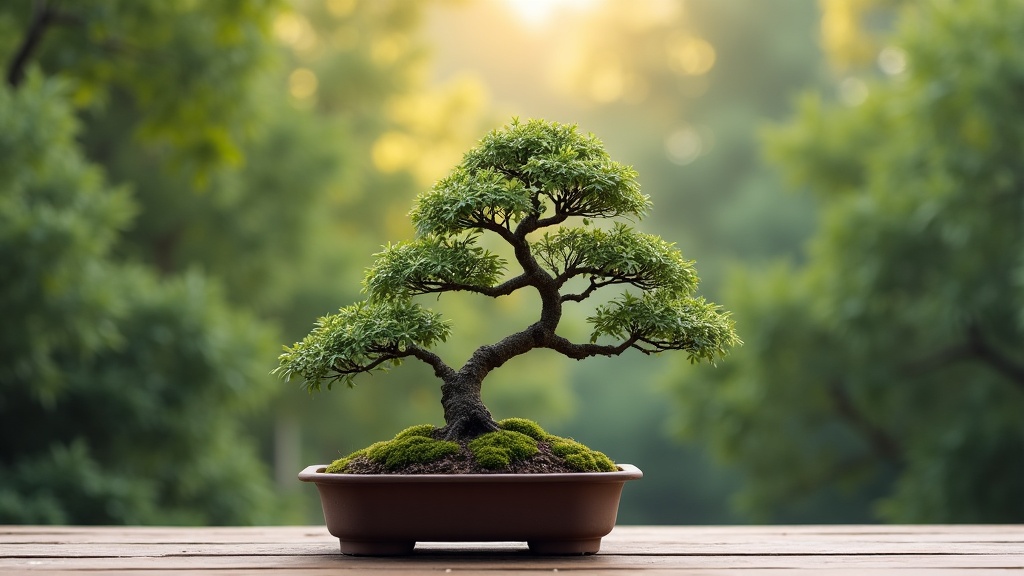
Characteristics: The trunk moves upward in a gentle S-curve or irregular bends, but the apex is positioned directly above the base of the trunk. This is the most common bonsai style in practice, because it captures the way most real trees actually grow — not perfectly straight, but reaching persistently upward despite minor obstacles.
Best species: Juniper (Juniperus), Japanese Maple (Acer palmatum), Ficus, Trident Maple. Almost any species can work in Moyogi.
Visual effect: Natural movement and grace. The informal upright feels alive — you sense the tree responding to its environment while never losing its upward intention.
Difficulty: Beginner-friendly. The organic movement allows for imperfection in a way that Chokkan does not. This is where I recommend most students begin.
Shakan — Slanting
Characteristics: The trunk grows at an angle — typically between 45 and 80 degrees from vertical. The roots on the side opposite the lean are prominently exposed, anchoring the composition visually. The apex leans away from the heaviest root and the strongest surface roots.
Best species: Juniper, Pine, Hornbeam (Carpinus), Beech (Fagus). Species with flexible young wood that holds wire well are ideal.
Visual effect: Dynamic tension. The slanting tree suggests persistent wind, a hillside, a battle with gravity — and the visible roots convey that the tree is winning that battle.
Difficulty: Beginner to intermediate. The main challenge is ensuring the root structure and visual weight support the lean convincingly.
Kengai — Full Cascade
Characteristics: The main trunk or primary branch cascades downward below the rim of the pot — often far below. Kengai trees are displayed on tall stands or shelves so the cascading element can hang freely. The apex points downward.
Best species: Japanese Maple, Wisteria, Star Jasmine (Trachelospermum jasminoides), Cotoneaster. Flexible, vigorous species that flower are particularly striking in cascade form.
Visual effect: Drama and perseverance. The cascade tree clings to an imaginary cliff face, its growth defying gravity, reaching not toward the sky but toward water far below. It is one of the most emotionally evocative styles in the tradition.
Difficulty: Advanced. Cascade styling requires strong wiring technique, deep understanding of the tree’s vascular flow (water and nutrients must travel against gravity), and a pot specifically shaped for the style. A tall cascade bonsai pot is essential equipment here.
Han-kengai — Semi-Cascade
Characteristics: Similar to Kengai, but the cascading branch does not fall below the bottom of the pot. It extends horizontally or drops only to the pot’s rim. This creates a less dramatic but often more elegant effect — the tree reaching outward rather than plunging downward.
Best species: Juniper, Cotoneaster, Azalea (Rhododendron). Flowering semi-cascades are among the most beautiful compositions in the art form.
Visual effect: A cliff-dwelling tree that leans over the edge without letting go. There is something hopeful in the semi-cascade — movement without total surrender to gravity.
Difficulty: Intermediate. Easier than full cascade in terms of horticultural management, but the composition requires careful balance between the cascading element and the upright portion.
Secondary Bonsai Styles: Where Artistry Deepens
Beyond the five primary forms, Japanese bonsai tradition recognizes several secondary styles that explore more complex compositions, unusual structural expressions, and deeply philosophical interpretations of the natural world.
Bunjin-gi — Literati
This is perhaps my favorite style to teach — and the hardest to explain to someone who has never felt it. Literati bonsai, inspired by the brushwork of Chinese scholar-painters, features a thin, dramatically curved trunk with very sparse foliage, often displayed in a small, shallow oval pot. The composition is deliberately asymmetrical, even spare. There is so much empty space.
That empty space is the point. Bunjin is the style that most directly embodies wabi-sabi: the beauty of incompleteness, the elegance of restraint. Best species: Japanese Black Pine, Scots Pine, Japanese White Pine. Difficulty: Advanced — the style requires absolute confidence in simplicity.
Yose-ue — Forest Planting
Multiple trees — always an odd number — planted together in a wide, shallow container to create the impression of a grove or forest. The trees vary in size to create perspective: larger trees at the front, smaller toward the back. Root systems may intertwine over time, creating a unified composition.
A wide shallow bonsai training pot is the standard container for forest plantings. Best species: Japanese Maple, Hornbeam, Zelkova (Zelkova serrata). Difficulty: Intermediate — selecting trees of compatible species and appropriate size relationships takes experience.
Ishitsuki — Rock Clinging / Rock Planting
Two variations exist: in one, the tree grows directly in a crevice of the rock, roots disappearing into it; in the other (neagari style), the roots wrap dramatically over the rock’s surface before plunging into the soil. Both evoke trees growing on mountainside boulders — an image of extraordinary tenacity.
Best species: Japanese Maple, Five-needle Pine, Trident Maple. A textured, porous bonsai accent rock is the critical element here. Difficulty: Advanced — the horticultural challenges of limited soil volume and watering are significant.
Fukinagashi — Windswept
Every branch, and often the trunk itself, sweeps in a single direction — as if the tree has spent decades in a constant, prevailing wind. The windswept style is one of the most narratively powerful: you can feel the wind even in a still room. The jin (deadwood) technique is often used on the windward side to show damage from that relentless force.
Best species: Juniper, Pine, Hawthorn (Crataegus). Difficulty: Intermediate to advanced — consistent directional growth takes years of patient wiring and patience.
Hokidachi — Broom Style
The trunk grows straight upward — like Chokkan — but branches spread outward from the top of a straight trunk in all directions, creating a broad, dome-shaped canopy. In winter, the fine ramification of deciduous trees in this style is extraordinary: a delicate network of branches like brushstrokes against the sky.
Best species: Zelkova, Chinese Elm (Ulmus parvifolia), Trident Maple. These species naturally develop the fine-branching structure that makes Hokidachi so striking. Difficulty: Intermediate — the straight trunk must be established early; branch development takes years.
How Wabi-Sabi Guides Style Selection
I am sometimes asked by students: “Which style should I choose for this tree?” My answer is always the same — look at the tree. What is it already trying to become?
Wabi-sabi, the Japanese aesthetic philosophy that underlies so much of bonsai practice, teaches us to perceive beauty in imperfection, asymmetry, and impermanence. A tree that has grown in a container for three years has already begun to reveal its nature. One trunk leans persistently to the left. Another has a dramatic movement near the base before straightening. A third has a low branch that seems to want to be the primary element.
These tendencies are not problems to be corrected. They are the tree’s voice. Our work as practitioners is to listen — and then to choose a style that amplifies what the tree is already expressing, rather than imposing an external ideal upon it.
This is why I caution beginners against starting with Chokkan. The formal upright demands perfection that is often imposed, not revealed. Begin instead with Moyogi, where the natural movement of the trunk is honored. Later, as your eye develops, you will find that you are not choosing styles for trees — you are discovering the style that was always latent within them.
For practitioners at any level, a thorough reference like the illustrated bonsai style guidebook can help you internalize the visual vocabulary of each form. The more deeply you know the classical styles, the more freely you can interpret and transcend them.
Practical Tips for Developing Any Style
Regardless of which style you are working toward, a few principles apply universally:
- Start with the right material. Young nursery stock is forgiving; it can be shaped. Older, thicker trunks have already committed to a direction. Work with what the material offers rather than against it.
- Wire early, wire patiently. The best time to establish a style’s primary movement is when the tree is young and the wood is flexible. Aluminum training wire is ideal for deciduous trees; copper wire offers more holding power for pines and junipers.
- Think in triangles. Most bonsai compositions, regardless of style, find their visual stability through triangular arrangements — whether of the overall silhouette, the branch structure, or the relationship between tree and pot.
- Study photographs of the natural counterparts. Before styling a cascade, study images of cliff-dwelling pines. Before developing a forest planting, spend time in actual woods. Nature is the original master.
- Be patient with time. A style is not created in a single session. It is revealed over years. This is not a limitation — it is the gift. The long arc of bonsai development is where the practice teaches us about ourselves as much as about trees.
Frequently Asked Questions
Q: What are the 5 main bonsai styles?
The five foundational styles are Chokkan (formal upright), Moyogi (informal upright), Shakan (slanting), Kengai (cascade), and Han-kengai (semi-cascade). These form the core of Japanese bonsai classification.
Q: Which bonsai style is best for beginners?
Moyogi (informal upright) is the most beginner-friendly. Its organic movement allows for natural imperfection, and nearly any species can work in this form. Juniper and ficus are excellent starting choices.
Q: What is the difference between Kengai and Han-kengai?
In full cascade (Kengai), the primary element falls below the bottom of the pot. In semi-cascade (Han-kengai), it extends horizontally or drops only to pot rim level — not below.
Q: How does wabi-sabi philosophy relate to choosing a bonsai style?
Wabi-sabi teaches us to find beauty in imperfection and to honor what is naturally present. In bonsai, this means listening to the tree’s existing tendencies and choosing a style that reveals rather than imposes. The most honest bonsai are those that feel inevitable.
Q: What is Literati (Bunjin) bonsai?
Bunjin-gi is a style inspired by Chinese literati painting — featuring a tall, thin, dramatically curved trunk with very sparse foliage. It is one of the most philosophically expressive styles, embodying the wabi-sabi principle of finding beauty in emptiness and restraint.
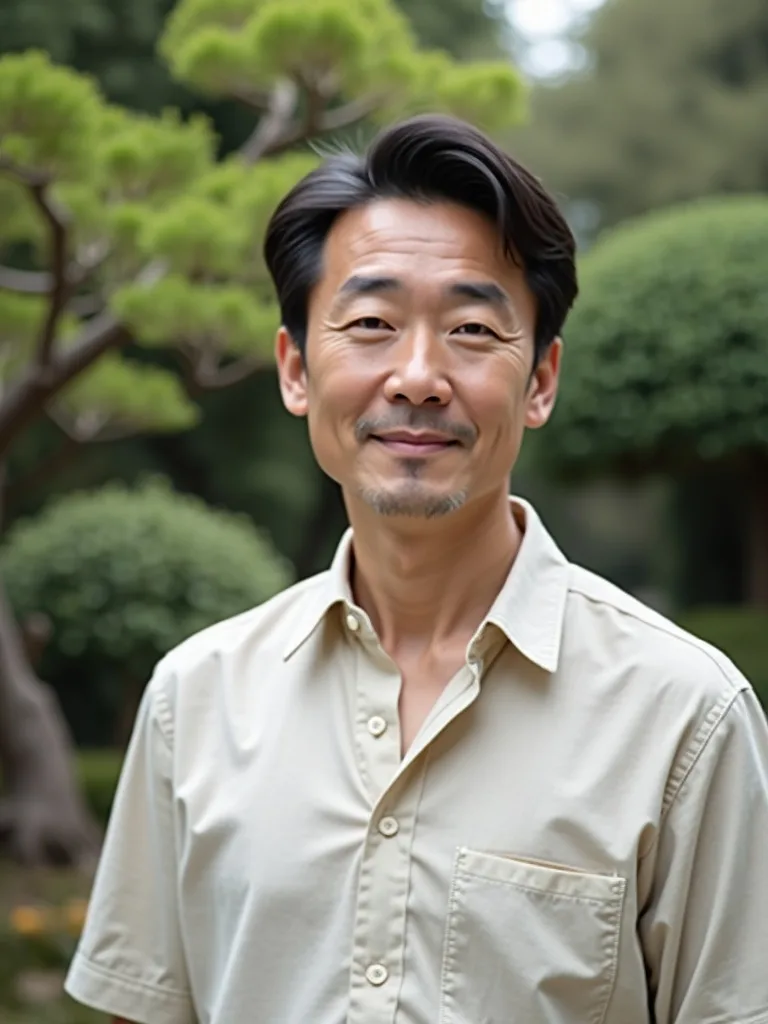
About Kenji
Bonsai Practitioner & Teacher — 20 Years
Kenji has practiced bonsai for over 20 years, training under master practitioners in Osaka and Kyoto before bringing his craft to Seattle. He approaches bonsai as a meditative discipline rooted in patience, observation, and deep respect for the natural world. Read more about Kenji