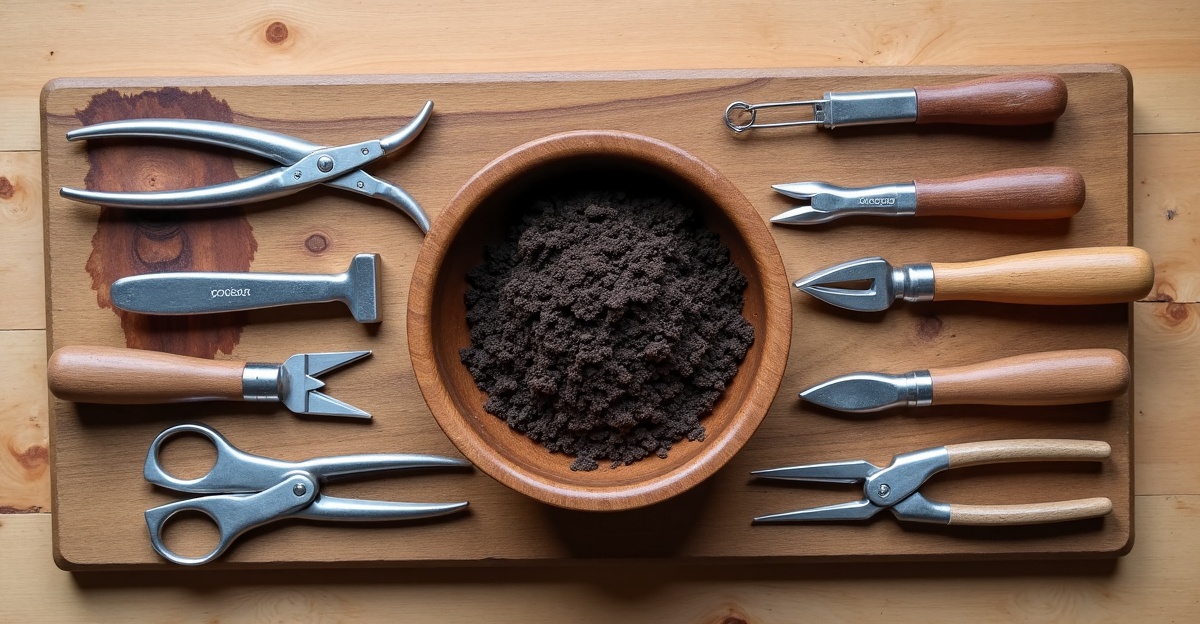
After 20 years of working with bonsai—first in Osaka and Kyoto, now here in Seattle—I can tell you that the right tools make all the difference. You don’t need a workshop full of equipment, but you do need a few precise implements and the correct soil mix. Here’s what I use and recommend for anyone getting started.
Quick Reference: Essential Bonsai Tools
| Tool | Purpose | Price Range | Best For |
|---|---|---|---|
| Concave Branch Cutters | Clean branch removal, minimal scarring | $30-$80 | Structural pruning |
| Fine Pruning Shears | Detail work, small branches | $25-$60 | Daily maintenance |
| Aluminum Training Wire | Shaping branches | $10-$25/roll | Deciduous trees |
| Copper Training Wire | Shaping branches (stronger hold) | $15-$35/roll | Conifers, mature trees |
| Bamboo Chopsticks | Working soil into roots | $5-$15 | Repotting |
| Root Rake/Hook | Untangling root balls | $15-$40 | Repotting |
| Concave Knob Cutter | Removing large knobs/stubs | $35-$85 | Advanced pruning |
The Three Essential Cutting Tools
1. Concave Branch Cutters
This is the tool I reach for most often. The concave cutting edge creates a slight hollow in the trunk when you remove a branch, which allows the tree to heal over the wound more naturally. A clean cut from a good pair of concave cutters will be nearly invisible in a year or two.
I’ve been using the same Kaneshin 8-inch cutters for fifteen years. They cost around $75, but they hold their edge remarkably well. For someone just starting out, a $30-40 pair from a reputable brand will serve you fine—just keep them sharp.
2. Fine Pruning Shears
Where concave cutters handle structural work, fine pruning shears are for the delicate detail work—trimming shoots, cleaning up small branches, pinching back growth. You’ll use these constantly during the growing season.
Look for bypass-style shears (where the blades pass each other like scissors) rather than anvil-style. The cut needs to be clean, not crushed. Japanese-made shears tend to be sharper and hold their edge longer, but there are good options at every price point.
3. Wire Cutters
Regular wire cutters from a hardware store will work, but specialized bonsai wire cutters have a blunt nose that lets you get close to the bark without damaging it. When you’re removing wire that’s been on a tree for months, this precision matters.
Training Wire: Aluminum vs. Copper
Wiring is how we guide branches into position, and you’ll need both aluminum and copper wire in various gauges.
Aluminum wire is softer and easier to work with. It’s what I recommend for beginners, and it’s what I still use for most deciduous trees. Gauges 1mm through 4mm will cover most situations.
Copper wire is stiffer and holds its shape better, which makes it ideal for conifers and for holding mature branches in position. It’s also more expensive. I use copper primarily on pines and junipers where I need that extra holding power.
Buy wire in small rolls at first—maybe 2mm and 3mm in aluminum. You can always add more gauges as you see what you need.
The Soil Mix That Changed Everything
I spent my first five years using whatever potting soil was convenient. Then I learned the proper bonsai soil mix in Japan, and I understood why so many of my early trees had struggled.
Bonsai soil needs to drain immediately while retaining just enough moisture. The roots need both water and air—sitting in soggy soil leads to root rot, while bone-dry soil stresses the tree. The solution is a granular mix with specific particle sizes.
The Basic Mix (What I Use for 90% of My Trees)
- 50% Akadama – Japanese clay aggregate, holds water while draining well
- 25% Pumice – Volcanic rock, improves drainage and aeration
- 25% Lava Rock – Provides structure and additional drainage
This is the foundation. For specific trees, I adjust:
- Conifers (pines, junipers): Add 10% more pumice, reduce akadama to 40%
- Tropical/deciduous: Add 10% composted bark for moisture retention
- Deciduous: Standard mix works perfectly
Particle Size Matters
All components should be sifted to 1/8″ to 1/4″ particle size. Too fine and the soil compacts; too coarse and it dries out too fast. I use stacked soil sieves—it takes an extra ten minutes when mixing soil, but it’s worth it.
Where to Source Components
Akadama is imported from Japan and can be expensive ($30-50 for a large bag), but it lasts. Pumice and lava rock are more affordable and can sometimes be found at local garden centers or landscape supply yards.
If akadama is hard to find or too expensive, you can substitute with calcined clay (Turface or Napa 8822). It’s not quite as good, but it’s a reasonable alternative.
Supporting Tools: Small but Essential
Bamboo Chopsticks
When repotting, you need to work fresh soil into and around the root ball. Bamboo chopsticks are perfect for this—they’re firm enough to work the soil in, but gentle enough not to damage fine roots. I keep half a dozen in my tool kit.
Root Rake and Hook
For untangling root balls during repotting. The rake side loosens compacted soil; the hook side teases apart individual roots. A good root hook costs $15-30 and will last decades.
Concave Knob Cutter
This is the specialized tool for removing large knobs, stubs, or old pruning scars. The spherical cutting edge carves out a hollow that heals remarkably clean. You don’t need this on day one, but it’s worth adding once you start working on older material.
What You Don’t Need
Beginner tool kits often include things like leaf trimmers, jin pliers, grafting knives, and root shears. You might use these eventually, but they’re not essential starting out.
Focus on the basics: good cutting tools, wire, proper soil mix. That’s 95% of the work.
Buying Advice
Where to buy: For tools, I recommend Kaneshin, Masakuni, or Joshua Roth if you want Japanese quality. For more affordable options, TianBonsai makes decent starter tools. For soil components, Stone Lantern or Bonsai Jack are reliable online sources.
How much to spend: You can get a functional starter set (cutters, shears, wire, soil components) for $100-150. Or you can invest $300-400 in tools that will last twenty years. Both approaches are valid—it depends on where you are in your bonsai journey.
Maintenance: Clean your tools after each use. Oil the pivot points monthly. Sharpen cutting edges once or twice a year. Good tools maintained well will outlive you.
Final Thoughts
The tools and soil I’ve described here are what I use daily. They’re not the only approach, but they’re proven over two decades of practice. Start with the essentials, learn how they work, and add specialized tools as you need them.
The most important tool, of course, is patience. But that one you already have.

About Kenji
Bonsai Practitioner & Teacher — 20 Years
Kenji has practiced bonsai for over 20 years, training under master practitioners in Osaka and Kyoto before bringing his craft to Seattle. He approaches bonsai as a meditative discipline rooted in patience, observation, and deep respect for the natural world. Read more about Kenji