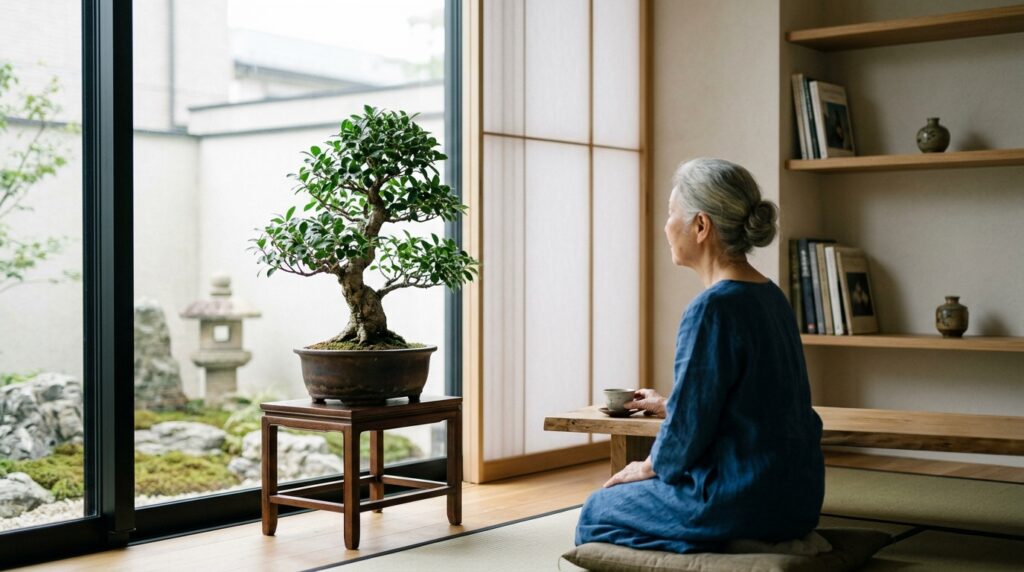
After twenty years of practicing bonsai, I can answer this honestly: keeping a bonsai alive is not inherently difficult, but it does ask you to pay attention in ways most houseplants do not. The tree will tell you what it needs—the challenge is learning to listen before the message becomes urgent.
Most beginner bonsai die not because the art is impossibly hard, but because new practitioners expect the tree to behave like a jade plant or pothos. A bonsai is a full-sized tree confined to a small pot, which means it depends entirely on you for water, nutrients, and seasonal rhythms it would otherwise manage on its own. Once you understand these three core needs—and match your species to your environment—the daily care becomes almost meditative.
Why Most Beginner Bonsai Die (And It’s Not Your Fault)
In my first year under Master Tanaka in Osaka, I killed three junipers. Not from neglect—from attention. I watered them like houseplants, kept them indoors for their “protection,” and wondered why they weakened within months. The lesson: outdoor trees need outdoor conditions, even when miniaturized.
Here are the most common beginner mistakes I see repeated:
- Keeping outdoor species indoors — Junipers, maples, pines, and most conifers are not houseplants. They need winter dormancy, natural temperature swings, and real sunlight. An indoor windowsill will slowly starve them.
- Watering on a schedule — Bonsai soil drains quickly. Watering “every three days” means nothing if the weather turns hot or windy. You water when the soil surface begins to dry, which might be twice a day in summer or every three days in cool spring weather.
- Trusting the mall kits — Those “bonsai starter kits” with mystery seeds are marketing, not horticulture. Real bonsai begin with established saplings or nursery stock that already have woody trunks. Growing from seed takes 5-10 years before you even begin shaping.
- Ignoring species needs — A tropical ficus tolerates indoor life. A Japanese maple does not. Mismatching the tree to your environment is the fastest way to fail.
The trees don’t die because you lack skill. They die because the initial advice was wrong.
What Makes Bonsai Different From Regular Houseplants
A potted monstera and a bonsai juniper live in entirely different worlds, even though both sit in containers. Understanding this difference is the key to keeping your tree alive.
| Factor | Typical Houseplant | Bonsai Tree |
|---|---|---|
| Root System | Allowed to fill pot over years | Trimmed regularly to fit shallow container |
| Watering Frequency | Weekly, sometimes less | Daily or twice-daily in growing season |
| Soil Type | Water-retentive potting mix | Fast-draining inorganic blend (akadama, lava rock, pumice) |
| Light Needs | Tolerates indoor lighting | Most need full outdoor sun (6+ hours) |
| Seasonal Care | Consistent year-round | Changes with seasons (dormancy, fertilizing cycles, protection) |
| Forgiveness Window | Days to a week if you forget to water | Hours to one day in hot weather |
This is not meant to discourage—only to calibrate expectations. A bonsai asks for daily awareness. In return, it offers something no houseplant can: the living arc of a tree’s year compressed into a space you can hold in both hands.
The Three Non-Negotiables: Water, Light, and Temperature
In Kyoto, Master Yamamoto taught me that bonsai care is not a long list of techniques—it’s three fundamentals done consistently. Get these right, and the tree will tolerate your beginner mistakes elsewhere.
Water: The Daily Discipline
Bonsai soil is designed to drain in seconds. This prevents root rot but means the tree depends entirely on you. Check the soil surface every morning—if the top quarter-inch feels dry, water thoroughly until it runs clear from the drainage holes. In summer heat or windy conditions, check again in the afternoon.
Do not mist the leaves as a substitute. Do not water “a little bit” each day. Soak the entire root mass, then let it breathe. A bonsai watering can with a fine rose gives you control without disturbing the soil surface.
Light: Match the Species to Your Reality
Most traditional bonsai species—junipers, pines, maples, elms—are outdoor trees that need full sun. “Bright indirect light” indoors is not enough. They will survive for months on stored energy, then decline.
If you cannot provide outdoor space:
- Choose true tropical/subtropical species: ficus, jade, schefflera, Chinese elm (can adapt to indoor life if near a south-facing window)
- Use supplemental full-spectrum grow lights positioned 6-12 inches from the canopy
- Accept that indoor bonsai will never develop the tight growth or vivid color of outdoor specimens
Temperature and Dormancy: Winter Is Not the Enemy
Temperate climate trees (maples, junipers, pines) need winter cold to survive. Dormancy is not death—it’s rest. Keeping them warm indoors year-round exhausts their biological clock.
Protect them from extreme freeze (below 15°F / -9°C) by moving to an unheated garage, cold frame, or burying the pot to the rim in mulch. But let them experience the seasonal cold they’re designed for.
Species That Forgive Beginner Mistakes
When students ask me what tree to start with, I don’t recommend the most prestigious species. I recommend the ones that will still be alive in six months while you learn.
Best for True Beginners:
- Ficus (Ficus retusa, Ficus benjamina) — Tropical, tolerates indoor life, vigorous growth, survives occasional under-watering. Grows anywhere warm. Ideal if you have no outdoor space.
- Chinese Elm (Ulmus parvifolia) — Adapts to indoor or outdoor, forgiving with water and light, fast healing after pruning mistakes. Semi-evergreen in mild climates.
- Jade (Crassula ovata) — Succulent tree, extremely drought-tolerant, thrives indoors, nearly impossible to kill with neglect. Not traditional, but builds confidence.
- Juniper (Juniperus procumbens) — If you have outdoor space, this is the classic beginner choice. Tough, cold-hardy, shows you what real bonsai styling looks like. Must live outside.
Avoid as a First Tree:
- Japanese Maple — Gorgeous but sensitive to heat, wind, and root disturbance. Learn on something more forgiving first.
- Azalea — Demands acidic soil, consistent moisture, and perfect drainage. One mistake and it sulks for months.
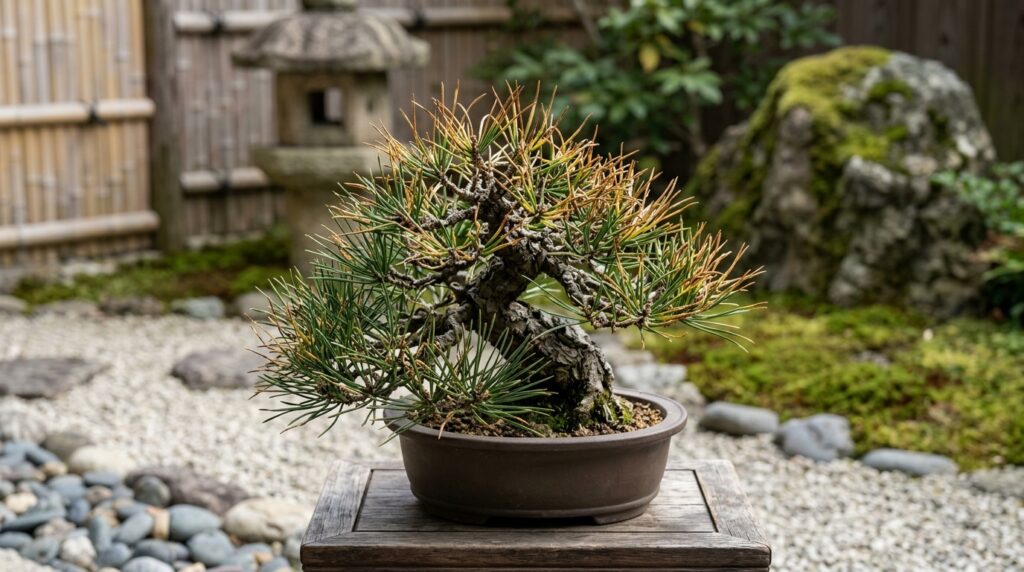
- Pine (most species) — Advanced techniques required for healthy growth. Pines don’t back-bud, so pruning mistakes are permanent.
Start with a young ficus bonsai or Chinese elm with an established trunk. These species want to live. They’ll teach you the rhythms of watering, growth, and seasonal change without punishing every mistake.
What Daily and Weekly Care Actually Looks Like
New practitioners often imagine bonsai care as an hour-long ritual. In reality, daily maintenance is brief. Seasonal work takes more time, but it comes in predictable cycles.
Daily (5 Minutes):
- Check soil moisture—water if the surface is dry
- Inspect for pests (aphids, spider mites, scale)
- Remove any dead leaves or debris from the soil surface
Weekly (15 Minutes):
- Fertilize during growing season (spring through early fall) with diluted balanced bonsai fertilizer
- Rotate the tree 90 degrees for even sun exposure
- Light pruning of runaway growth to maintain shape
Seasonal (Every Few Months):
- Spring: Repot if root-bound (every 2-3 years for young trees), begin fertilizing
- Summer: Increase watering frequency, provide afternoon shade if temperatures exceed 95°F
- Fall: Reduce fertilizer, prepare for dormancy, final styling before winter
- Winter: Protect from hard freeze, water sparingly, no fertilizer
The discipline is in the showing up, not in the complexity. Five minutes each morning with tea becomes the rhythm.
The Honest Truth: Can You Keep a Bonsai Alive?
Yes—if you choose a species that matches your environment and commit to daily watering. The trees that die are almost always outdoor species kept indoors, or beginners who treat watering as a weekly task instead of a daily check.
Bonsai is not a low-maintenance hobby. But it is not as fragile as the internet suggests, either. A healthy ficus or Chinese elm will survive a missed watering. A juniper will tolerate beginner pruning. What they will not tolerate is long-term neglect or fundamental mismatches in light, water, or temperature.
The learning curve is real. You will lose your first tree, or at least come close. I did. Every practitioner I know did. The question is whether you find the daily attention burdensome or grounding. For me, those five morning minutes became the part of the day I protect most carefully.
Frequently Asked Questions
Can I keep a bonsai tree indoors?
Only if you choose a tropical or subtropical species like ficus, jade, or Chinese elm. Traditional outdoor species (juniper, pine, maple) will slowly decline indoors no matter how bright your window. If you only have indoor space, start with a ficus—it’s the most forgiving true bonsai for interior conditions.
How often do bonsai trees need to be watered?
You water when the soil surface begins to dry, which varies by weather, season, and pot size. In summer, this may be twice daily. In cool spring weather, every 2-3 days. Never water on a fixed schedule—check the soil each morning and let the tree tell you what it needs.
What happens if I forget to water my bonsai?
One missed day rarely kills a healthy tree, though leaves may wilt. Water thoroughly as soon as you notice, and the tree will usually recover within hours. Repeated neglect—especially during hot weather—will cause branch dieback and eventually death. Bonsai soil is designed to drain fast, so they have very little water reserve.
Do bonsai trees need special soil?
Yes. Standard potting soil retains too much water and suffocates roots in a shallow bonsai pot. Bonsai soil is a fast-draining blend of inorganic components like akadama, pumice, and lava rock. You can buy premixed bonsai soil or blend your own, but proper drainage is non-negotiable for long-term health.
How long does it take to grow a bonsai from seed?
Growing from seed takes 5-10 years before you have a trunk thick enough to begin bonsai training. This is why most practitioners start with nursery stock, cuttings, or pre-bonsai material. “Bonsai seed kits” are misleading marketing—bonsai is a technique applied to established trees, not a special seed variety. If you want to practice the art, start with a young tree that already has a woody trunk.