Of all the aspects of bonsai care, fertilization is the one I see misunderstood most consistently — even by practitioners who have been growing trees for several years. Some fertilize too much, burning roots and forcing weak, leggy growth. Others never fertilize at all, wondering why their trees seem perpetually tired and slow to develop. A few fertilize at the wrong times of year, providing nutrients when the tree cannot use them and withholding them when the tree needs them most.
Fertilizing bonsai is not complicated, but it does require understanding what your tree is actually doing at each stage of the year. Bonsai grown in small pots have limited access to nutrients — the soil volume is tiny compared to what a tree would access in the ground. Without regular fertilization, the tree depletes the available nutrients in its substrate within weeks. With the right bonsai fertilizer applied at the right times and in the right amounts, your tree will grow with vigor, develop fine ramification, and build the resilience it needs to stay healthy for decades.
NPK Explained for Bonsai
Every fertilizer label shows three numbers separated by hyphens — something like 10-6-6 or 0-10-10. These numbers represent the percentage by weight of nitrogen (N), phosphorus (P), and potassium (K), the three primary macronutrients that all plants need.
Nitrogen (N) drives vegetative growth: leaves, shoots, and overall green mass. High nitrogen fertilizers promote vigorous growth and strong green color. They are most valuable in spring and early summer when you want the tree to push new growth.
Phosphorus (P) supports root development and flower and fruit production. It plays a critical role in energy transfer within the plant. For bonsai, phosphorus is particularly important during repotting recovery and in late summer as the tree begins to prepare for dormancy.
Potassium (K) regulates water movement within the plant, strengthens cell walls, and improves the tree’s overall hardiness and resistance to stress. Higher potassium fertilizers in late summer and fall help the tree harden its tissues before winter.
For bonsai, a balanced fertilizer — roughly equal NPK numbers, such as 6-6-6 or 10-10-10 — is a safe and effective choice for most of the growing season. Many experienced practitioners shift to lower nitrogen formulas in late summer to discourage soft growth before winter. The most important principle is to fertilize regularly with a balanced formula rather than chasing the perfect NPK ratio.
Seasonal Feeding Schedule
The timing of fertilization should follow the natural rhythm of your tree’s growth cycle. This is one of the areas where bonsai care most clearly reflects wabi-sabi philosophy: working with nature rather than against it, following the season’s lead.
Spring is the most important feeding period. As temperatures rise and new buds begin to swell, the tree’s demand for nutrients increases dramatically. Begin fertilizing as soon as you see the first signs of new growth — swelling buds or emerging shoots. Use a balanced or slightly nitrogen-rich fertilizer (such as 10-6-6) to fuel the growing season. Fertilize every two weeks for outdoor trees; indoor tropical trees can be fed monthly year-round.
Summer continues the active growing season. Maintain regular fertilization with a balanced formula. Be aware that high temperatures can make trees more susceptible to fertilizer burn, especially with synthetic fertilizers. If you are using a granular slow-release fertilizer, check that it has not been depleted by frequent watering. Continue feeding every two to four weeks depending on the product.
Fall is the transition period. As growth slows and the tree prepares for dormancy (in deciduous and conifer species), shift to a low-nitrogen, higher-potassium formula — something like 0-10-10 or 3-12-12. This encourages the tree to harden its tissues, store energy in its roots, and prepare for the cold months ahead without pushing soft new growth that would be vulnerable to frost.
Winter is a rest period for temperate trees. Deciduous trees and conifers held in outdoor conditions or cold storage should receive little to no fertilizer during winter dormancy. Their metabolic activity is minimal, and fertilizing a dormant tree is wasteful at best and harmful at worst. For tropical indoor species that continue growing year-round, maintain a reduced fertilization schedule — once a month with a balanced formula is sufficient.
Organic vs Synthetic Fertilizer
The choice between organic and synthetic fertilizers is one that every bonsai practitioner eventually considers, and there are genuine advantages to each approach.
Organic fertilizers — derived from plant and animal materials — release nutrients slowly as they are broken down by soil microorganisms. This slow release reduces the risk of root burn, builds microbial life in the soil, and provides a more consistent, long-term nutrient supply. Organic fertilizers also tend to improve soil structure over time. The traditional Japanese approach to bonsai fertilization relies heavily on organic materials like rapeseed cake (canola meal) and fish emulsion.
The main limitation of organic fertilizers is that their release rate depends on soil temperature and microbial activity. In cold weather or very fast-draining inorganic bonsai soil, organic fertilizers may break down slowly and unpredictably.
Synthetic fertilizers provide nutrients in immediately available forms that the plant can absorb directly through its roots. They allow precise control of NPK ratios and are particularly useful when a tree shows clear signs of deficiency that need rapid correction. Slow-release synthetic pellets (like Osmocote) offer a middle ground — synthetic nutrients delivered gradually over several months.
The risk with synthetics is over-application. Because nutrients are immediately available, it is easier to exceed the tree’s capacity to absorb them, leading to fertilizer burn or salt buildup in the soil. Always follow application rates carefully, and if in doubt, apply at half strength.
Many experienced practitioners use a combination: organic fertilizer for the baseline growing season feeding, with synthetic supplementation when a tree needs an extra push or during recovery from repotting.
Best Bonsai Fertilizers Reviewed
Biogold is the fertilizer I have used most consistently over my twenty years of practice, and it remains the gold standard of organic bonsai fertilization. Developed in Japan specifically for bonsai, Biogold is a small, pelletized organic fertilizer made from plant and animal sources. Its NPK ratio is approximately 6-4-4, making it ideal for the growing season. Biogold pellets are placed directly on the soil surface or in small fertilizer baskets and break down slowly over four to six weeks. The results — steady, balanced growth; deep green leaves; strong nebari development — speak for themselves. Find Biogold bonsai fertilizer on Amazon.
Osmocote is the most widely used slow-release synthetic fertilizer in bonsai and general horticulture. The small pellets are coated with a semi-permeable membrane that releases nutrients gradually in response to temperature and moisture — roughly the same conditions under which bonsai are actively growing. Osmocote’s 14-14-14 balanced formula makes it a convenient, reliable choice for practitioners who want consistent nutrition without frequent applications. One application lasts three to four months. It is particularly useful for practitioners who travel or who maintain large collections where individual feeding is impractical. Osmocote slow-release fertilizer on Amazon.
Liquid bonsai fertilizers offer the greatest flexibility and the fastest response. Diluted in water and applied during watering, liquid fertilizers are immediately available to the roots and can produce visible improvements in color and vigor within days. They are particularly useful for trees recovering from stress, for post-repotting recovery when used at low concentration, and for indoor tropical trees that benefit from consistent, low-level feeding. Look for balanced liquid fertilizers designed for trees or bonsai, and apply at half the recommended strength more frequently rather than at full strength less often. Liquid bonsai fertilizers on Amazon.
Signs of Over- and Under-Feeding
Your tree communicates its nutritional status through its foliage and growth patterns. Learning to read these signs allows you to adjust your fertilization approach before problems become serious.
Signs of under-feeding:
- Pale or yellowing leaves, particularly the older leaves lower in the canopy (nitrogen deficiency)
- Slow, weak growth with small leaves and short internodes
- Early leaf drop in deciduous species
- Poor color — leaves that should be deep green appearing washed-out or gray-green
- Lack of vigor after repotting, even with adequate light and water
Signs of over-feeding:
- White or crusty salt deposits on the soil surface or pot rim (mineral buildup from synthetic fertilizers)
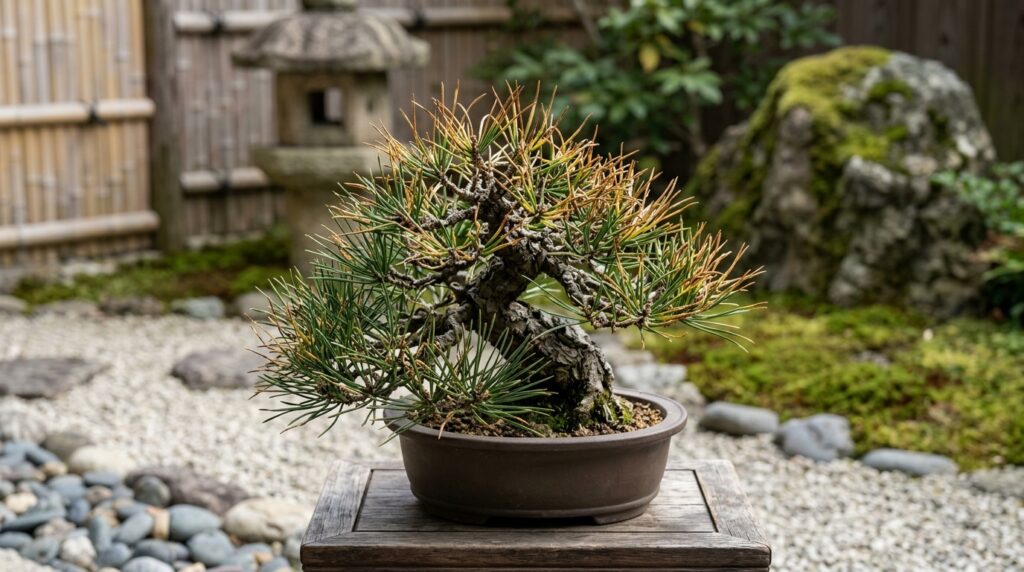
- Leaf tip burn — brown, crispy edges on otherwise healthy leaves
- Excessive, soft, elongated growth that looks out of proportion with the rest of the tree
- Roots that appear burned or blackened when you repot
- Sudden leaf drop after fertilization, indicating root burn from excessive concentration
If you suspect salt buildup from synthetic fertilizers, flush the soil thoroughly with clean water — water heavily several times in succession to leach accumulated minerals out through the drainage holes. Then reduce your fertilizer concentration and frequency.
Conclusion
Fertilizing your bonsai is an act of relationship — regular, attentive, responsive. It is not a once-a-season task or a set-and-forget system. The best bonsai practitioners I know look at their trees every day, notice small changes, and adjust their care accordingly.
Start with a quality balanced fertilizer — Biogold for a traditional organic approach, Osmocote for convenience, or a liquid formula for rapid response. Follow the seasonal rhythm: more nitrogen in spring and early summer, balanced through summer, lower nitrogen and higher potassium in fall, rest in winter for temperate species. Watch your tree’s response and let it guide your adjustments.
The nutrients you provide are not just fuel. They are part of the conversation between you and your tree — a quiet, patient exchange that, over months and years, builds something worth keeping.
Recommended products: Biogold bonsai fertilizer, Osmocote slow-release fertilizer, and liquid bonsai fertilizer options.
About Kenji
Bonsai Practitioner & Teacher — 20 Years
Kenji has practiced bonsai for over 20 years, training under master practitioners in Osaka and Kyoto before bringing his craft to Seattle. He approaches bonsai as a meditative discipline rooted in patience, observation, and deep respect for the natural world. Read more about Kenji