
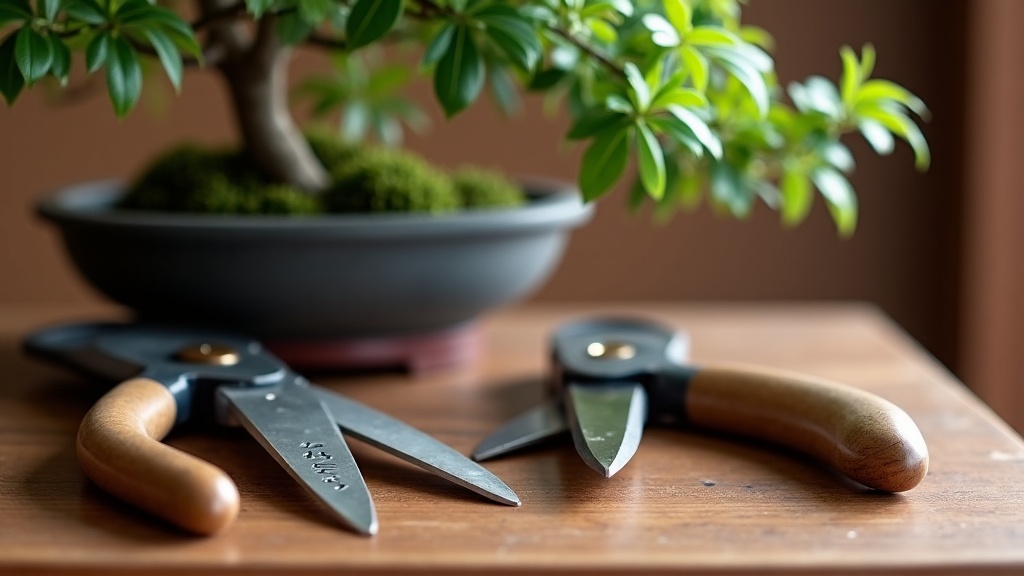
In twenty years of working with bonsai, I have learned that the quality of one’s tools speaks directly to the quality of one’s practice. When I was a student, my teacher would say, “A dull blade is a form of violence against the tree.” I did not fully understand this at the time. Now, holding a well-balanced Kaneshin concave cutter in my hand, feeling the clean resistance as it removes a branch flush to the bark, I understand completely.
The question I am asked most often by students who are just beginning is simple: which bonsai pruning shears should I buy? The honest answer is that it depends — on what stage you are at, what trees you work with, and what kind of cuts you are making. In this guide, I want to walk you through the major tool categories, explain what each does, and give you my honest view on the brands that are worth your attention.
Understanding Bonsai Cutting Tools
Bonsai pruning is not a single action — it is a family of actions, each requiring a different tool. Imagine a sculptor who uses only one chisel regardless of the detail required. The work would be crude. The same principle applies here.
The four essential categories of cutting tools in bonsai are:
- Concave branch cutters — for removing branches at the trunk or main limb
- Knob cutters — for removing old stubs and hollowing wound calluses
- Straight scissors (bonsai shears) — for general foliage trimming and twig work
- Bud scissors — for precision work on fine ramification and small growth
Each of these tools is engineered for a specific purpose. Understanding that purpose transforms how you approach your trees. Let me take you through each one.
Concave Branch Cutters: The Foundation of Clean Structure
If I had to choose only one specialty bonsai tool, it would be the concave branch cutter — called marunomi in Japanese. These are the tools that separate serious bonsai work from casual gardening.
The defining feature of a concave cutter is its curved, inward-facing blades. When you remove a branch with standard scissors or pruning shears, the cut leaves a flat or slightly convex stub. The tree must grow a thick callus ring over this flat surface, and the result is often a visible knob or bump in the bark — a permanent scar that diminishes the tree’s natural appearance.
A concave cutter removes the branch and simultaneously scoops a small concave depression into the remaining wood. When the tree calluses over a concave wound, the new bark grows across the depression and, over time, becomes nearly invisible. The wound heals into the tree’s surface rather than protruding from it. For any bonsai meant to suggest great age, this is not optional — it is essential.
I use concave cutters to remove branches from the trunk, to clean up previous cuts that healed poorly, and to refine the primary branching structure of a tree. I do not use them for fine twig work — that is what the scissors are for.
When to use concave cutters: Whenever removing a branch larger than pencil-thickness from the trunk or from a primary branch. Also useful for secondary branch removal on mature trees where clean healing is a priority.
You can find quality concave cutters on Amazon — I recommend starting with a search for bonsai concave cutters to compare current options and pricing.
Knob Cutters: Healing the Past
A knob cutter looks similar to a concave cutter at first glance, but its blades are more deeply rounded — almost spherical in their curvature. The purpose is different: rather than cleanly removing a living branch, the knob cutter is used to remove old, dead stubs and to reshape poorly healed wounds.
In nature, every tree carries its history in its bark and wood. Old stubs that were never properly removed, cuts that healed into disfiguring knobs — these are the wounds a knob cutter addresses. I think of it as corrective surgery. By rounding out an old wound into a clean concave form, I give the tree a second chance at a clean heal.
Knob cutters are also used in creating jin and shari — deadwood features that evoke the story of hardship and survival. The rounded cutting head lets you remove small amounts of material with great control.
When to use knob cutters: Old stub removal, wound reshaping, deadwood refinement. Not for branch removal on living wood where a concave cutter is more appropriate.
If you are shopping for knob cutters, browse bonsai knob cutters on Amazon to see the range available at different price points.
Straight Scissors and Bud Scissors: The Language of Detail
While concave and knob cutters handle structural work, the scissors handle refinement. These are the tools you reach for most often in day-to-day bonsai maintenance.
Straight bonsai scissors (sometimes called bonsai shears) are the workhorses of the tool kit. They are used for:
- Trimming foliage to shape the canopy
- Cutting small twigs and secondary branches
- Removing crossing branches in fine ramification
- General maintenance pruning throughout the growing season
A quality pair of bonsai scissors has narrow blades that can reach into the interior of the tree without disturbing surrounding growth. The blades should be sharp enough to cut cleanly without crushing the twig — crushed tissue invites disease and produces brown, unhealthy tips.
Bud scissors are a more specialized version with even longer, more slender blades. They excel at:
- Pinching or removing individual buds during spring growth management
- Cutting in tight spaces between dense ramification
- Precision thinning of fine branch structures
I reach for my bud scissors when I am working on refinement-stage trees where each cut matters enormously. The extra blade length gives me visibility and access that regular scissors cannot provide.
For scissors, I recommend looking at bonsai scissors and shears on Amazon where you can compare lengths and styles.
Brand Comparisons: Kaneshin, Masakuni, Tinyroots, and Budget Options
The tool market for bonsai ranges from inexpensive starter sets to hand-forged Japanese instruments that cost as much as a fine fountain pen. Let me give you my honest assessment of the major brands.
Kaneshin
Kaneshin tools are made in Japan by skilled craftspeople who have been producing bonsai tools for generations. The steel is high-carbon, the hardening is precise, and the finish is excellent. What distinguishes Kaneshin is the edge retention — a well-maintained Kaneshin cutter will stay sharp through many seasons of work.
I have two Kaneshin concave cutters that I have been using for over a decade. They required sharpening twice and have never needed repair. For someone committed to serious practice, these are lifetime tools. Browse Kaneshin bonsai tools on Amazon.
Masakuni
Masakuni is perhaps the most prestigious name in Japanese bonsai tools. Their instruments are forged individually, inspected carefully, and finished to a standard that borders on art. The price reflects this — Masakuni tools are among the most expensive available.
I recommend Masakuni to advanced practitioners who have already developed their technique and know what they want from a tool. Using a Masakuni cutter before you have mastered the basics is like learning to write with a hand-turned pen — beautiful, but perhaps more than the moment requires. See Masakuni tools on Amazon.
Tinyroots
Tinyroots is an American company that curates quality bonsai tools and makes them accessible to practitioners outside Japan. Their tools are not hand-forged in the traditional sense, but they are substantially better than generic options and provide an excellent entry point for intermediate students.
If you are past the absolute beginner stage but not yet ready to invest in Japanese hand-forged tools, Tinyroots is where I would look first. Find Tinyroots bonsai tools on Amazon.
Budget Options
I am often asked about budget tools — the sets sold under various brand names for $20-40 that appear on Amazon in abundance. My honest answer: they are not without value for absolute beginners who are not yet sure whether bonsai will become a serious practice.
The steel is softer, the edge dulls faster, and the fit and finish is less precise. But if you are working on a practice tree and just beginning to learn the movements of pruning, an inexpensive tool will teach you the basic mechanics. When you find yourself caring about the quality of the cut, that is the moment to upgrade.
Browse beginner bonsai tool sets on Amazon to see current options.
Maintenance and Care: Honoring Your Tools
In the wabi-sabi tradition, there is beauty in the worn and well-maintained. A tool that has been cared for carries its history with dignity. Neglected tools, on the other hand, become agents of harm rather than help.
Here is how I care for my bonsai cutting tools:
After each use: Wipe the blades clean with a dry cloth to remove sap, moisture, and debris. Sap can be sticky and acidic — left on the blade, it will dull the edge and eventually pit the steel.
Disinfection: Between trees, especially if you suspect disease, wipe blades with isopropyl alcohol (70% or higher). This simple habit prevents the transmission of fungal and bacterial infections from one tree to another. I keep a small bottle near my work area at all times.
Lubrication: Every few uses, apply a small drop of camellia oil to the pivot point of cutters and scissors. Camellia oil — traditional in Japanese blade care — protects against rust without damaging steel. Wipe any excess oil from the blades before cutting, as residue can contaminate the tree’s cut surface.
Sharpening: When a cut no longer feels clean — when you feel crushing or tearing rather than slicing — it is time to sharpen. For scissors, a ceramic sharpening rod or diamond file works well on the flat inner face of each blade. For concave cutters, a small whetstone and careful attention to the bevel angle will restore the edge. If you are not confident sharpening your own tools, many bonsai specialty shops offer this service.
Storage: Store tools in a dry environment. Humidity is the enemy of steel. I keep mine in a folded canvas tool roll, which protects the edges and allows airflow.
A Reflection on the Craftsman’s Relationship with Tools
My teacher kept his tools for forty years. The handles were worn smooth from use, the steel had taken on a particular patina, and every tool showed its history in the small marks and adjustments made over decades. He called them his dogu — not just tools, but instruments through which intention becomes action.
I think about this often when I am at my workbench. The best bonsai pruning shears are not simply the most expensive or the sharpest — they are the ones you know well, that fit your hand in a familiar way, that you have maintained and cared for over time. The relationship between craftsman and tool is a slow one, built through use and attention.
Begin where you are. If you are a beginner, a modest set of quality scissors and a single concave cutter is enough. As your practice deepens, your tools will grow with you. And one day, perhaps, you will find yourself with a pair of cutters that you have known for ten years, understanding exactly what your teacher meant.
If you are ready to build your toolkit, start by exploring bonsai pruning shears on Amazon — look for tools with good reviews, visible country of origin, and steel specifications where available. The investment in proper tools is an investment in your trees, and in your practice.