Walk into any garden center and you will find bags of potting mix marketed for bonsai. The packaging looks professional. The price seems reasonable. And yet, using standard potting mix — or anything close to it — is one of the fastest ways to kill your bonsai tree.
I have repotted hundreds of trees over two decades of bonsai practice. Many of them came to me from well-meaning owners who had followed the advice on a bag of commercial potting soil. The roots were dark, mushy, and oxygen-starved — classic signs of soil that held too much moisture and not enough air. The tree was slowly suffocating underground.
Understanding bonsai soil mix is not complicated, but it does require letting go of assumptions about what “good soil” looks like. For bonsai, good soil looks almost nothing like the rich, dark, moisture-retentive compost we associate with healthy gardens. Good bonsai soil is gritty, granular, and drains so fast it almost seems wrong. But it is exactly right.
This guide will explain what a proper bonsai soil mix needs to do, break down the most important components, compare ready-made and DIY options, and give you specific mix ratios for different tree types.
What Bonsai Soil Needs to Do
Before choosing your soil components, it helps to understand the three things a good bonsai soil mix must accomplish simultaneously.
Drainage. After watering, excess water must flow through and out of the pot within seconds. Bonsai roots need oxygen as much as they need water. Soil that holds pooled water around the roots creates anaerobic conditions that invite root rot and fungal disease. The fine particle structure of most potting mixes, especially when compacted over time, prevents adequate drainage.
Aeration. The spaces between soil particles should be large enough to hold air even when the soil is moist. Bonsai are typically grown in shallow pots, which means the root system is compressed into a small volume of growing medium. That medium must be porous enough to allow oxygen to reach all parts of the root zone.
Water retention. At the same time — and this is where the balance becomes an art — the soil must retain enough moisture between waterings to keep the roots from drying out completely within hours. In a very shallow bonsai pot with a fast-draining substrate, a tree can desiccate surprisingly quickly. The right soil holds just enough moisture to buffer against heat and missed waterings without becoming waterlogged.
These three requirements — drainage, aeration, water retention — seem contradictory. The genius of proper bonsai soil is that the right particle components achieve all three at once.
Akadama Explained
Akadama is the cornerstone of traditional Japanese bonsai soil and the component most worth understanding. It is a naturally occurring volcanic clay from Japan, heat-processed and sifted into uniform granules. The name literally means “red ball earth” in Japanese.
What makes akadama special is its unique structure. Each granule is porous, absorbing water and holding it within its structure while the spaces between granules remain open for drainage and aeration. This gives akadama excellent water retention without sacrificing the drainage and oxygen exchange that bonsai roots require.
Over time — typically two to three years — akadama granules begin to break down. As they soften and compact, drainage decreases. This is one reason bonsai are repotted on a regular cycle: not only to prune the roots, but to refresh the soil before it breaks down too far.
Akadama is typically used as 33 to 50 percent of the bonsai soil mix, depending on species and climate. In drier climates or during summer, a higher proportion of akadama helps the tree retain more moisture. In humid climates or for conifers that prefer drier conditions, a lower proportion is better.
You can purchase akadama for bonsai on Amazon — look for double-fired (hard) akadama for outdoor trees, as it breaks down more slowly, and regular akadama for indoor trees where you repot more frequently.
Pumice and Lava Rock
Pumice and lava rock are the structural backbone of most modern bonsai soil mixes, providing drainage and aeration in a way that akadama alone cannot.
Pumice is a light, porous volcanic rock that does not break down over time. Its countless tiny air pockets make it excellent for aeration and drainage while still holding a small amount of moisture within its pores. It is pH neutral and contains trace minerals that can benefit root health. Pumice is typically used at 33 to 50 percent of the total mix.
For bonsai, you want pumice sifted to a particle size of about 3 to 6 millimeters — coarse enough to maintain air pockets, fine enough to support the root system. Pumice sold specifically for bonsai use is usually pre-sifted to the right size range.
Lava rock (also called scoria) serves a similar function to pumice. It is harder and heavier, with a more irregular, sharp-edged structure that helps anchor roots. Lava rock drains extremely well and does not compact or break down over time. It is also inert and pH neutral. When pumice is unavailable or expensive, lava rock is an excellent substitute or complementary component.
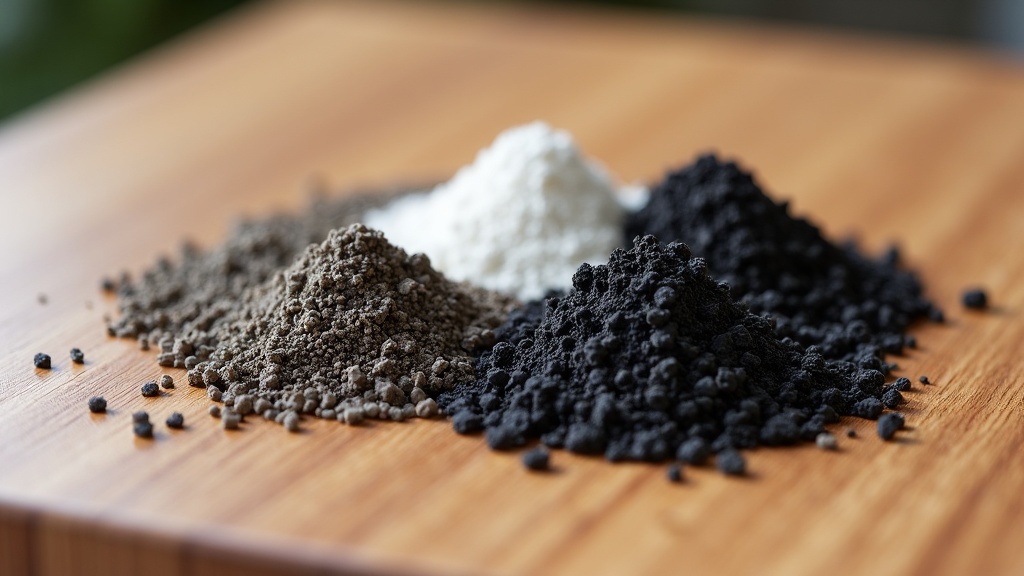
Together, pumice and lava rock create the open, gritty matrix that gives proper bonsai soil its characteristic appearance — nothing like garden soil, and everything like what roots actually need.
Ready-Made Mixes vs DIY
For many practitioners, purchasing a ready-made bonsai soil mix is the simplest and most reliable option. Quality premixed bonsai soils use the same components described above — akadama, pumice, and lava rock — in proportions calibrated for general use. They save time, eliminate the need to source and sift individual components, and are particularly useful when you only have a few trees to repot.
Ready-made bonsai soil mixes on Amazon vary considerably in quality. Look for products that list their specific components (akadama, pumice, lava rock, or equivalents) and that use particle sizes in the 3 to 6 millimeter range. Avoid anything that looks or feels like dark potting compost.
DIY mixing is preferred by serious practitioners for several reasons. It allows you to adjust ratios for specific species, climates, and pot depths. It is often more economical when you are repotting a large collection. And it gives you complete control over the quality of each component.
The basic DIY mix is simple: equal parts akadama, pumice, and lava rock (approximately one-third each). This ratio works well for most tropical and subtropical indoor species. From there, you adjust based on the factors described in the next section.
Mix Ratios by Species
Different species have different moisture and drainage preferences, and the bonsai soil mix should reflect those needs.
Tropical species (Ficus, Fukien Tea, Jade, Serissa) generally prefer a soil that retains slightly more moisture than the standard mix, as they are accustomed to humid environments with consistent rainfall. A ratio of 40% akadama, 30% pumice, 30% lava rock works well. For succulents like Jade, shift toward more pumice: 20% akadama, 50% pumice, 30% lava rock.
Deciduous species (Chinese Elm, Trident Maple, Japanese Maple, Hornbeam) have active growing seasons in spring and summer when they need consistent moisture for leaf and shoot development, followed by drier conditions in winter dormancy. A balanced ratio of 33% akadama, 33% pumice, 33% lava rock is a reliable starting point. In very dry climates, increase akadama to 40 to 50 percent.
Conifers (Japanese Black Pine, Juniper, Cedar) are adapted to well-drained, relatively dry soils and dislike sustained moisture around their roots. For conifers, reduce akadama and increase the inorganic components: 20% akadama, 40% pumice, 40% lava rock. This ensures fast drainage and prevents the root rot to which pines are particularly susceptible.
What NOT to Use in Bonsai Soil
Understanding what to avoid is just as important as knowing what works.
Standard potting mix or compost. Too fine, too water-retentive, and compacts over time into an airless mass. Even “well-draining” potting mixes are not designed for the shallow containers and compressed root systems of bonsai.
Garden soil or topsoil. Heavy, dense, and prone to compaction. Garden soil in a bonsai pot will turn into a brick within one growing season.
Sand (fine). Coarse horticultural sand or grit can be a minor component in some mixes, but fine sand — the kind from a beach or sandbox — fills in the air pockets between particles, reducing drainage rather than improving it. If using sand, use only coarse-grained builder’s sand.
Perlite as the primary component. Perlite is useful as a minor addition to improve drainage in emergency situations, but it is too light, floats when watered, and does not hold moisture effectively enough for bonsai. It is a poor substitute for pumice.
Orchid bark. While chunky bark improves drainage in houseplant mixes, it breaks down relatively quickly, holds inconsistent moisture, and does not provide the stable, long-term structure that bonsai roots need.
Conclusion
Choosing the right bonsai soil mix is one of the most consequential decisions you make as a bonsai practitioner. It affects how often you water, how well your tree’s roots develop, and ultimately whether your tree thrives or slowly declines.
The principles are straightforward: drainage, aeration, and balanced water retention. The components that deliver these properties — akadama, pumice, and lava rock — are widely available and not expensive when purchased in quantity. Whether you buy a quality premixed bonsai soil or blend your own, understanding what each component does and why allows you to make intelligent decisions for each tree in your collection.
Start with a balanced mix. Observe your tree. Adjust with each repotting. The soil is not set in stone — it is part of the living, evolving relationship between you and your tree.
Key resources: akadama for bonsai, ready-made bonsai soil mix, and pumice for bonsai.