
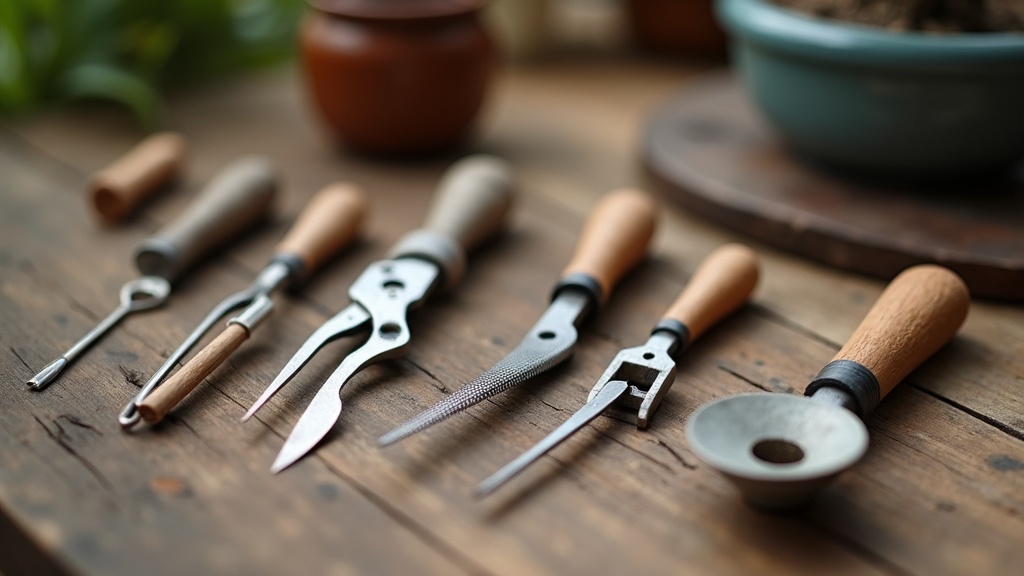
The Tools That Shape Living Art
In twenty years of bonsai practice, I have learned that a practitioner’s relationship with their tools reveals much about their relationship with the art itself. The impatient student buys every shiny implement in the catalog. The wise student asks: what do I actually need to serve this tree today?
This guide answers that question honestly — for both the beginner holding their first juniper and the advanced practitioner developing collected material for the third decade.
Understanding Bonsai Tool Categories
Before listing specific tools, it helps to understand the four functional categories. Every bonsai tool falls into one of these:
- Cutting tools — for pruning branches, roots, and foliage
- Wiring tools — for applying and removing training wire
- Root and repotting tools — for working with soil and root systems
- Finishing tools — for wound treatment, cleaning, and refinement work
A beginner needs one or two tools from each category. An advanced practitioner builds a curated collection over years, selecting tools that match their specific species and style preferences.
Essential Tools for Beginners
1. Bonsai Shears (Scissors) — Your Most-Used Tool
The bonsai shear is the workhorse. You will use it more than any other tool. Proper bonsai shears have long, thin blades that can access interior branches without disturbing surrounding foliage — a critical difference from garden scissors, whose wide blades crush as much as they cut.
For beginners, I recommend starting with a mid-range Japanese shear in the 7–8 inch range. Japanese-made tools from Kaneshin or Tinyroots hold their edge longer and are worth the modest premium over Chinese-made alternatives.
Shop bonsai shears on Amazon →
What to avoid: Cheap stainless steel shears that look the part but fail to hold an edge. A dull bonsai shear tears bark rather than cutting cleanly, inviting disease.
2. Concave Branch Cutter — The Tool That Heals
The concave branch cutter is what separates bonsai technique from ordinary tree trimming. Its curved cutting surface removes a branch flush with the trunk while creating a slight concave hollow — a shape that heals over time to leave only a subtle scar rather than a protruding stub.
This is the single most important specialized tool in bonsai. It directly determines whether your trunk lines remain clean and naturalistic over the years. I recommend starting with an 8-inch concave cutter, which handles branches up to ¾ inch diameter — sufficient for most development work.
Shop concave cutters on Amazon →
3. Root Hook / Soil Rake — For Repotting
Repotting is the most invasive intervention in bonsai practice, and doing it with improper tools damages roots unnecessarily. A good root hook — also called a soil rake — gently separates compacted root masses and removes old soil without tearing the fine feeder roots your tree depends on.
For most beginners, a two- or three-pronged soil rake is ideal. It’s aggressive enough to separate tangled roots but gentle enough to protect fine root structure.
Shop bonsai root rakes on Amazon →
4. Wire Cutters (Bonsai-Specific) — Do Not Skip This
Never remove bonsai training wire with regular wire cutters or pliers. Bonsai wire cutters have a rounded head designed to cut wire close to the trunk without gouging the bark. The small investment pays for itself the first time you avoid scarring a tree you’ve trained for two years.
Aluminum wire is standard for beginners; bonsai-specific cutters handle it cleanly. If you advance to copper wire, you’ll need slightly heavier cutters — but that purchase can wait.
Shop bonsai wire cutters on Amazon →
Tools for the Advancing Practitioner
5. Knob Cutter — For Removing Stubs and Nodules
Where the concave cutter removes live branches, the knob cutter removes dead wood stubs, old branch bases, and unwanted surface irregularities. Its spherical cutting head bites into wood at any angle. Advanced practitioners use it to create natural deadwood features — jin and shari — that add age and character to the design.
6. Jin Pliers — Carving and Deadwood Work
Jin pliers strip and twist bark to create jin (deadwood branch stubs) and shari (deadwood trunk sections). These techniques, drawn from the wabi-sabi aesthetic of embracing imperfection and age, are among the most artistically demanding in bonsai practice.
This tool is not for beginners — not because it is technically difficult, but because the judgment required to know when and where to create deadwood takes years to develop. When you’re ready, it will be one of your most creatively rewarding tools.
7. Trunk Splitter — For Advanced Structural Work
The trunk splitter does exactly what the name suggests: it splits trunk and branch wood to create naturalistic deadwood textures, or to facilitate dramatic bending of otherwise rigid material. Used with restraint, it opens artistic possibilities unavailable to the practitioner who relies only on wire.
Like jin pliers, this belongs in the advanced toolkit. The beginner’s energy is better spent mastering the fundamentals of pruning and wiring before introducing structural splitting.
8. Turn Table (Rotating Stand) — Underrated for All Levels
I include the turntable in every toolkit discussion because it is among the most practically useful bonsai accessories and consistently overlooked. Working on all sides of a tree without moving it protects roots, prevents dropped trees, and gives you the 360-degree perspective necessary for sound design decisions.
A sturdy metal turntable rated for 20+ lbs is a lifetime purchase. Buy once, buy quality.
Shop bonsai turntables on Amazon →
Tool Brands Worth Knowing
Japanese Brands (Premium)
Kaneshin and Masakuni are the most respected Japanese tool makers. Their tools are hand-forged, heat-treated to precise hardness, and will outlast any practitioner who cares for them properly. Expect to pay $40–$120 per tool. Worth every yen.
Mid-Range Options
Tinyroots and Bonsai Boy offer quality tools at 30–50% below Japanese premium prices. Well-suited for serious beginners who want proper tools without the full investment. Quality control is good but not equivalent to Kaneshin or Masakuni.
Budget Starter Kits
Multiple Chinese-manufactured kits are available on Amazon in the $30–$60 range. The shears in these kits will dull quickly and the concave cutters may crush rather than cut cleanly. For a first tree or a gift, they are acceptable. For serious practice, upgrade within the first year.
Browse beginner bonsai tool kits on Amazon →
Tool Maintenance: The Practice of Respect
A tool that is cared for reflects the practitioner’s relationship with their art. Clean cutting edges after each session with a dry cloth, then a light wipe of camellia oil — the same oil used for Japanese woodworking tools for centuries. Store in a tool roll or dry cabinet. Sharpen with a whetstone when edges begin to drag rather than cut cleanly.
Well-maintained bonsai tools can last 20–30 years. This is the wabi-sabi principle made practical: beauty and function through longevity, not constant replacement.
Frequently Asked Questions
What bonsai tools do I absolutely need as a beginner?
Start with three: a pair of bonsai shears, a concave branch cutter, and bonsai-specific wire cutters. These three tools cover 90% of basic maintenance and initial styling work.
Should I buy a bonsai tool kit or individual tools?
For the first year, a quality mid-range kit is perfectly reasonable and more economical than individual pieces. As you develop your practice and understand what work you’re doing most, buy premium individual tools for the tasks you perform most frequently.
Is there a difference between bonsai tools and regular garden tools?
Yes — significantly. Bonsai tools are precision instruments designed for the specific cuts, angles, and delicacy that bonsai work requires. A garden pruner will remove a branch, but it won’t leave the concave wound that heals cleanly on a bonsai trunk. The right tool does the right job.
What wire should beginners use for bonsai training?
Aluminum wire in 1.0mm, 1.5mm, and 2.0mm gauges covers most beginner needs. It’s easier to apply than copper and more forgiving of technique errors. Copper wire holds better and is preferred for advanced work, particularly with conifers.
Shop bonsai training wire on Amazon →
Begin With What Serves the Tree
The ancient Chinese masters worked with the simplest tools. Wabi-sabi teaches us that imperfection and simplicity hold their own beauty. You do not need an elaborate toolkit to begin a meaningful bonsai practice — you need the right tools for where you are in the journey.
Start with the essentials. Learn what your trees require. Let your toolkit grow as your practice grows. The tools will follow the art, not the other way around.