Everything You Need to Know About Bonsai Trees
A bonsai is not a species of tree—it’s an art form that shapes ordinary trees into living sculptures through patient cultivation. After twenty years of practice, I’ve learned that understanding this distinction is where every bonsai journey begins.
The word “bonsai” translates to “planted in a container,” but the practice encompasses far more than miniaturization. It’s a conversation between practitioner and tree, a meditation on time and restraint, and a way of seeing the essence of nature in a single branch.
What Makes a Tree a Bonsai
Any woody plant can become a bonsai. I’ve worked with maples, pines, junipers, elms, and even fruit trees—each responds differently to training, but all follow the same fundamental principles.
The defining characteristics are:
- Containment: Growth restricted by a shallow pot
- Training: Branches shaped through pruning and wiring
- Proportion: Trunk, branches, and foliage balanced to suggest a mature tree
- Care: Ongoing attention to watering, feeding, and styling
A bonsai isn’t permanently stunted—it’s continuously managed. Without care, it will either die from neglect or outgrow its training.
The Philosophy Behind the Practice
During my training in Kyoto, my teacher would say that bonsai reveals what’s already there. We don’t force trees into unnatural shapes—we guide them toward their essential form.
This aligns with wabi-sabi, the Japanese aesthetic that finds beauty in imperfection and transience. A scar where a branch was removed, the weathered texture of aged bark, the asymmetry of wind-swept foliage—these aren’t flaws. They’re the tree’s story.
Western horticulture often aims for symmetry and perfection. Bonsai moves in the opposite direction: toward naturalism, age, and the irregular beauty of trees shaped by time and environment.
Choosing Your First Tree
Beginners often start with one of these species:
| Species | Difficulty | Indoor/Outdoor | Best Feature |
|---|---|---|---|
| Chinese Elm | Easy | Both | Forgiving, adapts to indoor conditions |
| Juniper | Easy | Outdoor | Classic appearance, hardy |
| Ficus | Easy | Indoor | Tolerates low light, rapid growth |
| Japanese Maple | Moderate | Outdoor | Stunning fall color, delicate leaves |
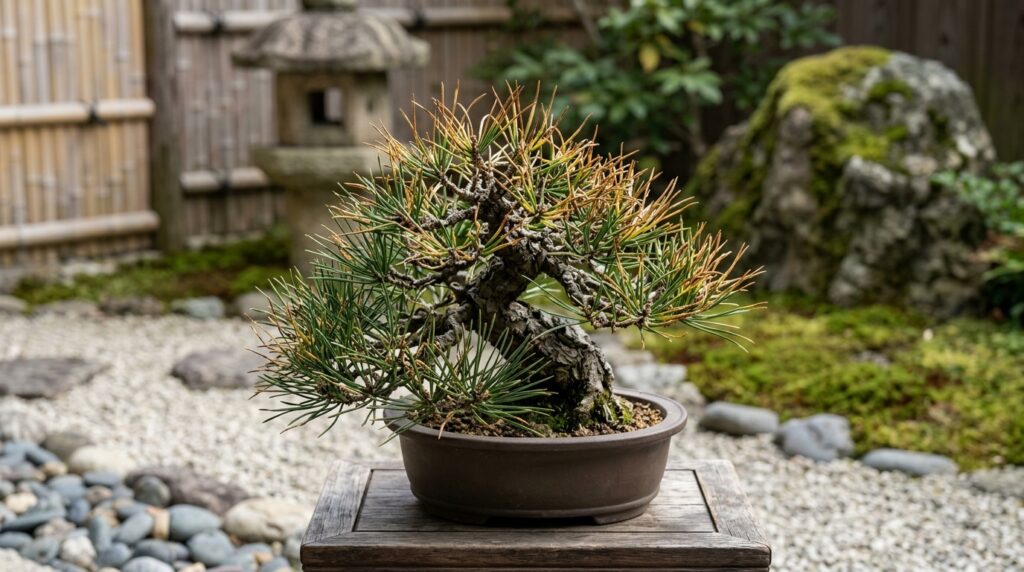
| Japanese Black Pine | Difficult | Outdoor | Traditional species, strong character |
I recommend starting with a Chinese elm bonsai tree or juniper bonsai tree. Both tolerate beginner mistakes and respond well to training.
Essential Care Requirements
Watering
More bonsai die from improper watering than any other cause. The shallow pots dry quickly, but overwatering suffocates roots.
Check soil moisture daily by inserting a finger half an inch deep. Water thoroughly when the surface feels dry—not before. Use a bonsai watering can with a fine spray to avoid disturbing the soil.
Water until it flows from drainage holes. Wait a moment, then water again. This ensures complete saturation.
Light
Most bonsai need abundant light—at least 5-6 hours of direct sun for outdoor species. Indoor species like ficus tolerate filtered light but perform better near south-facing windows.
Insufficient light causes weak, elongated growth. If leaves pale or branches stretch toward the light source, the tree needs a brighter location.
Soil
Standard potting soil stays too wet for bonsai. Proper bonsai soil mix drains quickly while retaining some moisture—typically a blend of akadama, pumice, and lava rock.
The goal is soil that remains barely moist between waterings but never waterlogged. Good drainage prevents root rot, the most common killer of bonsai.
Fertilizing
Restricted soil volume means limited nutrients. Feed regularly during the growing season—I use a balanced bonsai fertilizer at half strength every two weeks from spring through early fall.
Reduce or stop feeding during winter dormancy. Trees need rest as much as they need growth.
Training Techniques
Pruning
Pruning serves two purposes: maintaining shape and encouraging dense growth. I distinguish between maintenance pruning (removing unwanted shoots) and structural pruning (establishing major branches).
For maintenance, pinch or cut new growth throughout the season. For structural changes, work during late winter when trees are dormant and wounds heal more readily.
Use sharp, clean bonsai pruning shears. Dull tools crush tissue and invite disease.
Wiring
Wrapping branches with wire allows you to reposition them as they grow. It’s the primary method for creating movement and structure.
Apply bonsai training wire at a 45-degree angle, firm but not tight. Check every few weeks—remove wire before it cuts into bark.
This takes practice. My first attempts looked like tangled Christmas lights. Start with lower branches where mistakes matter less.
Repotting
Most bonsai need repotting every 2-3 years to prevent root binding. Signs include water pooling on the surface, roots circling the pot’s edge, or sluggish growth.
Repot in early spring before buds swell. Remove the tree, trim outer roots, and replant in fresh soil. Use a bonsai pot with drainage slightly larger than the root mass.
Common Mistakes to Avoid
After years of teaching, I see the same errors repeatedly:
- Keeping outdoor species indoors: Junipers, pines, and maples need winter dormancy. They’ll decline without seasonal cold.
- Inadequate light: “Bright indirect light” isn’t enough for most species. They need actual sun.
- Impatient styling: Bonsai develops over years, not weeks. Aggressive pruning or wiring damages trees.
- Ignoring species requirements: Research your specific tree. A ficus and a pine have completely different needs.
- Using garden soil: Dense soil kills roots. Always use proper bonsai substrate.
Tools You’ll Actually Need
The market offers hundreds of specialized tools. You need perhaps five to start:
- Concave branch cutters for clean branch removal
- Bonsai shears for general trimming
- Wire cutters for removing training wire
- Root rake for repotting
- Wire set in assorted gauges
Quality tools last decades. Cheap ones frustrate and damage trees. Buy once if you can.
Creating Your First Bonsai Style
Traditional bonsai follows several recognized styles. The most common are:
- Formal Upright (Chokkan): Straight trunk, symmetrical branching
- Informal Upright (Moyogi): Curved trunk with natural movement
- Slanting (Shakan): Trunk grows at an angle, suggesting wind exposure
- Cascade (Kengai): Trunk curves downward, mimicking trees on cliffs
- Forest (Yose-ue): Multiple trees in one pot
Don’t force a predetermined style onto your tree. Observe its natural character—the direction of the trunk, existing branch placement, any interesting features—and work with that.
Understanding Seasonal Changes
Deciduous trees will drop leaves in fall. This isn’t death—it’s dormancy. Reduce watering, stop fertilizing, and protect from hard freezes.
Evergreens remain green but still enter dormancy. Growth slows, water needs decrease. Even indoor tropical species experience seasonal rhythms tied to day length.
Spring brings the year’s strongest growth. This is when I do major work: repotting, structural pruning, initial wiring. The tree’s energy accelerates healing and growth in new directions.
Where Bonsai Practice Leads
The trees teach patience that extends beyond horticulture. You learn to see time differently—a five-year plan for a branch structure, a decade to develop convincing trunk taper.
You develop sensitivity to subtle changes: the barely visible swelling of spring buds, the texture shift as bark ages, the way light filters through layers of foliage.
Eventually, the technical aspects become intuitive. Your hands know when wire is tight enough, when a branch has set in position, where to make the next cut. This is when bonsai shifts from following rules to genuine artistic expression.
Frequently Asked Questions
How long does it take to grow a bonsai tree?
A pre-bonsai or nursery stock can look presentable within 2-3 years of training. A refined, exhibition-quality bonsai takes 10-30 years of development. Some of the trees I maintain are over 100 years old, passed down through generations.
Can bonsai trees live indoors?
Only tropical and subtropical species (ficus, jade, schefflera) tolerate indoor conditions year-round. Species native to temperate climates—junipers, maples, pines—require outdoor growing with seasonal dormancy. They will die if kept indoors permanently.
How often should I water my bonsai?
There’s no universal schedule. Check soil daily and water when the surface begins to dry—this might be daily in summer heat or every few days in cool weather. Watering depends on species, pot size, soil mix, location, and season. Observation matters more than routine.
Why are bonsai pots so shallow?
Shallow pots restrict root growth, which limits top growth proportionally—this keeps the tree small. They also improve drainage and provide aesthetic balance. Deep pots encourage excessive root development and look visually heavy beneath a miniature tree.
Do I need to start with an expensive tree?
No. Some of my favorite trees started as $30 nursery stock. Beginners actually benefit from affordable material—mistakes hurt less, and you learn faster when you’re willing to experiment. Invest in good tools and soil before investing in expensive trees.