I tell students this early: you can safely remove a surprising amount from a healthy bonsai, but only if you understand what you are removing, when you are removing it, and why the tree can recover. For most healthy bonsai, I am comfortable removing up to about one-third of the foliage in a single session, while root work and heavy structural pruning demand a more careful hand.
That short answer needs context. A juniper being cleaned is not the same as a trident maple being cut back in summer, and neither should be handled like a weak azalea that has only just recovered from repotting. In bonsai, the question is rarely “How much can I remove?” by itself. The better question is “How much can this tree afford to lose today without losing momentum, health, or character?”
If you are building your tool kit, a sharp pair of concave bonsai cutters, a reliable set of bonsai pruning shears, and properly sized aluminum bonsai wire make careful reduction much easier and much cleaner.
This article contains affiliate links. If you buy through them, I may earn a small commission at no extra cost to you.
The safest general rule
For a healthy, established bonsai in active growth, removing around 20 to 30 percent of the foliage or fine branching in one session is usually safe. That is a working rule, not a law. Vigorous deciduous trees often tolerate more selective reduction than conifers, and tropical species in warm, stable conditions can also rebound quickly. But once you combine heavy top pruning, root pruning, wiring stress, heat stress, or recent repotting, that safe percentage drops fast.
In practice, I divide removal into three categories. Light maintenance trimming is frequent and low risk. Moderate refinement pruning is more selective and usually still safe on a strong tree. Heavy structural reduction changes the outline, branch hierarchy, or trunk line and should be timed much more carefully.
| Type of work | Typical amount removed | When it is usually safe | Main caution |
|---|---|---|---|
| Light maintenance trim | 10 to 20% of soft growth | During active growth on healthy trees | Do not keep pinching a weak tree just to hold shape |
| Moderate refinement pruning | 20 to 30% of foliage or twigs | When energy is strong and timing fits the species | Watch for stacking stress with wiring or heat |
| Heavy structural reduction | 30%+ or removal of major branches | Only on vigorous trees, in the right season | Recovery may take a full season or longer |
| Root pruning during repotting | Often 15 to 30% of roots, sometimes more on advanced material | At species-appropriate repotting time | Do not pair with severe top work unless the species and condition justify it |
What you are removing matters more than the percentage
Many beginners think in terms of volume: half the leaves, half the roots, half the branches. Trees do not respond that way. A bonsai can often tolerate a fair amount of fine-tip trimming, but it may struggle badly if you remove one key sacrifice branch, one strong live vein, or the small cluster of growth that feeds an important interior branch.
When I prune, I think first about function. Which shoots are extending too far? Which ones are shading the interior? Which branches are useful for taper, back budding, or future design? A small cut in the right place can reduce vigor more effectively than a large amount of random clipping.
Over twenty years, I have noticed that students often remove too much of what is easy to cut and too little of what actually needs correction. Long soft extension gets trimmed timidly, while dense weak clutter stays untouched because it looks complicated. A healthier tree usually comes from the opposite choice: reduce strong excess, preserve useful inner growth, and remove confusion rather than simply reducing mass.
How species changes the answer
Deciduous bonsai
Maples, elms, hornbeams, zelkovas, and many other deciduous trees usually tolerate pruning well when healthy. During the growing season, they can often handle moderate canopy reduction, especially if you are cutting back long internodes to pairs of leaves or redirecting extension. Some advanced growers also use partial or full defoliation on strong deciduous material, but that is not the same as ordinary trimming and should not be treated casually.
With deciduous bonsai, the main risks are weakening fine twigs through repeated over-pruning and removing too much leaf area during hot weather. Leaves are not just decoration. They are the engine that rebuilds the tree after your cuts.
Conifers
Junipers and pines require more restraint. Junipers do not appreciate hard cutting into bare interior wood unless there is live foliage nearby to sustain the branch. Pines are even more tied to timing and technique. Needle plucking, candle work, bud selection, and branch removal each affect energy in different ways.
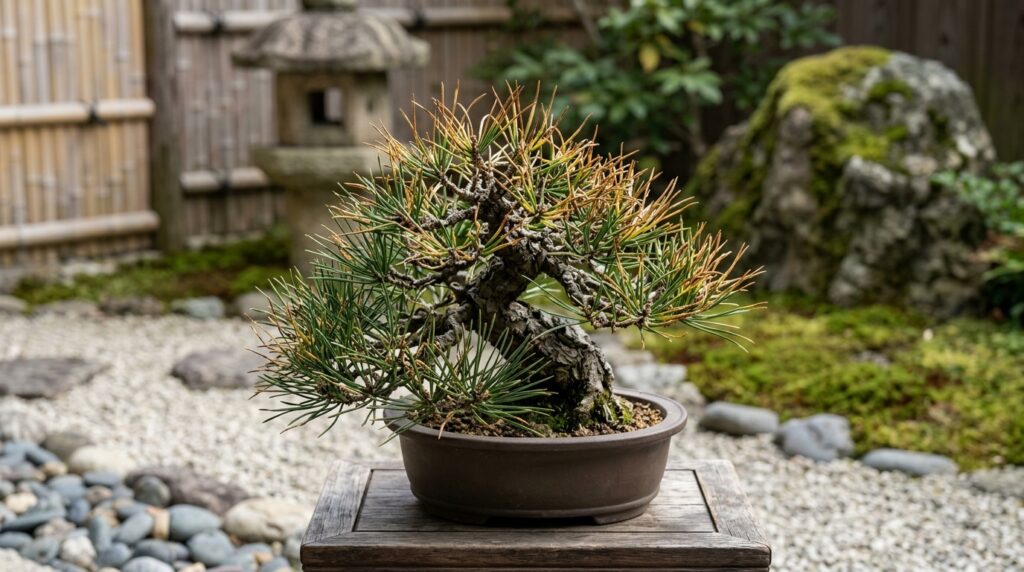
I have seen healthy junipers look acceptable immediately after an aggressive cleanup, only to sulk for months because too much live foliage was stripped from key branches. The damage is often delayed. That is why conifer work should feel measured, not satisfying in a dramatic way.
Flowering and fruiting species
Azalea, crabapple, quince, bougainvillea, and similar species add another layer: the flowering cycle. You may be able to remove a fair amount safely from a health standpoint, but if you prune at the wrong moment you can remove the next bloom display entirely. Sometimes that trade is worthwhile. If the branch structure is poor, I will gladly sacrifice one season of flowers for better bones. But it should be a deliberate decision.
Tropical bonsai
Ficus, jade, schefflera, and other tropicals are often forgiving in warm conditions with strong light. They can usually handle repeated trimming better than temperate trees, especially indoors under stable summer conditions or outdoors in proper warmth. Even so, forgiveness is not permission for constant cutting. A tropical bonsai that is always being trimmed and never allowed to regain strength gradually becomes small and tired rather than refined.
When heavy pruning is reasonable and when it is not
Heavy reduction is appropriate when the tree is clearly vigorous, the season supports recovery, and the design problem is large enough that incremental trimming will only prolong the issue. If a branch is too thick, too straight, badly placed, or ruining taper, it usually does not improve because you stare at it for another year.
Heavy reduction is not appropriate just because the tree looks overgrown and you feel motivated. I avoid major removal when a tree has recently been repotted, is still recovering from pests, was moved to a new environment, is in a heat wave, or has weak extension. A tree can survive a hard cut and still be set back far more than necessary.
A simple checklist helps:
- Is the tree healthy enough that you would call it vigorous, not merely alive?
- Is this the right season for this species?
- Has it recovered from its last major stress?
- Do you know which branch or roots you are preserving to carry the next stage of design?
- Will this cut improve the bonsai two years from now, not just today?
If several of those answers are uncertain, reduce the scope of the work.
Top pruning and root pruning should not always be heavy together
This is where many bonsai are quietly weakened. Beginners often feel that if they are repotting, they should also “finish the job” by cutting the top back hard. Sometimes that is justified, especially on robust material during a planned redesign. Often it is simply too much at once.
Roots and foliage support each other. If you remove a large share of the roots, the canopy is already under adjustment. If you also remove a large share of the foliage, the tree loses both uptake and energy production at the same time. On very strong stock, that can still work. On ordinary bonsai, it often leads to a long, uneven recovery.
My usual approach is to let one major stress dominate the session. If root work is significant, top pruning is conservative. If top reduction is severe, I prefer to leave the roots alone unless there is a compelling horticultural reason not to wait.
Aftercare matters here just as much as the cuts. Good drainage with an appropriate bonsai soil mix, steady watering, protection from extreme afternoon sun, and patience do more for recovery than extra interventions.
How often do you have to trim a bonsai?
This is closely tied to how much you remove each time. Most bonsai are better managed with regular, lighter trimming than with repeated drastic cuts. During active growth, fast deciduous species may need attention every one to three weeks, while slower conifers may only need selective work a few times across the season. Structural pruning is much less frequent, often seasonal or even yearly.
One quiet lesson from long practice is that trimming frequency reflects your goals. A tree in development should often be allowed to run more than a tree in refinement. Students sometimes trim every shoot the moment it extends because they want the tree to look finished all summer. But if you never allow extension, you also limit thickening, healing, and back budding patterns that make future refinement possible.
So if you are asking how often you have to trim a bonsai, the honest answer is: often enough to control shape and energy, but not so often that you interrupt the tree’s ability to build strength. For many home growers, watching vigor and internode length is more useful than following a rigid calendar.
Signs you removed too much
Some stress is normal after meaningful work. What you are watching for is sustained weakness. Warning signs include:
- New growth that stalls or emerges unusually small
- Interior shoots yellowing or drying back
- Tips browning on junipers after aggressive foliage cleaning
- Failure to push strongly in the expected growth window
- Persistent wilting despite proper watering
If you suspect you overdid it, the answer is usually restraint, not correction by more pruning. Do not fertilize heavily to force recovery, and do not keep styling a tree that is already telling you to stop. Stabilize water, light, and temperature, then let the tree rebuild.
I have also learned that trees rarely object to one thoughtful session as much as they object to a sequence of small bad decisions. A heavy cut, followed by rewiring, followed by repositioning, followed by missed watering on a hot day can do far more damage than the cut alone.
My practical rule for deciding how much to remove
If you want one workable guideline, use this:
- Remove all clearly dead, damaged, or unusable growth first.
- Remove the strongest excess growth that is shading or unbalancing the design.
- Pause and reassess the silhouette and the health of the remaining structure.
- Stop when the design problem is solved, even if you feel tempted to keep refining.
The last step matters most. Many bonsai are over-pruned in the final five minutes, when the tree already looks better and the grower chases neatness instead of function. I still remind myself to put the scissors down and look from a few feet away before making the last cuts.
If the tree still needs major improvement after that pause, I ask whether the next cut belongs to this season or the next one. Good bonsai are often built through staged removal, not maximum removal.
FAQ
Can I cut half of my bonsai off?
Sometimes, yes, but only in specific cases. A vigorous tree in the right season may tolerate removal of half the canopy or a major branch, especially during a redesign. That does not mean it is the best choice. On refined bonsai, removing half the top is often unnecessary and creates a long recovery.
Is it safe to remove lots of roots and lots of branches at the same time?
Usually not. Strong material may survive it, but most bonsai recover better when you avoid stacking heavy root and top work in one session.
Do bonsai grow back after hard pruning?
Many do, but not all in the same way. Deciduous trees often back bud readily. Conifers can be far less forgiving, especially if cut back beyond live foliage. Always judge recovery potential by species, branch condition, and season.
Should I trim a weak bonsai to make it easier to manage?
No. A weak bonsai usually needs stronger growing conditions, not more styling. Reduce only what is clearly dead or harmful, then focus on recovery.
About the author: Kenji is a bonsai practitioner with 20 years of experience, trained in Osaka and Kyoto. He teaches patient, practical bonsai design with an emphasis on seasonal timing, tree health, and the quiet discipline of letting the tree decide how far you can go.