
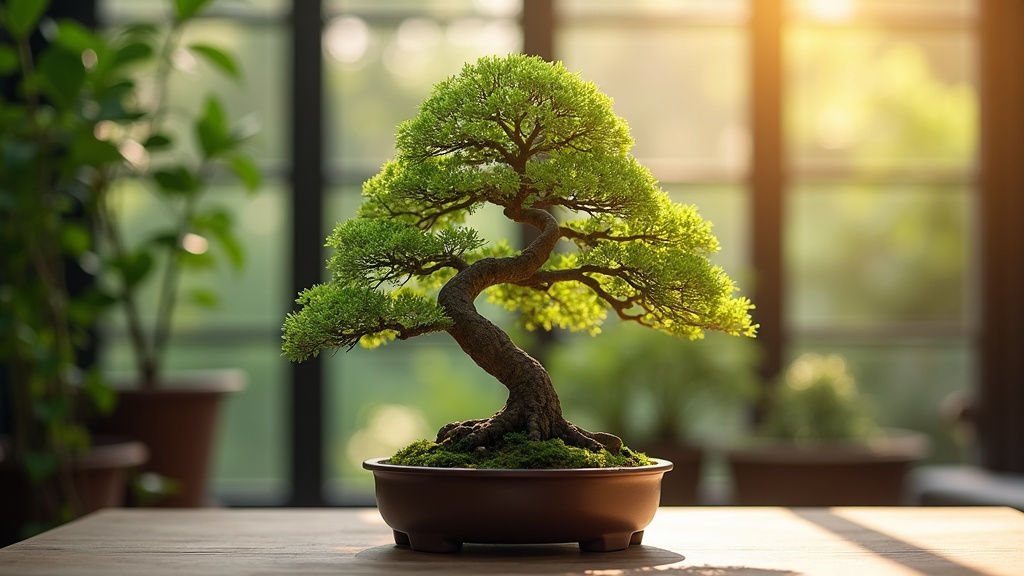
There is a saying I return to often in my practice: mono no aware — the gentle sadness of transient things. A bonsai tree growing on your windowsill is exactly that. It is alive, breathing, reaching toward the light. It asks something of you each day. And in that asking, it teaches you patience, presence, and care. This is the heart of indoor bonsai tree care.
Over my twenty years working with bonsai, I have come to believe that the tree does not simply sit in your home — it becomes part of your home’s rhythm. The way you water it, the light you offer it, the humidity you provide — these are not chores. They are a practice. A meditation. A relationship.
Whether you are new to bonsai or have kept one for years, this guide will walk you through the essential pillars of indoor bonsai tree care: light, water, humidity, seasonal adjustment, and the common mistakes that quietly harm even well-intentioned trees. Read slowly. Take notes. Then go sit with your tree.
Understanding Light Requirements for Indoor Bonsai
Light is life. This is not metaphor — it is biology. Your bonsai tree is, at its core, a tree that has been trained into miniature form. It still carries the memory of the forest, the open sky, the long afternoon sun. When we bring it indoors, we must honor that memory as best we can.
Most indoor bonsai species — ficus, jade, fukien tea, schefflera — need a minimum of four to six hours of bright, indirect light each day. A south-facing window is your best ally in the Northern Hemisphere. East-facing windows offer gentler morning light, which many tropical species appreciate. North-facing windows are rarely sufficient on their own.
Watch your tree closely. Leggy, elongated growth reaching toward a window is a sign of light starvation. Yellowing leaves that drop without apparent cause often point to the same root problem. The tree is speaking to you.
When natural light is insufficient — especially during winter months or in apartments without ideal window placement — a quality grow light can transform your indoor bonsai tree care routine. I recommend a full-spectrum LED grow light placed 12 to 18 inches above the canopy for 12 to 14 hours per day. One that has served my students well is the GooingTop LED Grow Light — it is energy-efficient, adjustable, and provides the spectrum your tree truly needs.
- South-facing window: Best for most indoor bonsai species
- East-facing window: Ideal for morning light lovers like fukien tea
- Supplemental grow lights: Essential in winter or low-light homes
- Rotate your tree: A quarter turn every week ensures even growth
Rotate your tree. I say this to every student. We forget that the back of the tree is in shadow while the front drinks the light. A simple quarter-turn each week ensures balanced, harmonious growth — a central principle of the wabi-sabi aesthetic.
Watering Your Indoor Bonsai: The Art of Knowing When
If there is one aspect of indoor bonsai tree care that trips up even experienced growers, it is watering. Not because it is complicated, but because it requires presence. You cannot water on autopilot.
The foundational rule: water when the topsoil begins to dry, not before, not long after. Press your finger about half an inch into the soil. If it feels barely moist to dry, it is time to water. If it is still damp, wait another day and check again.
When you do water, water thoroughly. Pour slowly and evenly across the entire soil surface until water flows freely from the drainage holes. This ensures the entire root system receives moisture, not just the top layer. Then let the soil drain completely before returning the pot to its tray.
The vessel you water from matters more than most people realize. A narrow-spouted watering can gives you control — you can direct water gently, avoiding the force that disturbs soil and surface moss. I have used and gifted the Haws Indoor Watering Can to many of my students. Its long, graceful spout is designed precisely for this kind of attentive, precise watering.
- Check daily: Finger-test the soil each morning
- Water deeply: Until water drains from the bottom holes
- Use room-temperature water: Cold water can shock tropical roots
- Avoid standing water: Never let the pot sit in pooled water for hours
- Seasonal adjustment: Trees drink more in summer, less in winter
In summer, when your tree is in active growth, you may find yourself watering daily or even twice a day in a warm, sunny room. In winter, the rhythm slows. The tree rests. Honor that rest. Do not water out of habit — water out of awareness.
A note on water quality: if your tap water is heavily chlorinated, let it sit in an open container overnight before using it. Some of my students swear by rainwater collection. I will not argue with them.
Humidity Management: Creating a Microclimate
Indoor environments are, by nature, dry. Heating systems in winter and air conditioning in summer strip moisture from the air. For tropical bonsai species — which evolved in humid forests — this dryness is a silent stressor. Proper indoor bonsai tree care means addressing humidity directly.
The target relative humidity for most tropical indoor bonsai is between 50% and 70%. A simple hygrometer placed near your tree will tell you what you are actually working with. Many homes sit at 30% to 40% in winter — not ideal.
There are several elegant solutions:
- Humidity trays: A shallow tray filled with pebbles and water placed beneath your pot. As the water evaporates, it creates a zone of elevated humidity directly around the tree. The pot sits on the pebbles, above the waterline, so roots are never waterlogged. I recommend the Bonsai Boy Humidity Drip Tray — practical, clean-looking, and purpose-built for this use.
- Misting: A gentle misting of the foliage in the morning can help, though it is not a substitute for ambient humidity. Use room-temperature water and mist lightly — heavy misting can invite fungal issues.
- Room humidifier: If you keep several trees or live in a particularly dry climate, a small humidifier near your collection is a worthy investment. It benefits both your trees and your own comfort.
- Grouping plants: Plants transpire, releasing moisture. Grouping your bonsai with other houseplants creates a naturally more humid microclimate.
Wabi-sabi teaches us to find beauty in imperfection and simplicity. A pebble tray is humble, inexpensive, and deeply effective. Sometimes the most elegant solution is the simplest one.
Seasonal Care: Listening to the Year’s Rhythm
A bonsai tree, even an indoor one, carries the seasons within it. Tropical species kept indoors year-round experience less dramatic seasonal change, but they still respond to shifts in light duration, temperature, and your home’s microclimate. Thoughtful indoor bonsai tree care means staying attuned to these cycles.
Spring and Summer: This is the growing season. Your tree is building energy, pushing new shoots, developing roots. It will want more water, more light, and more frequent fertilization. This is the time for light pruning and wiring if desired. Repotting, if needed, is best done in early spring just as growth resumes.
Autumn: Growth begins to slow. Reduce fertilizer gradually — switch from high-nitrogen formulas to lower-nitrogen, higher-phosphorus blends that support root development over foliage. Continue watering attentively; the tree still has needs, they are simply quieter.
Winter: Rest. Reduce watering frequency. Stop or significantly reduce fertilization. If your tree is near a window, make sure it is not touching cold glass — the chill can damage tropical roots and foliage. A grow light on a timer becomes especially valuable in these shorter days. Move your tree away from heating vents, which blast dry air directly onto the foliage.
I tell my students: the tree will tell you what season it is. Watch for the signs — the pace of new growth, the rate at which soil dries, the color and texture of the leaves. These are your calendar.
Common Mistakes in Indoor Bonsai Tree Care
I have watched many trees decline, and I say this not to discourage but to illuminate. Most suffering in indoor bonsai comes from a handful of repeated, correctable mistakes. Naming them clearly is an act of compassion toward your tree.
Overwatering: The single most common cause of indoor bonsai death. Root rot sets in silently, below the soil line, long before leaves show distress. When you finally see yellowing and drop, the roots may already be compromised. Always check soil moisture before watering. When in doubt, wait a day.
Insufficient light: A tree on a dim shelf across the room from a window is not receiving meaningful light. It is surviving, not thriving. Move it closer to the light source, or add supplemental lighting. Light is not optional.
Wrong soil: Bonsai require fast-draining, well-aerated substrate — not regular potting soil. Dense, moisture-retaining potting mix smothers roots and causes rot. Use bonsai-specific soil or create a mix of akadama, pumice, and lava rock.
Ignoring humidity: Dry air causes leaf tip browning, crispy edges, and stress. These signs are often misread as watering problems. Check your humidity levels before assuming the issue is water.
Repotting too often — or never: A rootbound tree in compacted soil cannot absorb water or nutrients efficiently. Most indoor bonsai benefit from repotting every two to three years. Conversely, repotting too frequently stresses a tree unnecessarily. Observe the roots at the drainage holes to judge timing.
Inconsistent care: The tree does not need perfection. It needs consistency. Daily attention — even just a glance, a touch of the soil — is worth more than an occasional heroic intervention.
Choosing the Right Indoor Bonsai Species
Not all bonsai are suited to indoor life. Many species traditionally used in bonsai — Japanese maple, juniper, pine — are temperate trees that require cold winters and outdoor conditions. Keeping them indoors year-round leads to slow decline.
For successful indoor bonsai tree care, choose species adapted to indoor conditions:
- Ficus (Ficus retusa, Ficus microcarpa): Hardy, forgiving, tolerant of lower humidity and light variation. Excellent for beginners.
- Fukien Tea (Carmona retusa): Produces small white flowers and berries. Prefers warmth and humidity.
- Jade Plant (Crassula ovata): Succulent, drought-tolerant, beautiful in bonsai form. Ideal for those who tend to underwater rather than overwater.
- Chinese Elm (Ulmus parvifolia): Can be kept indoors in mild climates. Semi-evergreen with delicate, fine foliage.
- Schefflera (Umbrella Tree): Vigorous grower, tolerant of indoor conditions, responds well to pruning and training.
Begin with a species suited to your environment and your experience level. There is no shame in starting with a forgiving ficus. Mastery comes with time, and time requires that the tree survive long enough to teach you.
A Closing Thought: Presence Is the Practice
In wabi-sabi, we find beauty in the imperfect, the incomplete, the impermanent. Your bonsai tree will lose leaves. It will have seasons of vigorous growth and seasons of quiet rest. It will occasionally surprise you with a problem you did not anticipate. This is not failure. This is relationship.
Successful indoor bonsai tree care is not about following a rigid checklist — though the practical elements in this guide are essential. It is about showing up. It is about developing the kind of attentiveness that notices when the soil has dried, when the light has shifted, when the tree is asking for something different.
Sit with your tree for a few minutes each day. Not always to do something — sometimes just to observe. In that quiet observation, you will learn more about bonsai than any guide can teach you.
The tree is patient. Be patient with yourself as well.
— Kenji