As an Amazon Associate, I earn from qualifying purchases made through links in this article.
I judge a bonsai soil by how it behaves after watering. The main difference between bonsai soil and potting soil is structure: bonsai mixes usually contain coarse, stable particles that preserve air spaces in shallow pots, while ordinary potting mixes generally contain more fine organic material and retain moisture longer.
During my training in Osaka and Kyoto, I learned to watch the water before changing the recipe. A tree needs moisture and oxygen together. The right mix makes that balance easier to maintain with your species, your pot, and the time you have to water.
What is the difference between bonsai soil and potting soil?
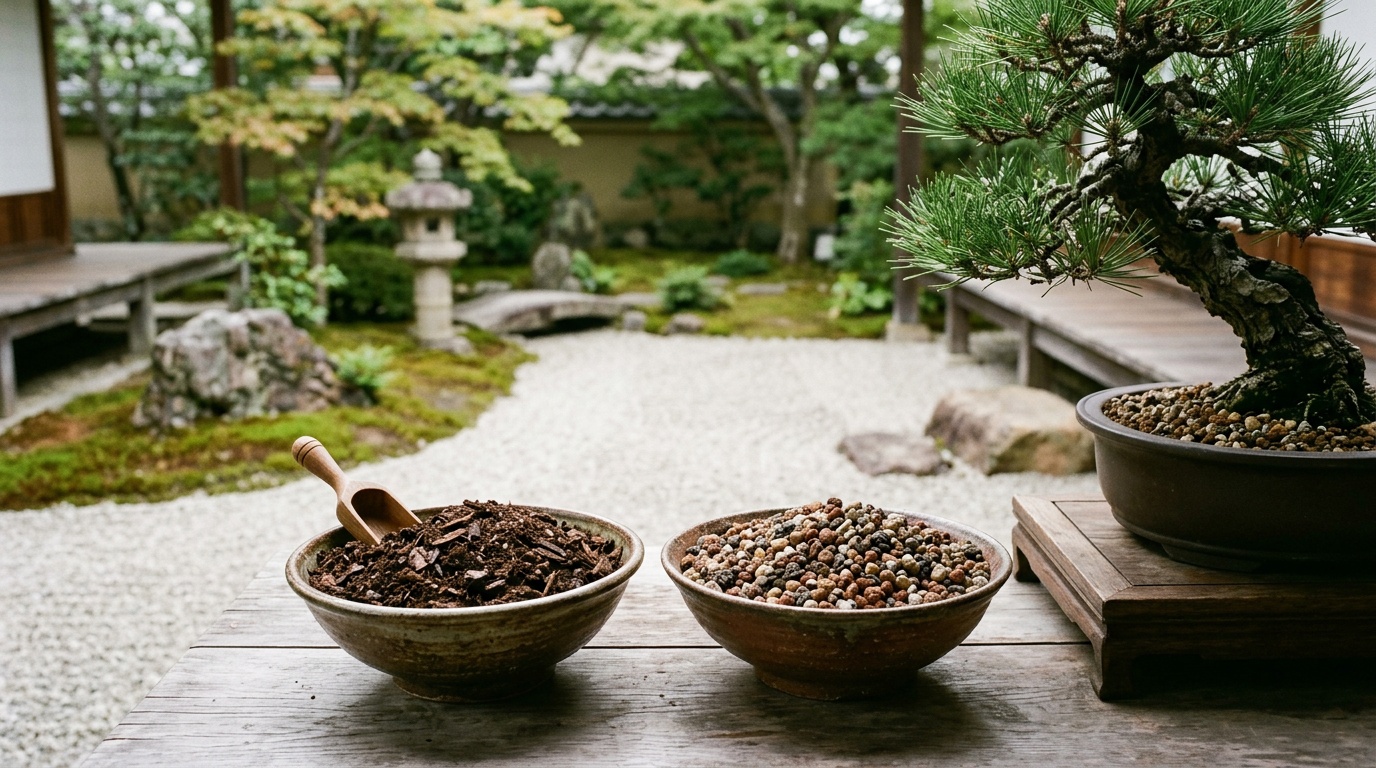
Bonsai soil is a growing medium selected for the demands of a restricted root system. It commonly combines akadama, pumice, and lava rock. Potting soil usually combines peat moss or coir with bark, perlite, and sometimes compost or starter fertilizer. Both can be soil-free in the ordinary garden sense.
The names are imperfect guides. A coarse bark-based nursery mix may function well for a developing tree, while a bag labeled “bonsai soil” may contain mostly fine peat. Read the ingredients, examine particle size, and consider the container.
| Feature | Typical granular bonsai mix | Typical general-purpose potting mix |
|---|---|---|
| Structure | Distinct granules with spaces between them | Finer, fibrous material with added aeration components |
| Water behavior | Drains readily while porous particles retain moisture | Usually retains more water, depending on formulation |
| Air after watering | Usually more available when screened and uncompacted | Can become limited in shallow pots when fine or degraded |
| Changes over time | Some particles persist; akadama can break down | Organic components decompose and the mix may settle |
| Fertility | Usually requires an intentional feeding program | May include an initial fertilizer charge |
| Useful setting | Established bonsai in shallow containers | Many nursery plants and trees in development containers |
Neither category guarantees success. The Arnold Arboretum’s collection-care guide describes mixes containing sand, loam, and peat or leaf mold, with different proportions for different trees. Its central requirement is both water retention and air circulation. Successful bonsai cultivation does not depend on excluding every organic ingredient.
Why shallow bonsai pots make soil choice important
Roots use oxygen for respiration. After watering, some pore spaces must become available for air while others continue holding water. A mix that stays saturated too long can restrict oxygen and contribute to root decline. A mix that dries too quickly can damage fine roots between waterings.
Container depth matters. With the same medium, a shallow pot generally has a larger proportion of its root zone in the wetter region near the bottom than a tall pot does. A mix that works in a deep nursery container can therefore behave poorly in a shallow bonsai dish.
Particle size matters alongside the ingredient list. Fine material settles between larger pieces, reducing the spaces that would otherwise carry air and water. Adding a handful of gravel to dense potting soil rarely changes its overall structure enough.
Nor should you expect a bottom layer of stones to correct a poorly chosen medium. Illinois Extension’s container drainage guidance advises against using gravel beneath soil to improve drainage. For a straightforward beginner setup, use a consistent mix through the root zone, mesh over the drainage holes, and unobstructed outlets.
In teaching, I often find that “fast drainage” has been mistaken for “no water retention.” Good pumice can feel damp after free water has escaped. That combination is useful: roots receive stored moisture without sitting in continuously water-filled spaces.
What the main bonsai soil ingredients do
Akadama, pumice, and lava rock
Akadama is a granular Japanese clay used for moisture retention and nutrient holding. It eventually breaks down; hardness, handling, weather, and watering affect how quickly. Its usefulness comes with the responsibility to monitor the mix and repot when needed.
Pumice is a porous volcanic material that retains some water while supporting an open structure. Lava rock supplies durable granules and structural stability, although its porosity and water retention vary. These materials work together; none has just one function.
For many medium-sized bonsai, screened particles around 2-6 mm are a practical starting range. Tiny trees usually need a finer grade and closer moisture monitoring. Larger development containers may suit coarser material. Avoid turning a useful guideline into a requirement for every tree.
Bark, peat, coir, and perlite
Screened, aged pine bark can provide an organic component without introducing as much fine material as many houseplant mixes. Peat and coir retain moisture well, but their proportion and texture need particular care in shallow pots. Perlite adds air space cheaply, though its lightness makes it prone to floating and moving during watering.
If buying components, look for stated particle sizes rather than decorative claims. A bag of screened horticultural pumice is a useful category to compare when improving a development mix. Check the grade and volume before ordering.
Garden soil and fine sand are poor default substitutes. Their texture can close the spaces you are trying to preserve. Likewise, an untested absorbent product is not automatically interchangeable with horticultural clay: some soften into sludge when soaked.
Bonsai soil mix recipes you can adjust
Measure these recipes by volume, using the same scoop. They are starting points, not experimentally proven optimums for every tree. Screen out dust before mixing, moisten dusty materials during handling, and avoid crushing soft granules.
Deciduous bonsai: a moisture-retentive starting mix
For an established Japanese maple or Chinese elm in a suitable bonsai pot, start with:
- 2 parts akadama
- 1 part pumice
- 1 part lava rock
This makes a 50:25:25 mix. A four-liter batch uses two liters of akadama and one liter each of pumice and lava. These proportions follow the general deciduous starting recipe in Bonsai Empire’s soil guide, which also recommends adjusting mixtures for growing conditions.
Pines and junipers: an open starting mix
Use equal parts akadama, pumice, and lava rock as a starting point. Keep particle sizes reasonably consistent. In a cool, rainy setting, assess whether less akadama or a coarser grade would suit the tree at its next repotting. In a hot, windy setting, the same recipe may need much more frequent watering.
Do not interpret a conifer’s preference for an aerated root zone as permission to let its roots become completely dry. Pines and junipers also differ by species, vigor, and development stage.
A budget mix for trees in development
For a vigorous young elm or ficus in a deeper training container, a practical trial mix is two parts pumice to one part screened, aged pine bark. This avoids the cost of filling a large container with imported akadama. Bark quality varies, so test a small batch and watch its drying behavior before using it throughout a collection.
Azaleas deserve a separate decision: their acidic root-zone requirements often lead growers to kanuma-based mixes. Succulent bonsai such as Portulacaria afra also need a different moisture approach from maples. Identify the plant before copying a recipe.
When ordinary potting soil can be appropriate
Regular potting mix will not automatically kill a bonsai. Nursery trees often arrive growing strongly in organic media. A young tree being grown for trunk thickness may benefit from a well-aerated nursery mix in a development container, provided watering matches the medium.
The distinction is especially useful when choosing a pot. A shallow exhibition container may complete the visual composition of a refined tree, but it can be an unnecessary constraint while you are still building the trunk and primary branches. Choose enough root space for the work ahead.
Across twenty years of practice, I have become less interested in finding one mix for every bench. The tree beside a wall and the tree exposed to afternoon wind can need different moisture reserves, even when they are the same species.
If you can water only once daily, an extremely coarse mix in a tiny pot may be impractical during summer. A more retentive mix, a larger training pot, protection from drying wind, or reliable irrigation may be needed. Increasing peat until the pot stays wet continuously is not a sound substitute for that planning.
For indoor ficus, check light and temperature alongside soil. Slow drying may reflect weak light and low water use. Soil changes cannot compensate fully for an unsuitable growing location.
How to change soil and check the result
A healthy tree in an imperfect mix usually gives you time to plan. Repot according to species and growth stage: many temperate deciduous trees are repotted around bud swelling in spring, while tropical trees generally tolerate root work better in warm, active growth. Conifers require their own timing and root-handling approach.
- Observe the existing root ball. Note whether water penetrates, runs around a dry core, or leaves the interior wet for unusually long periods.
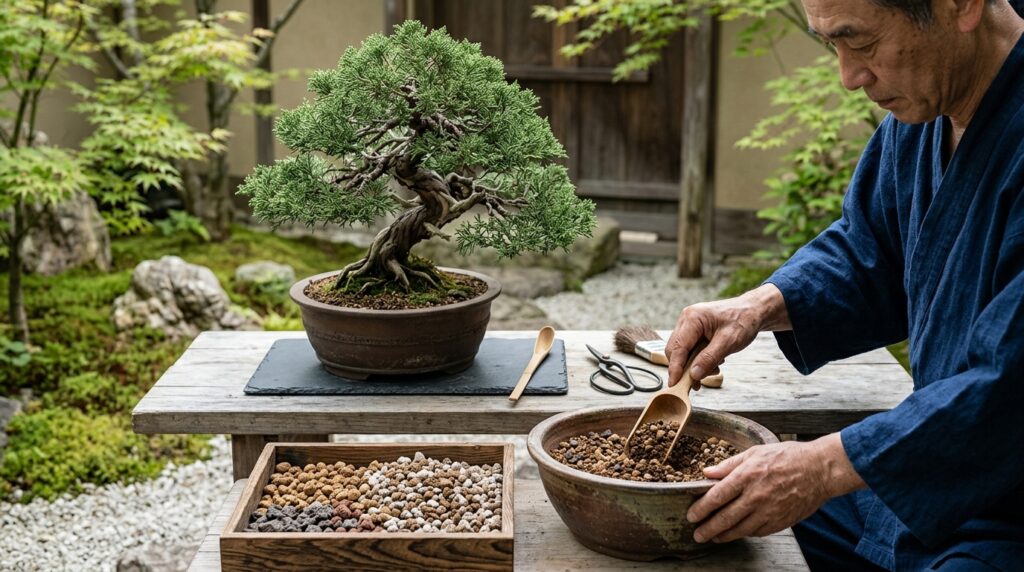
- Prepare the pot and mix first. Fit drainage mesh and anchoring wire before exposing roots. A bonsai soil sieve set helps separate dust and oversized particles.
- Remove old medium conservatively. Work according to species and root health. Avoid indiscriminately washing every root bare, especially on pines and other conifers; staged replacement may be appropriate.
- Anchor and fill carefully. Settle fresh particles around roots with a chopstick, gently filling voids without grinding or compacting the medium.
- Water thoroughly and provide aftercare. Protect the recovering tree from drying wind and excessive exposure appropriate to its species.
Old organic soil inside a new granular mix can create two drying patterns. Check the retained core as well as the outer material. A wooden skewer inserted carefully into that core can help you assess moisture; a dry-looking surface alone is insufficient.
After recovery, water thoroughly when the root zone needs it, rather than giving small daily sips. Feed according to species, season, and product directions. Mineral particles do not provide a complete fertilizer supply.
I keep brief notes after repotting: mix, particle grade, pot depth, and how the tree responds through summer. Change one main variable next time. If water increasingly pools, investigate surface crusting, blocked holes, crowded roots, and particle breakdown before blaming the recipe.
To compare a new recipe before repotting, fill a spare pot of similar depth, water it thoroughly, and observe it over several days in the intended location. This will reveal obvious problems such as floating particles, settling, or persistent saturation. It will not predict the exact watering interval once a tree is present, because roots and foliage change water use.
During the first growing season, check moisture daily and more often during hot weather. Lift smaller pots to learn the difference between freshly watered and partly dried weights. Pair that observation with an interior moisture check until the new routine becomes familiar.
Frequently asked questions
Can I mix bonsai soil with regular potting soil?
Yes, but judge the resulting structure. Fine potting material can fill gaps between granules, so blending equal volumes does not guarantee an airy medium. For a shallow pot, a purpose-mixed granular substrate is usually easier to manage consistently.
Can I use cactus soil for bonsai?
Sometimes. “Cactus soil” covers widely different products, including fine peat-heavy blends. Check ingredients and texture. A coarse formulation may suit succulent bonsai; it is not automatically suitable for a moisture-demanding deciduous tree.
Does bonsai soil need fertilizer?
Usually, yes. Akadama and other components can hold some nutrients, but that is different from supplying balanced nutrition. Check whether a purchased mix already includes fertilizer before adding more.
How often should bonsai soil be replaced?
There is no universal interval. Young, vigorous trees can fill pots quickly; mature trees may remain longer between repottings. Inspect root density, infiltration, and particle condition, then schedule work in the appropriate seasonal window.
What is the best bonsai soil mix for beginners?
Choose a screened mix suited to your species, with clearly listed ingredients and particle size. Equal parts akadama, pumice, and lava is a common starting point for many conifers; the 50:25:25 recipe above suits many deciduous trees. Observe how your particular pot dries before changing anything.
A useful mix gives you a readable rhythm: thorough watering, drainage, gradual drying, and renewed watering when needed. Begin there. The right recipe becomes clearer as you learn the tree.