Japanese Maple Bonsai: How to Style and Care for This Classic
In twenty years of practicing bonsai, I’ve found Japanese maples to be the most forgiving teachers — they reward patience with stunning seasonal displays and respond to careful shaping with elegant architecture. Their delicate leaves, vibrant autumn colors, and naturally graceful branching make them ideal subjects for both beginners learning fundamental techniques and experienced practitioners exploring advanced styling.
I trained under masters in Osaka and Kyoto who worked primarily with Acer palmatum, the Japanese maple. What I learned is that success with these trees comes not from forcing a vision, but from observing what the tree offers and working with its inherent character. This is the essence of wabi-sabi — finding beauty in the natural form, the asymmetry, the passage of seasons.
Why Japanese Maples Excel as Bonsai
Japanese maples possess several qualities that make them exceptional bonsai subjects. Their leaves naturally reduce in size with proper care, ramification develops readily with thoughtful pruning, and their bark develops attractive texture with age. Most cultivars are hardy in zones 5-9, tolerating both cold winters and warm summers when properly protected.
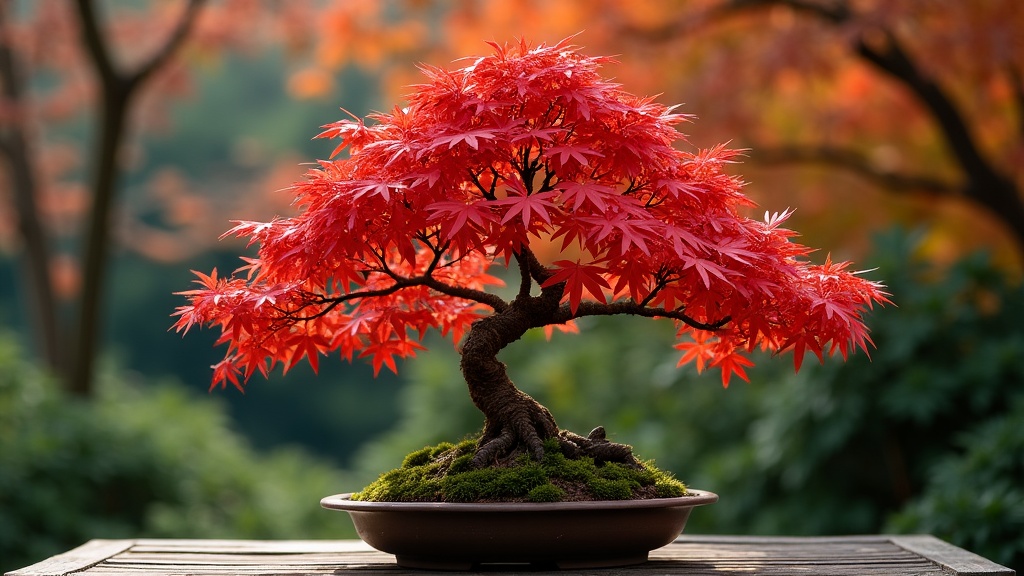
The real appeal lies in their seasonal transformation. Spring brings delicate green or red emerging leaves. Summer provides a canopy of color ranging from chartreuse to deep burgundy depending on cultivar. Autumn delivers the spectacular display that makes these trees famous. Even winter reveals elegant branch structure — the reward for patient pruning work.
Unlike some species that resist shaping or require decades to show character, Japanese maples respond within a single growing season. Back-budding occurs reliably when you prune correctly. The wood remains flexible enough for wiring young branches while developing rigidity in established structure.
Selecting the Right Cultivar
I’ve worked with dozens of Acer palmatum cultivars. Each has distinct characteristics that suit different bonsai styles and aesthetic goals. Your choice should match both your climate and your vision for the tree’s ultimate form.
| Cultivar | Leaf Type | Color | Best Styles |
|---|---|---|---|
| Deshojo | Small, palmate | Bright red spring, green summer | Informal upright, slanting |
| Kiyohime | Tiny, compact | Green to orange-red | Shohin, cascade, literati |
| Seigen | Medium, deeply lobed | Red year-round | Formal upright, multi-trunk |
| Shishigashira | Crinkled, unique texture | Green to gold-orange | Informal upright, broom |
| Kashima | Very small | Green to crimson | All styles, excellent for shohin |
For your first Japanese maple bonsai, I recommend starting with Deshojo or Kashima. Both are vigorous, forgiving of pruning mistakes, and produce reliable results. Avoid dissectum varieties (threadleaf maples) initially — while beautiful, they require different techniques and can frustrate beginners.
Essential Care Requirements
Soil Composition
Japanese maples demand excellent drainage but consistent moisture — a paradox that proper soil mixture resolves. I use a blend of 40% akadama bonsai soil, 30% pumice, and 30% lava rock for established trees. Young developing trees benefit from slightly more organic content — add 10-15% composted pine bark.
The akadama provides water retention and cation exchange capacity. Pumice and lava rock ensure oxygen reaches the roots while preventing waterlogging. This combination allows you to water thoroughly without fear of root rot, the primary killer of Japanese maple bonsai.
Never use standard potting soil or garden dirt. These compact over time, suffocating roots and creating anaerobic conditions that lead to fungal problems.
Watering Approach
Water when the soil surface begins to dry but before it becomes completely dry. In summer heat, established trees may require watering twice daily. During spring and fall, once daily usually suffices. Winter dormancy reduces needs significantly — weekly watering may be adequate.
I check moisture by touching the soil surface and observing the leaf turgor. Wilting leaves indicate stress, but by the time you notice, damage has begun. Prevention through consistent observation is key.
Use a bonsai watering can with a fine rose to avoid disturbing the soil surface. Water the entire soil mass until water flows freely from drainage holes. Surface watering that doesn’t penetrate fully leads to uneven root development.
Light and Temperature
Japanese maples prefer morning sun with afternoon shade in climates above zone 7. Full sun creates compact growth and vibrant color but risks leaf scorch on hot days. Deep shade produces weak, leggy growth with poor ramification.
I place my trees where they receive 4-6 hours of direct morning light, then dappled shade during the afternoon heat. This mimics their natural forest edge habitat and produces healthy, balanced growth.
Temperature extremes require protection. Below 25°F (-4°C), move trees into an unheated garage or cold frame. Above 95°F (35°C), provide additional shade and increase watering frequency. The roots are more vulnerable than the canopy — protect the pot from freezing and overheating.
Fertilization Schedule
Feed lightly and consistently rather than heavily and sporadically. I use organic bonsai fertilizer pellets from early spring through mid-autumn, withholding nitrogen after August to encourage hardening before winter.
The feeding schedule follows the tree’s growth cycle:
- Early spring: Balanced fertilizer (10-10-10) as buds swell
- Late spring through summer: Continued balanced feeding every 2-3 weeks
- Late summer: Reduce nitrogen, shift to 0-10-10 formulation
- Autumn: Stop feeding 4-6 weeks before first frost
- Winter: No fertilization during dormancy
Young trees in development can tolerate stronger feeding. Mature trees maintained for refinement require gentler nutrition to avoid excessive vigor that disrupts established proportions.
Pruning and Styling Techniques
Branch Structure Development
Japanese maple bonsai styling begins with establishing primary branch structure. I select branches that emerge at different heights along the trunk, alternating left and right with slight backward branches for depth. Remove crossing branches, parallel branches, and any growth that obscures the trunk line.
The first branch should be the lowest and thickest, positioned approximately one-third of the way up the trunk. Secondary branches should be progressively finer and shorter as you move up the tree. This creates taper and the illusion of an ancient tree.
Use sharp concave branch cutters for clean cuts that heal flush with the trunk. Japanese maples compartmentalize wounds effectively, but large cuts benefit from cut paste application to prevent die-back and encourage callus formation.
Leaf Reduction Methods
Leaf size directly impacts the illusion of scale in bonsai. Japanese maples naturally produce smaller leaves under stress, but we can guide this response through technique rather than neglect.
Defoliation in early summer forces a second flush of smaller leaves and increases ramification. I remove all leaves by cutting the leaf blade while leaving the petiole attached. Within days, new buds form at nodes, producing leaves 40-60% smaller than spring growth.
Only perform full defoliation on healthy, vigorous trees. Weak or recently transplanted trees lack the energy reserves to respond properly. Partial defoliation — removing only the largest leaves — offers a gentler approach for trees in refinement.
Wiring Guidelines
Japanese maple branches are flexible when young but stiffen with age. Wire shaping is most effective on current-year growth and branches under 1/4 inch diameter. Older wood requires guy-wires or gradual bending with tension devices.
I prefer aluminum bonsai wire for Japanese maples. The soft bark scars easily, and aluminum applies sufficient pressure without biting in as quickly as copper. Wire from late autumn through winter when the tree is dormant and sap flow is minimal.
Wrap wire at 45-degree angles, starting from the trunk or a thicker anchor point and working toward branch tips. Use wire approximately one-third the diameter of the branch you’re shaping. Remove wire after 3-4 months or before it begins cutting into the bark — Japanese maples thicken rapidly during active growth.
Seasonal Care Calendar
Japanese maple bonsai care follows distinct seasonal rhythms. Working with these natural cycles rather than against them produces healthier trees and better results.
Spring (March-May): Repotting window opens as buds swell but before leaves emerge. Root prune and refresh soil every 2-3 years for young trees, every 3-5 years for mature specimens. Begin fertilization as leaves unfold. Prune structural branches before leaf-out for clear visibility of branch architecture.
Summer (June-August): Primary growing season requires attentive watering and continued feeding. Pinch new shoots back to 1-2 leaf pairs to encourage ramification. Defoliation window is early summer for healthy trees. Apply wire to new growth for shaping. Watch for aphids and spider mites in hot, dry weather.
Autumn (September-November): Reduce then stop fertilization to allow hardening. Leaf color display requires cool nights and moderate days. Remove wire before leaves drop to avoid losing track of it. Light pruning to remove crossed branches or water sprouts. Begin preparing winter protection.
Winter (December-February): Dormancy period requires minimal care but consistent protection. Keep soil barely moist, never saturated or completely dry. Protect from hard freezes below 25°F. This is the ideal time for major structural wiring and detailed branch arrangement — the bare framework reveals the tree’s true form.
Common Issues and Solutions
Leaf Scorch
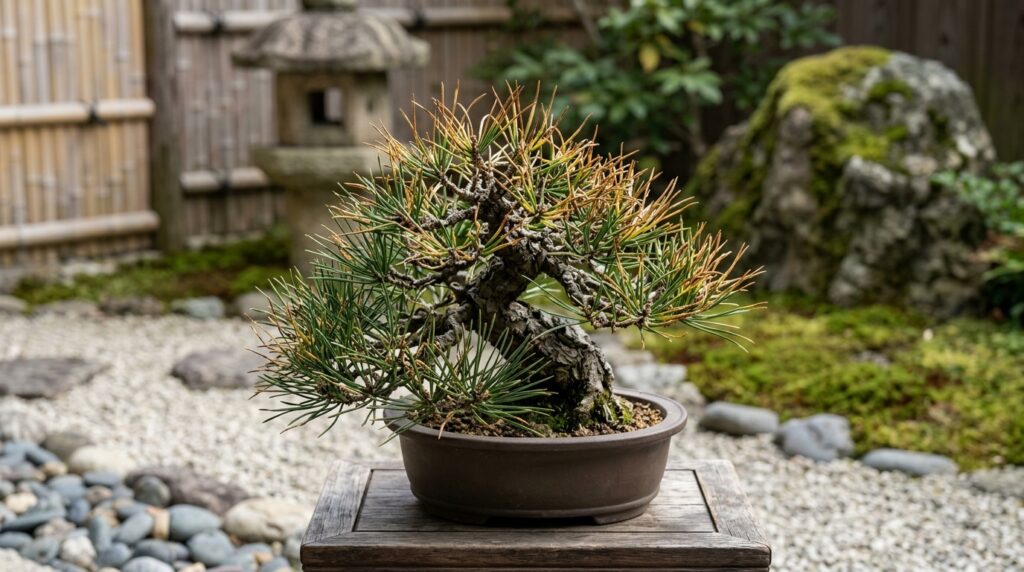
Brown, crispy leaf edges indicate insufficient water or excessive heat. Japanese maples are understory trees that evolved in partial shade. Full afternoon sun in hot climates overwhelms their transpiration capacity.
Prevention is simpler than cure: provide afternoon shade, increase watering frequency during heat waves, and ensure adequate soil moisture retention. Once scorching occurs, remove damaged leaves and improve growing conditions. The tree will produce new foliage if stressed during the growing season.
Reverse Taper and Thick Cuts
Removing large branches can create inverse taper where the trunk appears thicker above a cut than below. Prevention through early structural decisions is ideal, but correction is possible through patience.
Allow sacrifice branches to grow freely above the affected area, thickening the trunk through photosynthesis. After 2-3 years, remove the sacrifice branch and repeat if necessary. This gradual approach maintains tree health while correcting proportions.
Weak Back-Budding
Japanese maples typically back-bud readily, but weak or shaded interior areas may fail to produce new growth. Strategic pruning that allows light penetration to interior branches stimulates dormant buds.
Remove strong apical growth to redirect energy downward. Partially defoliate to allow light into the interior canopy. Fertilize adequately to provide resources for new bud formation. Results appear the following growing season, not immediately.
Frequently Asked Questions
How long does it take to develop a Japanese maple bonsai from nursery stock?
A presentable tree with basic branch structure and refined silhouette typically requires 3-5 years of focused work. Initial structure development takes 1-2 years: selecting primary branches, establishing taper, reducing height. Ramification and refinement follow, requiring another 2-3 years. The timeline varies with starting material quality and how aggressively you can work. I’ve created acceptable shohin-size trees in two seasons from ideal nursery specimens, while other projects have evolved over a decade.
Can Japanese maple bonsai survive indoors?
No. Japanese maples are temperate deciduous trees requiring winter dormancy triggered by cold temperatures and shortened day length. Indoor conditions lack the environmental cues necessary for their natural cycle. Attempting to keep them inside leads to gradual decline over 6-18 months. Provide outdoor growing conditions with winter protection below 25°F. Unheated garages, cold frames, or protected areas against buildings offer adequate protection while maintaining dormancy requirements.
What’s the best time to repot Japanese maple bonsai?
Repot as buds begin swelling in early spring, typically March in zone 6-7, later in colder zones and earlier in warmer regions. The exact timing is visible on the tree: buds enlarge and show color but haven’t yet opened into leaves. This brief window — usually 1-2 weeks — provides maximum recovery time during the growing season while minimizing transplant shock. Avoid repotting during active growth in summer or approaching dormancy in autumn. Emergency repotting outside this window is possible but stressful.
How do you prevent leggy growth and encourage compact branching?
Compact growth results from consistent pinching during the growing season combined with adequate light exposure. As new shoots extend to 3-4 leaf pairs, pinch back to 1-2 pairs. This forces energy into lateral buds rather than apical extension. Ensure the tree receives sufficient morning sun — shade produces elongated internodes and weak growth. Moderate fertilization also helps; excessive nitrogen creates rapid, soft growth with poor structure. Defoliation in early summer resets the growth pattern and produces a second flush of compact leaves.
Why are my Japanese maple leaves staying green instead of turning red in autumn?
Autumn color requires specific environmental conditions: cool nights (40-50°F), warm days (60-70°F), adequate soil moisture, and proper nutrition throughout the growing season. Excessive nitrogen late in the season delays color development. Drought stress can cause leaves to drop before coloring. Insufficient light produces muted colors. Some cultivars display better color than others — varieties like ‘Deshojo’ and ‘Seigen’ show reliable red tones, while others tend toward orange or yellow. If conditions are appropriate but color remains poor, consider cultivar genetics as the limiting factor.