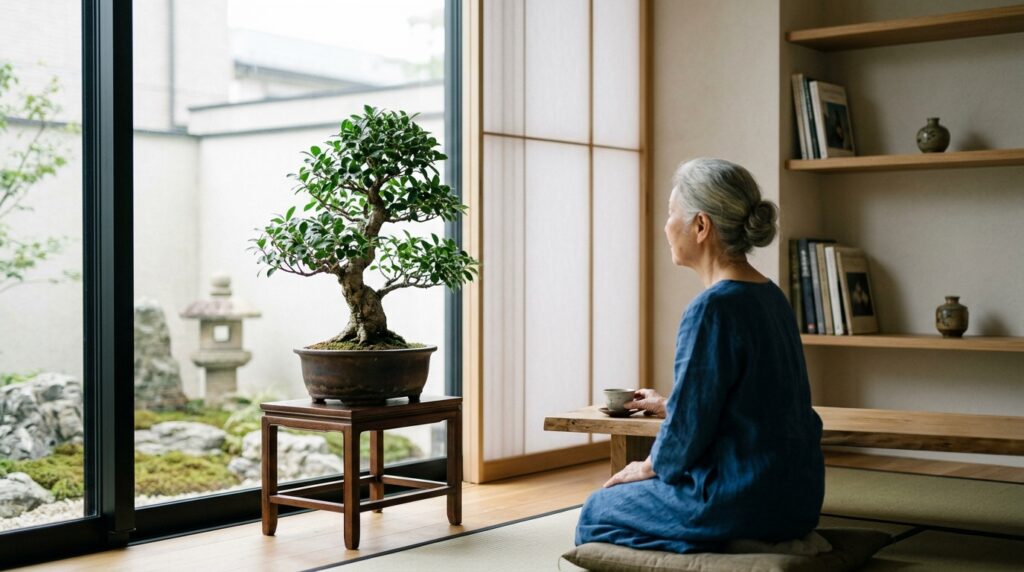
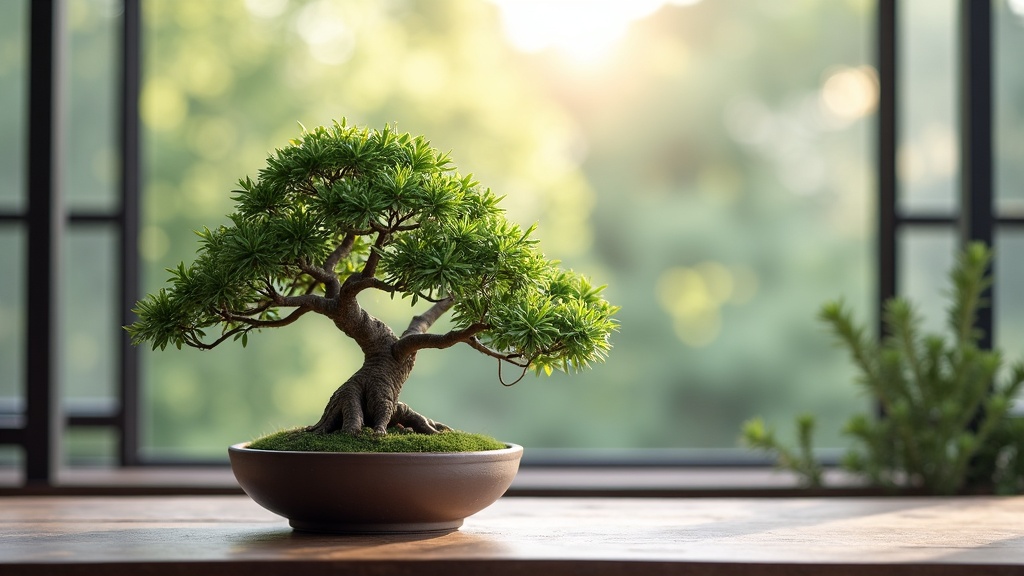
After twenty years of training bonsai both outdoors and in controlled environments, I can tell you with certainty: the best bonsai trees for indoors are tropical and subtropical species that tolerate low humidity and indirect light—specifically Ficus, Chinese Elm, Jade, Hawaiian Umbrella, and Fukien Tea. These five species have consistently thrived in my indoor collection and in the hundreds of student setups I’ve guided through the years.
Most beginners fail with indoor bonsai because they try to force temperate species like Japanese Maple or Juniper to survive inside. Those trees evolved to need winter dormancy; they will slowly decline indoors no matter what you do. The species I recommend below are adapted to the stable temperatures and reduced light that define indoor environments.
Why Indoor Bonsai Require Different Species
In my early years training in Osaka, I learned a hard lesson: the trees that thrive in traditional Japanese gardens—pines, maples, junipers—do not translate to indoor cultivation. These temperate species require seasonal temperature fluctuations and full sun exposure that no window can replicate.
Indoor environments present three fundamental challenges: reduced light intensity (even a south-facing window provides only 10-20% of full outdoor sun), low humidity (typically 30-40% compared to outdoor 60-80%), and stable year-round temperatures. The species that succeed indoors are those that evolved in tropical or subtropical climates where these conditions mirror their natural habitat.
This is not a limitation—it is an opportunity to work with species that offer faster growth, more forgiving care requirements, and year-round aesthetic interest without dormancy periods.
The Five Best Bonsai Species for Indoor Growing
Ficus (Ficus retusa, Ficus benjamina)
Ficus bonsai remain my first recommendation for indoor cultivation. I have maintained the same Ficus retusa bonsai in my north-facing studio for twelve years, and it has never shown stress.
The Ficus tolerates lower light better than almost any bonsai species, recovers quickly from pruning mistakes, and develops aerial roots that add visual complexity over time. In my Kyoto training, we called it “the forgiving tree” because it rebounds from neglect that would kill more sensitive species.
Key advantages: Tolerates low light, handles missed waterings, develops thick trunks relatively quickly, produces small leaves naturally without difficult techniques.
Challenges: Dislikes sudden environmental changes—moving from room to room will cause leaf drop. Once you find a good spot, leave it there.
Chinese Elm (Ulmus parvifolia)
The Chinese Elm bonsai occupies a unique position: it can survive both indoors and outdoors, making it ideal for beginners who want flexibility. While I prefer outdoor cultivation for elms when possible, I have seen exceptional indoor specimens that rival outdoor quality.
The elm’s small serrated leaves reduce naturally with indoor light levels, and the species ramifies (develops branch structure) more readily than Ficus. The bark develops attractive exfoliating patterns as the tree matures.
Key advantages: Responds well to pruning and wiring, develops fine branch structure, semi-deciduous nature creates seasonal interest even indoors, very pest-resistant.
Challenges: Needs more light than Ficus—place within two feet of a south or west window. Will show etiolation (stretched growth) in insufficient light.
Jade (Crassula ovata)
Jade represents the opposite end of the care spectrum from traditional bonsai. As a succulent, it stores water in its leaves and trunk, making it nearly impossible to kill through underwatering. I recommend jade bonsai for travelers or anyone who cannot maintain consistent watering schedules.
The trunk develops sculptural character quickly—a five-year-old jade can look ancient if properly styled. The thick, fleshy leaves create a distinctive silhouette unlike any other bonsai species.
Key advantages: Extremely drought-tolerant, develops thick trunks rapidly, handles low humidity without issue, branches thicken and lignify (become woody) within a single growing season.
Challenges: Overwatering causes root rot more easily than with other species. Water only when soil is completely dry. The succulent leaves also make traditional wiring techniques difficult.
Hawaiian Umbrella (Schefflera arboricola)
The Hawaiian Umbrella bonsai grows wild throughout my training region in Okinawa. I appreciate its compound leaves and upright growth habit, which creates a canopy structure naturally without extensive pruning.
This species tolerates the same indoor conditions as common houseplants, making it predictable and reliable. The aerial roots that develop on mature specimens add visual interest similar to Ficus.
Key advantages: Handles low light and low humidity, grows vigorously (providing frequent styling practice), forgiving of pruning errors, rarely experiences pest problems.
Challenges: Can develop long internodes (spacing between leaves) in low light. Requires consistent pruning to maintain compact form. The compound leaves never reduce to the tiny size of elm or ficus foliage.
Fukien Tea (Carmona retusa)
The Fukien Tea bonsai represents the most advanced option on this list. I place it fifth not because of inferior quality—the small leaves, white flowers, and dark bark make it visually stunning—but because it demands more precise care than the previous four species.
In my experience, Fukien Tea requires consistent moisture (never fully dry, never waterlogged), high humidity (above 50%), and bright indirect light. Students who can maintain these conditions are rewarded with one of the most refined indoor bonsai available.
Key advantages: Produces small white flowers sporadically throughout the year, develops very fine branch ramification, naturally small leaves, bark becomes attractively fissured with age.
Challenges: Sensitive to both overwatering and underwatering. Will drop leaves if conditions change. Not forgiving of mistakes.
Species Comparison: Quick Reference
| Species | Light Needs | Watering | Difficulty | Best For |
|---|---|---|---|---|
| Ficus | Low to Medium | Moderate | Beginner | Low-light spaces, forgiving growth |
| Chinese Elm | Medium to High | Moderate | Beginner | Fine branch development, seasonal interest |
| Jade | Medium | Low (drought-tolerant) | Beginner | Infrequent watering, rapid trunk development |
| Hawaiian Umbrella | Low to Medium | Moderate | Beginner | Vigorous growth, canopy structure |
| Fukien Tea | Medium to High | Precise (consistent moisture) | Intermediate | Flowering, refined appearance, experienced growers |
Essential Care Requirements for Indoor Bonsai
Light Placement
Place your indoor bonsai within three feet of a window—this is not negotiable. I have evaluated hundreds of failing indoor bonsai, and insufficient light causes 60% of problems. South-facing windows provide the strongest light in the Northern Hemisphere; west-facing windows offer good afternoon sun; east-facing windows work for Ficus and Hawaiian Umbrella.
Rotate your tree 90 degrees every two weeks to ensure even light exposure on all sides. Without rotation, the tree will develop asymmetric growth, always leaning toward the window.
Watering Technique
Water thoroughly when the soil surface begins to dry—this means watering until water flows freely from drainage holes. Partial watering creates dry pockets in the root ball and leads to progressive root death.
Check soil moisture daily by touching the surface. Environmental conditions change constantly (heating systems, air conditioning, seasonal humidity), so watering frequency will vary from every two days to every five days depending on conditions.
Use a watering can with a fine rose attachment to avoid disturbing soil. I prefer early morning watering—it allows the tree to enter the day with full moisture reserves.
Humidity Management
Indoor heating and air conditioning create desert-like humidity levels. While the species I recommend tolerate low humidity better than outdoor-adapted trees, they still benefit from increased moisture.
Place your bonsai on a humidity tray filled with gravel and water. The water should not touch the pot bottom—the evaporation creates a microclimate of higher humidity around the tree. Refill the tray weekly.
Group multiple bonsai together; they create a shared humid microclimate through transpiration.
Fertilization
Indoor bonsai grow year-round (no dormancy period) but at reduced rates compared to outdoor trees. I use balanced liquid fertilizer at half strength every two weeks during spring and summer, monthly during fall and winter.
Reduce fertilizer frequency in winter even though indoor trees do not go dormant—lower light levels mean reduced photosynthesis and less nutrient demand.
Common Mistakes That Kill Indoor Bonsai
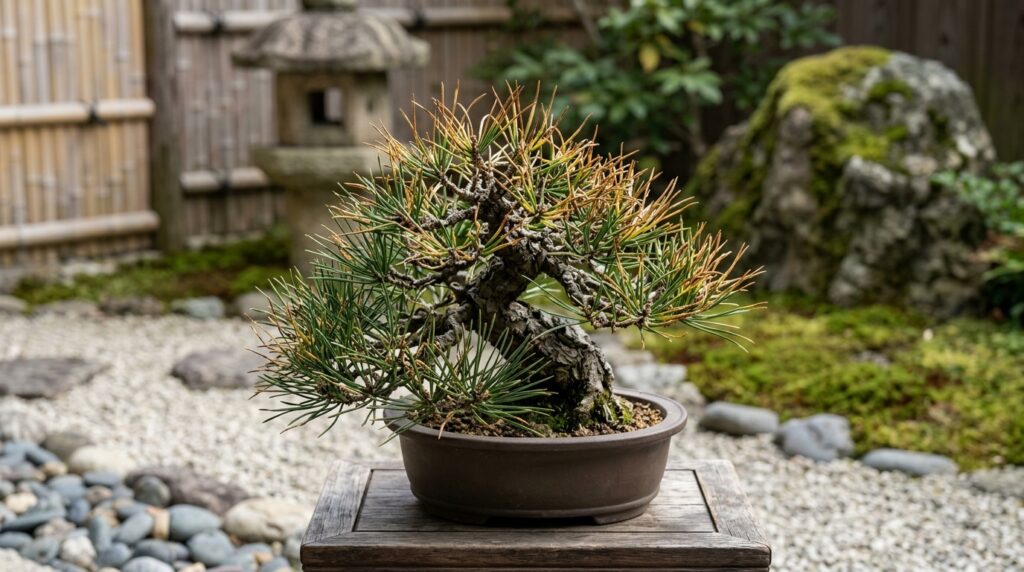
Growing temperate species indoors. Junipers, Japanese Maples, and Pines need outdoor winter dormancy. They will not survive more than one year inside. This is the single most common mistake I see.
Insufficient light. “Indirect light” does not mean “across the room from a window.” It means “near a window but not in direct sun beam.” The intensity difference between a windowsill and six feet into a room is dramatic.
Decorative pots without drainage. Bonsai must have drainage holes. Excess water must escape. Pots without drainage guarantee root rot within months. If you want to use a decorative container, place the bonsai in a proper training pot with drainage holes inside the decorative outer pot, then remove it for watering.
Inconsistent watering. Indoor bonsai die from watering neglect more than any other cause. The small pot size means limited water reserves—missing waterings by even two days during active growth can cause severe damage.
Never pruning. Indoor bonsai grow continuously. Without regular pruning (trimming back new shoots to two or three leaves), they develop long, weak branches that destroy the bonsai form. I prune my indoor ficus every two to three weeks during growing season.
Frequently Asked Questions
Can I grow Japanese Maple or Juniper bonsai indoors?
No. These temperate species require winter dormancy with temperatures between 30-45°F for several months. Without dormancy, they exhaust their energy reserves and die within 6-18 months. This applies to all pine, spruce, juniper, maple, and elm species except Chinese Elm (which is subtropical). If you want these species, you must grow them outdoors or in an unheated garage during winter.
How much light does an indoor bonsai actually need?
Minimum 4-6 hours of bright indirect light daily, which means placement within 2-3 feet of a window. South or west-facing windows work best. If your only windows are north-facing or heavily shaded, consider supplementing with full-spectrum grow lights positioned 12-18 inches above the tree, running 12-14 hours daily.
Which indoor bonsai is truly the easiest for beginners?
Ficus retusa (also sold as Ficus “Ginseng”). It tolerates the widest range of light conditions, recovers from watering mistakes better than other species, and grows vigorously enough that styling errors correct themselves within a growing season. After Ficus, I recommend Jade for anyone who travels frequently or forgets watering.
Do indoor bonsai need to go outside in summer?
They do not need to, but they will grow faster and stronger if you can provide a few months outdoors in partial shade. I move my indoor ficus collection to a covered porch in May through September—they develop noticeably thicker trunks and denser foliage. Transition gradually over 7-10 days to avoid shock from the light intensity change. Never place indoor-adapted trees in full sun; they will burn.
How often should I repot an indoor bonsai?
Every 2-3 years for young trees (under 10 years old), every 3-5 years for mature specimens. Repot in spring when you see roots circling the drainage holes or water draining very slowly despite proper watering technique. Use well-draining bonsai soil (akadama, pumice, and lava rock mixture), not garden soil or potting mix. Poor soil causes more indoor bonsai deaths than any factor except insufficient light.