Disclosure: If you buy through the Amazon links in this article, I may earn a small commission at no extra cost to you.
I can usually tell an overwatered bonsai before I touch the soil, because the tree develops a certain tired softness: yellowing leaves that do not feel crisp, growth that loses firmness, and soil that never seems to breathe. The change you should make is rarely “give less water” in the abstract. More often, you must water by observation instead of schedule, improve drainage, and match the rhythm to the species, season, and soil you actually have.
After many years of growing and teaching bonsai, I have found that beginners often blame themselves for watering too often when the deeper problem is that the tree is planted in a mix that stays wet too long. I have also seen the opposite: people become so afraid of overwatering that they let a weak tree swing into drought stress. The goal is not restraint for its own sake. The goal is oxygen around the roots, followed by a thorough watering when the tree is ready.
The Fast Answer: What Overwatering Usually Looks Like
Overwatering in bonsai is not simply a matter of pouring too much water through the pot once. If the pot drains well, a heavy watering is often healthy. The real problem is sustained wetness. Roots need both moisture and air. When the root zone stays saturated for too long, fine feeder roots weaken, roots begin to rot, and the foliage starts showing stress above the soil line.
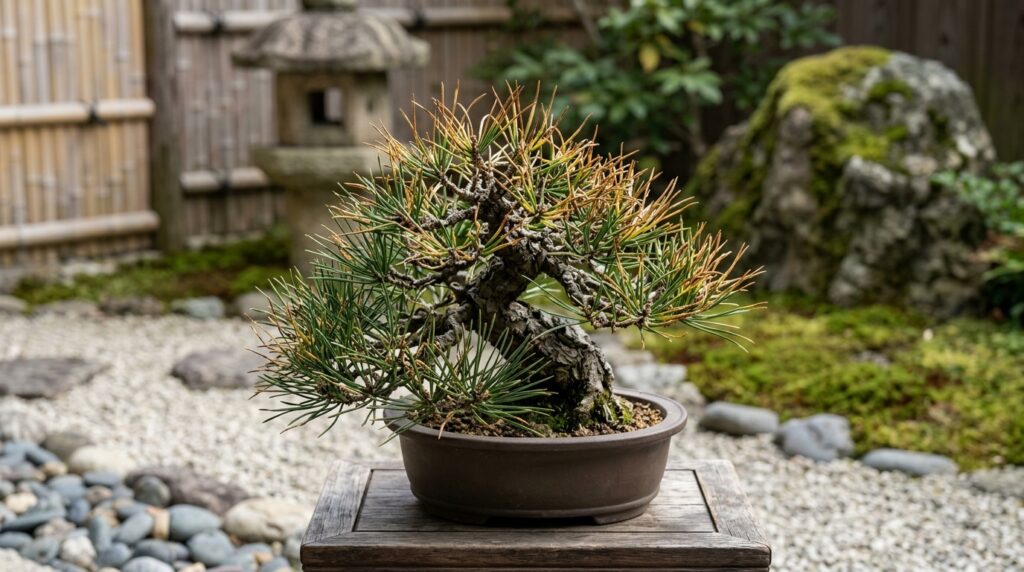
The most common signs are yellowing leaves, limp or dull foliage, weak new growth, a sour or musty smell from the soil, algae or constantly slick moss on the surface, and a pot that still feels heavy several days after watering. In severe cases you may see blackened roots, leaf drop while the soil is still wet, or branch dieback that seems confusing because the tree looks “watered.”
That confusion matters. An overwatered tree often looks thirsty because damaged roots can no longer move water properly. I have had students water again at exactly that point, which only deepens the problem.
How to Tell Overwatering From Underwatering
Both problems can cause yellow leaves, dull foliage, and a weak-looking tree. The difference is in the texture, timing, and soil condition around those symptoms. If you judge by leaf color alone, you will often misread the tree.
| Sign | More often overwatering | More often underwatering |
|---|---|---|
| Leaf color | Soft yellowing, sometimes pale green first | Yellowing followed by crisp browning |
| Leaf texture | Limp, soft, sometimes swollen-looking | Dry, brittle, curled, papery |
| Soil condition | Wet for days, dense, cool, sometimes sour-smelling | Dry, shrinking from pot edge, hard to re-wet |
| Pot weight | Stays heavy a long time | Becomes very light quickly |
| Progression | Usually gradual decline | Can become dramatic very quickly in heat |
| Root condition | Brown or black, soft, unhealthy smell | Dry, brittle fine roots |
If you want one practical test, use your fingers and a wooden chopstick together. Check below the surface, not just the top dressing. If the upper half inch looks dry but the interior stays wet and cold day after day, you are not dealing with a thirsty tree. You are dealing with a soil-air imbalance.
The Most Reliable Signs I Look For
1. Soil that never approaches dryness
This is the clearest warning. Healthy bonsai soil should move through a cycle: fully watered, evenly moist, then approaching dryness before the next watering. If your tree seems to stay in the second stage indefinitely, something is wrong. Either the soil is too organic, the pot is oversized, drainage is poor, or the tree is in light so weak that it cannot use the water you give it.
2. Yellowing that starts quietly, not dramatically
Overwatering often announces itself as a slow fade rather than a sudden collapse. Ficus may drop yellow leaves gradually. Chinese elm may look dull and less eager. Juniper foliage can lose energy and shift from vibrant green to tired olive before it browns. In my own garden, that subtle color flattening is often visible a week or two before beginners notice anything at all.
3. A musty smell or algae-heavy surface
Moss is not automatically bad. Good bonsai often carries moss beautifully. But if the soil surface is always slick, stagnant, or sour-smelling, pay attention. That usually means the surface and upper root zone are staying wet too long. I see this often on gift-store bonsai planted in peat-heavy soil beneath decorative gravel.
4. Weak response after watering
A healthy tree often looks a bit fresher within hours after a needed watering. An overwatered tree does not. It may continue to look limp because the roots are not functioning properly. This is one of those observations that becomes easier with time, and it is worth cultivating.
Why Bonsai Become Overwatered
The usual cause is not generosity with the watering can. It is a combination of poor drainage and fixed habits.
- Watering on a schedule: “Every morning” sounds disciplined, but bonsai do not use water at the same rate each day.
- Dense organic soil: Peat-rich potting soil stays wet too long in shallow bonsai containers.
- Too little light: Indoor trees in dim rooms consume water slowly, so wet roots linger.
- Oversized pots: Excess soil mass holds moisture longer than a small root system can handle.
- Blocked drainage holes: Old roots, compacted fines, or a decorative tray can trap water.
- Cold or stagnant conditions: Low temperatures and poor airflow reduce evaporation and root activity.
I often tell students that overwatering is really a systems problem. If the system is right, frequent watering during hot weather is not dangerous. If the system is wrong, even moderate watering becomes too much.
What To Change Right Away
Stop watering by the calendar
Check the tree daily, but water only when the root mass needs it. For many bonsai, that means watering thoroughly once the upper layer has started to dry and the interior is no longer saturated. Use a chopstick, finger, and pot weight together. Over time, the hand learns the difference.
Water thoroughly when you do water
Do not respond to overwatering by giving tiny sips. That usually makes the top layer misleadingly damp while the lower root zone stays stale. Instead, wait until the tree genuinely needs water, then water deeply until it runs freely out of the drainage holes.
Improve light and airflow
If your tree is a tropical bonsai indoors, move it closer to your brightest window. If it is an outdoor species such as juniper, pine, maple, or elm, make sure it is actually being grown where that species belongs. Poor light slows water use dramatically. Airflow helps the soil cycle more naturally as well.
Check drainage holes and saucers
Never let a bonsai pot sit in standing water. If you use a humidity tray, the pot should rest above the waterline, not in it. Also inspect the drainage holes. If they are blocked, no refined watering technique will save you.
When Soil, Not Watering Frequency, Is the Real Fix
This is the point many articles skip. If your bonsai is planted in a water-retentive nursery mix, your watering technique can only compensate so much. Repotting into a proper bonsai substrate is often the real correction, though timing matters.
For most species, I prefer a fast-draining aggregate mix built around particles that hold moisture without collapsing. Akadama, pumice, and lava rock remain the classic baseline because they create the air spaces roots need. If you are shopping for materials, a simple starting point is a tagged Amazon search for akadama pumice lava bonsai soil. For moisture checking, many beginners find a plain bonsai soil moisture meter helpful, though I still trust fingers and chopsticks more.
Do not rush into emergency repotting unless the tree is clearly declining in active season and the root situation is untenable. A weak tree can be pushed further by badly timed root work. Often the safer first step is to reduce watering, improve conditions, and wait for the correct repotting window for that species.
Species Matter More Than Beginners Expect
Juniper and pine
These resent constantly wet roots. If a juniper is turning dull yellow-green and the soil never dries, I become suspicious quickly. They like thorough watering followed by some air return in the root zone. A peat-heavy indoor setup is especially dangerous for juniper, which should normally be outdoors.
Ficus
Ficus tolerates moisture better than many temperate species, but it still dislikes stagnation. Indoors, yellow leaf drop often comes from the combination of low light and overwatering rather than water alone. I have seen ficus recover simply from brighter light and a slower watering rhythm.
Japanese maple and elm
These need steadier moisture than juniper, especially in heat, but they still should not sit in sour soil. Beginners sometimes hear “maples like water” and translate that into constant wetness. What maples like is dependable moisture in an airy substrate.
Jade and other succulents
These are often overwatered because their small tree form makes people treat them like leafy tropical bonsai. They want a pronounced dry-down between waterings. Softening leaves and black stems are strong warnings here.
A Practical Recovery Plan
- Check whether the tree is temperate outdoor or tropical indoor, because placement affects water use immediately.
- Stop scheduled watering and inspect the root zone depth each day.
- Let the soil approach the appropriate dryness for the species before watering again.
- When you water, drench thoroughly and let it drain completely.
- Remove standing water under the pot and improve airflow around the tree.
- Delay fertilizer if roots are stressed badly; feeding a rotting root system does not help.
- Plan a proper repot into better substrate in the correct seasonal window if the current soil stays waterlogged.
I would add one quiet but important point from practice: avoid doing five rescue actions at once. When people panic, they move the tree, prune it, fertilize it, repot it, and change watering all in one afternoon. A stressed bonsai usually benefits from fewer disturbances, not more.
Frequently Asked Questions
Can a bonsai recover from overwatering?
Yes, if you catch it before root rot becomes advanced. Many trees recover once the watering rhythm, light, airflow, and soil conditions improve. Recovery is slower than most people expect because the roots must regain function before the foliage can look confident again.
Should I repot immediately if I think I overwatered my bonsai?
Not always. If the tree is stable, correcting the watering pattern and waiting for the proper repotting season is usually safer. Emergency repotting makes sense only when the soil is truly unworkable and the tree is declining beyond what better watering can stabilize.
Why are my bonsai leaves yellow even though the soil is wet?
That often points to root stress from overwatering, low light, or both. Wet soil does not help if the roots cannot use it. Yellow leaves are a symptom above the soil, not proof that the tree wants more water.
Is moss causing overwatering?
No. Moss does not cause overwatering by itself. It can, however, hide the real moisture level and make beginners water too soon because they only read the surface visually. Lift a little moss aside and inspect the soil underneath.
How often should I water my bonsai?
There is no honest fixed schedule. A bonsai may need water twice in one hot summer day or go several days in cool weather. Species, pot size, soil, root density, season, and placement all change the answer.
Overwatering is best understood as a mismatch between water, oxygen, and timing. When you learn to read the soil as carefully as you read the silhouette of the tree, most watering problems become much simpler. A healthy bonsai does not want constant attention. It wants accurate attention.