Most people fail with indoor bonsai trees because they treat them like houseplants. After twenty years of practice, I’ve learned that indoor bonsai require a fundamentally different approach—one that honors both the tree’s biological needs and the constraints of indoor environments.
The truth is, very few tree species truly thrive indoors. But with proper species selection, environmental control, and patient care, you can cultivate beautiful bonsai that adapt to indoor life. This guide shares what I’ve learned through years of practice and study in Osaka and Kyoto.
Understanding Indoor Bonsai Fundamentals
The term “indoor bonsai” is somewhat misleading. In nature, no trees grow indoors. What we call indoor bonsai are tropical and subtropical species that can tolerate the stable temperatures and lower light levels found inside our homes.
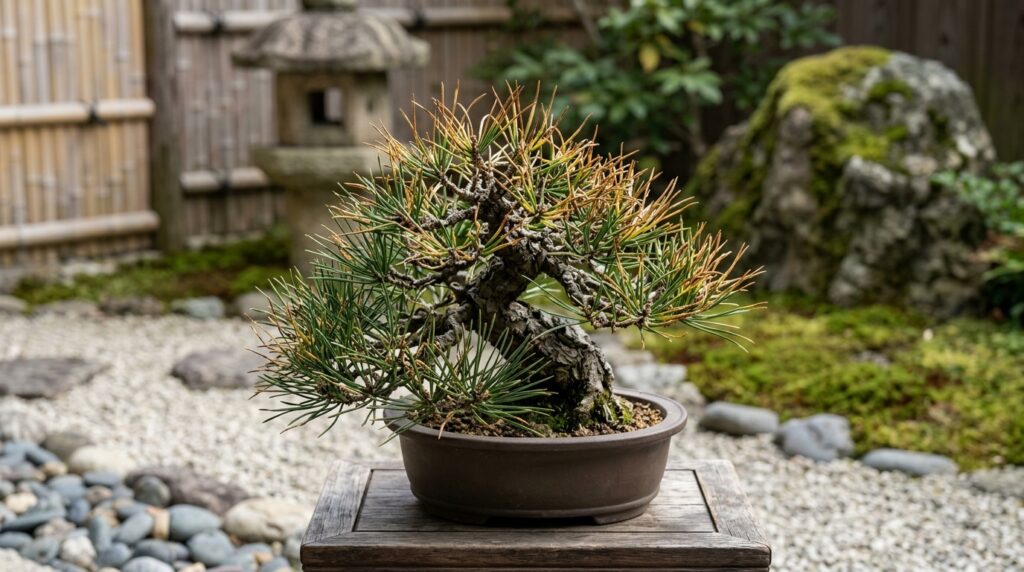
Traditional temperate species—Japanese maple, pine, juniper—require winter dormancy and cannot survive year-round indoors. This is the first lesson: work with nature, not against it.
Best Species for Indoor Cultivation
Through trial and observation, I’ve found these species adapt most successfully to indoor environments:
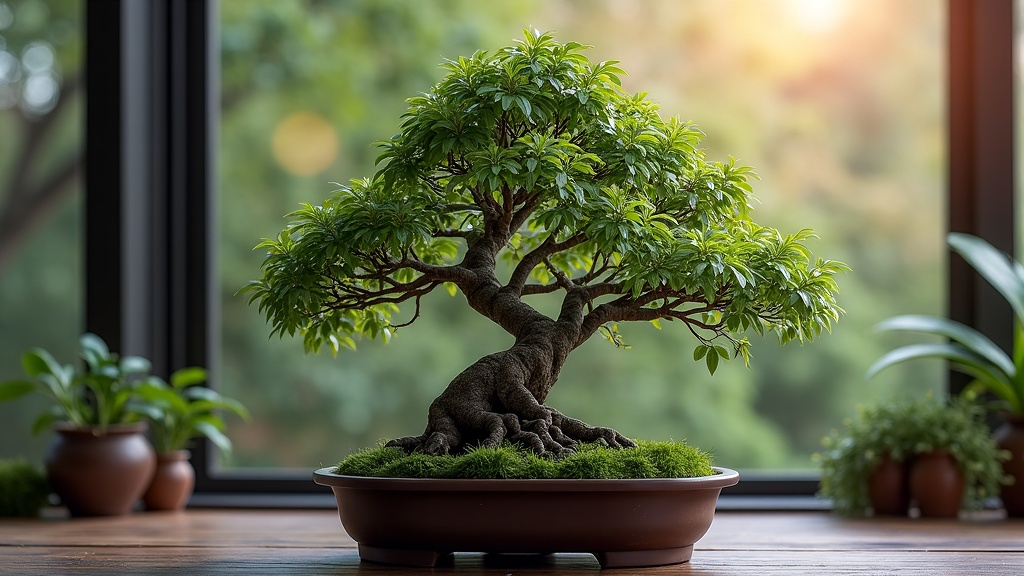
- Ficus (Ficus retusa, Ficus benjamina) — Extremely forgiving, tolerates low light, responds well to pruning
- Chinese Elm (Ulmus parvifolia) — Semi-deciduous, fine branching, adaptable to indoor conditions
- Jade (Crassula ovata) — Succulent nature makes it drought-tolerant, very beginner-friendly
- Schefflera (Schefflera arboricola) — Fast-growing, handles indoor light well, develops thick trunks quickly
- Fukien Tea (Carmona retusa) — Beautiful small leaves, white flowers, requires consistent care
- Hawaiian Umbrella (Schefflera arboricola) — Hardy, tolerates various light conditions
I recommend beginners start with ficus or jade. These species forgive mistakes while you develop your understanding.
The Four Essential Elements
Light: The Most Critical Factor
Light deficiency is the primary killer of indoor bonsai. Trees need significantly more light than we imagine.
Place your tree within two feet of a south-facing window. East or west windows work for species like ficus, but growth will be slower. North-facing windows rarely provide adequate light.
If natural light is insufficient, supplement with full-spectrum LED grow lights. Position them 6-12 inches above the canopy, running 12-14 hours daily. I use this approach during winter months when daylight is limited.
Watering: Daily Attention Required
I check my indoor bonsai every morning. The small soil volume in bonsai pots dries quickly, especially near windows with good light.
Water when the soil surface begins to dry but before it becomes completely dry. Insert your finger half an inch into the soil—if it feels barely moist, water thoroughly until water flows from drainage holes.
Use room-temperature water. I fill my watering can the night before, allowing chlorine to dissipate and water to reach room temperature. Cold water shocks tropical species.
Never water on a schedule. Trees drink at different rates depending on light, temperature, humidity, and season. Observation replaces routine.
Humidity: Recreating Tropical Conditions
Indoor heating and air conditioning create desert-like conditions. Most indoor bonsai species evolved in humid tropical environments.
Maintain 40-60% relative humidity through these methods:
- Place trees on humidity trays filled with gravel and water (pot sits on gravel, above water level)
- Group multiple trees together to create a microclimate
- Run a cool mist humidifier near your trees during heating season
- Mist foliage in morning (not a substitute for proper watering)
Temperature: Stability Matters
Indoor bonsai prefer consistent temperatures between 60-75°F. Avoid placing trees near heating vents, air conditioning units, or drafty windows. Sudden temperature fluctuations stress trees and cause leaf drop.
Most tropical species tolerate brief temperature drops to 50°F but suffer below that threshold. If you live in a cold climate, move trees away from windows on winter nights.
Soil and Potting Considerations
Indoor bonsai soil must drain quickly while retaining some moisture. I use a mix of:
- 40% akadama (Japanese clay granules)
- 30% pumice
- 30% lava rock
This open, granular structure prevents the root rot that kills so many indoor trees. Pre-mixed bonsai soil blends work well for beginners.
Avoid regular potting soil. It retains too much water in the shallow bonsai container, suffocating roots.
When to Repot
Repot tropical species every 2-3 years in early spring. Signs that repotting is needed:
- Water pools on surface before draining
- Roots circling densely at pot edges
- Tree dries out very quickly after watering
- Reduced vigor despite proper care
Feeding Your Indoor Bonsai
Indoor trees grow year-round in stable temperatures, unlike outdoor trees with seasonal dormancy. This means consistent, moderate feeding.
I use liquid balanced bonsai fertilizer at half-strength every two weeks during active growth. In winter, when growth slows even indoors, I reduce feeding to monthly.
Organic fertilizers release nutrients slowly and improve soil biology. I supplement liquid feeding with solid organic cakes placed on the soil surface.
Pruning and Shaping Techniques
Indoor species typically grow faster than outdoor temperate trees. Regular pruning maintains shape and encourages ramification (fine branching).
Maintenance Pruning
Allow shoots to extend 4-6 leaves, then prune back to 1-2 leaves. This technique, repeated patiently over years, creates dense foliage pads.
Remove crossing branches, branches growing straight up or down, and anything that disrupts the tree’s visual flow. Step back frequently to see the whole composition.
Wiring
Use aluminum bonsai wire to position branches. Wire in late winter before spring growth flush.
Wrap wire at 45-degree angles, firm but not cutting into bark. Check weekly—indoor trees grow faster and wire can cut in quickly. Remove wire after 2-3 months before it scars bark.
Common Species Comparison
| Species | Light Needs | Watering | Difficulty | Special Notes |
|---|---|---|---|---|
| Ficus | Medium to High | Moderate | Easy | Most forgiving; drops leaves when stressed but recovers |
| Chinese Elm | High | High | Moderate | Fine ramification; prefers cool nights |
| Jade | High | Low | Very Easy | Drought tolerant; thick trunk develops quickly |
| Fukien Tea | High | Moderate-High | Difficult | Beautiful but sensitive; needs consistent conditions |
| Schefflera | Medium | Moderate | Easy | Fast growth; tolerant of varying conditions |
Common Problems and Solutions
Leaf Drop
Sudden environmental change causes most leaf drop. When you bring a tree home, some adjustment leaf drop is normal. Maintain consistent conditions and new leaves will emerge.
Chronic leaf drop indicates lighting issues, watering problems, or temperature stress. Assess all environmental factors systematically.
Yellowing Leaves
Yellow leaves at the interior of the tree are normal aging. Yellow leaves throughout indicate overwatering, nutrient deficiency, or insufficient light.
Check soil moisture before watering. Ensure drainage holes are clear. Increase light exposure if possible.
Pests
Indoor environments favor spider mites, scale, and aphids. Inspect trees weekly, especially leaf undersides.
Treat infestations with neem oil spray or insecticidal soap. Isolate affected trees to prevent spread. Good air circulation and proper humidity reduce pest pressure.
The Philosophy of Indoor Bonsai
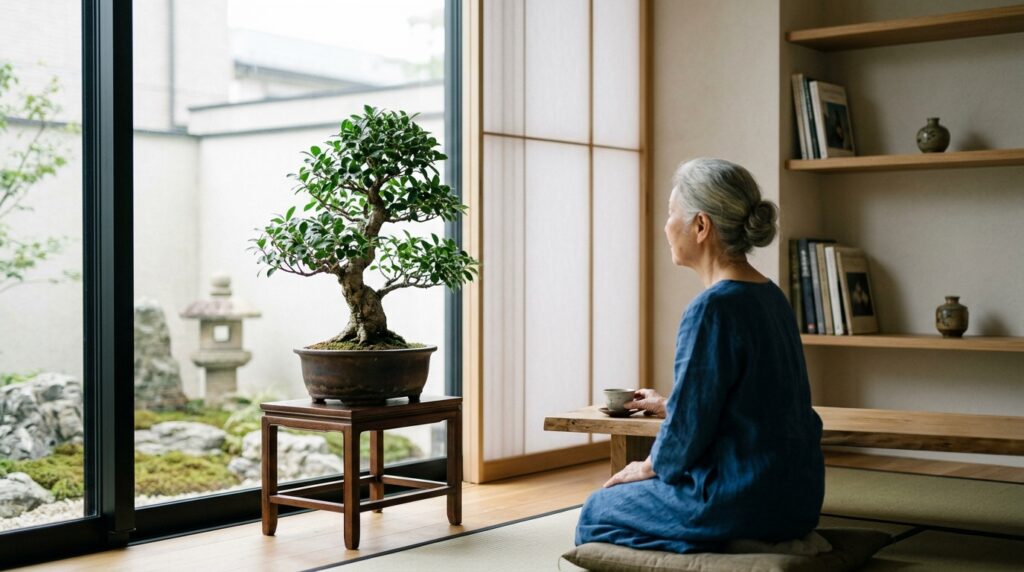
In the wabi-sabi tradition, we find beauty in imperfection and transience. Your indoor bonsai will not achieve the gnarled, weathered character of ancient outdoor specimens. Instead, appreciate what indoor cultivation offers: the daily companionship of a living tree, the meditation of routine care, the satisfaction of growth guided by patient attention.
Indoor bonsai demands compromise. The tree adapts to your environment; you adapt your expectations to the tree’s possibilities. This mutual accommodation is the practice itself.
Starting Your Practice
Begin with a single, forgiving species. A small ficus bonsai in a south window teaches more than three difficult trees struggling in poor conditions.
Invest in essential tools gradually: sharp pruning shears, wire, proper soil. Quality tools last decades and make work precise and enjoyable.
Most importantly, develop the habit of daily observation. Five minutes each morning, studying your tree’s response to care, teaches you what books cannot.
Frequently Asked Questions
Can any bonsai be kept indoors?
No. Temperate species like Japanese maple, juniper, and pine require winter dormancy with cold temperatures. They will slowly decline and die if kept indoors year-round. Only tropical and subtropical species can live permanently indoors.
How often should I water my indoor bonsai?
Check soil daily, water when the surface begins to dry. This might be daily in summer near a bright window, or every 2-3 days in winter. Watering frequency varies with light, temperature, tree species, pot size, and season. Observation trumps schedules.
Do I need special grow lights for indoor bonsai?
If you have a south-facing window with 4+ hours of direct sun, natural light may suffice for species like ficus and jade. For other exposures, or for optimal growth, full-spectrum LED grow lights significantly improve results. They’re essential during winter in northern climates.
Why does my indoor bonsai keep losing leaves?
Leaf drop signals environmental stress: sudden location change, insufficient light, improper watering, or temperature fluctuation. Ficus species drop leaves readily but usually recover. Maintain stable conditions and assess light levels first—inadequate light is the most common cause.
How long does it take to grow an indoor bonsai?
Bonsai is not a destination but a continuous practice. A young tree begins showing bonsai character in 3-5 years with regular pruning and training. Refinement continues indefinitely. You can also start with pre-trained material and focus on maintaining and improving existing structure.