How to Care for a Bonsai Tree: The Complete Guide
After twenty years of working with bonsai, I can tell you that most beginners fail not from lack of care, but from caring in the wrong ways. A bonsai is not a houseplant — it’s a tree living in a small pot, and it demands attention to detail that mirrors the patience required to shape it.
Learning how to care for a bonsai tree means understanding five essentials: water, light, soil, pruning, and feeding. Master these, and your tree will thrive for decades. Ignore them, and it will be dead within weeks.
Understanding What Bonsai Actually Needs
The word “bonsai” means “tree in a pot,” and that constraint defines everything. Your tree cannot send roots deep into the ground to find water during drought. It cannot grow tall to escape shade. The pot limits resources, which means you become responsible for providing exactly what the tree needs — no more, no less.
This is not decoration. This is horticulture reduced to its essence. Every action matters because there is no buffer, no margin for error in that small container of soil.
Watering: The Skill That Takes Years to Learn
I watched my teacher in Osaka spend three years teaching a student how to water properly. That student is now a respected practitioner. Watering seems simple, but it is where most trees die.
Check the Soil, Not the Calendar
Never water on a schedule. The soil tells you when to water. Press your finger into the soil up to the first knuckle. If it feels dry, water thoroughly. If it feels damp, wait.
Different species, pot sizes, soil mixes, and seasons all change water needs. A juniper in summer heat may need water twice daily. The same tree in winter may need water once a week. The soil knows — check it.
How to Water Properly
When you water, water thoroughly. Use a bonsai watering can with a fine rose to avoid disturbing the soil. Water until it runs freely from the drainage holes. Wait a few minutes, then water again. This ensures the entire root ball is saturated, not just the surface.
Tap water is usually fine, but if your water is heavily chlorinated or very hard, let it sit overnight before using. Some practitioners collect rainwater — it’s ideal but not necessary.
Light: Position Your Tree for the Species You Have
Most bonsai are outdoor trees. This surprises people who see bonsai as interior decoration, but it is true. Junipers, pines, maples — these are outdoor species that need real sunlight, seasonal temperature changes, and natural air movement.
Outdoor Bonsai Placement
Place outdoor bonsai where they receive morning sun and afternoon shade, especially in hot climates. Six hours of direct sunlight is ideal for most species. Protect them from harsh afternoon sun in summer and from freezing winds in winter.
Use bonsai display benches to elevate trees to a comfortable working height and improve air circulation around the pots.
Indoor Bonsai Species
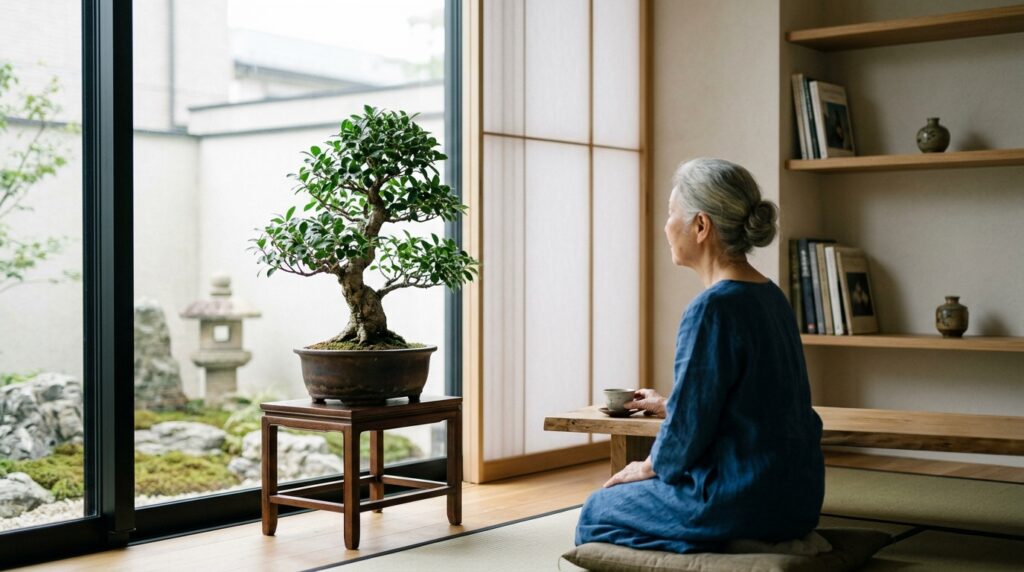
True indoor bonsai are tropical and subtropical species: ficus, jade, Chinese elm, schefflera. Even these need bright, indirect light — ideally near a south-facing window. If natural light is insufficient, supplement with grow lights positioned 6-12 inches above the canopy.
Soil: The Foundation of Health
Bonsai soil is not potting soil from a garden center. It is a specialized mix designed for drainage and aeration. Roots need oxygen as much as water. Dense, organic soil holds too much moisture and suffocates roots.
Components of Bonsai Soil
A standard mix combines three components:
- Akadama — Japanese volcanic clay that retains moisture while providing structure
- Pumice — improves drainage and aeration
- Lava rock — provides stability and additional drainage
Mix these in equal parts for most species. Conifers prefer more drainage (increase pumice/lava), while deciduous trees tolerate slightly more water retention (increase akadama). Pre-mixed bonsai soil is available for beginners.
When to Repot
Repot young trees every 1-2 years, mature trees every 3-5 years. The timing depends on root growth, not appearance. When roots circle the pot or become densely matted, it’s time.
Repot in early spring before buds break. Remove the tree, trim away one-third of the root mass using sharp bonsai root scissors, and replant in fresh soil. This stimulates new feeder root growth.
Pruning and Shaping: Creating Form
Pruning serves two purposes: maintaining health and creating aesthetic form. Remove dead, diseased, or crossing branches immediately. Structural pruning — shaping the tree’s overall design — happens during dormancy for most species.
Maintenance Pruning
Throughout the growing season, pinch back new growth to maintain the tree’s shape. For most deciduous trees, allow shoots to extend 4-6 leaves, then prune back to 2 leaves. This encourages branching and keeps growth compact.
Use proper bonsai pruning shears that make clean cuts. Ragged cuts invite disease.
Wiring for Shape
Wire is how we bend branches into position. Wrap anodized aluminum or annealed copper wire around branches at a 45-degree angle, then gently bend to the desired position. Leave wire on for 3-6 months, but watch closely — it must be removed before it cuts into growing bark.
This technique requires practice. Start with less valuable material until you develop feel for how much pressure the branch can tolerate.
Fertilizing: Replacing What the Pot Cannot Provide
In nature, trees draw nutrients from decomposing organic matter and mineral soil. In a pot, these resources deplete quickly. Fertilize regularly during the growing season to maintain vigor.
What to Use
Balanced organic fertilizer is safest for beginners. Look for NPK ratios around 10-10-10 or similar. Organic bonsai fertilizer releases nutrients slowly and is forgiving of application errors.
Feed every two weeks during active growth (spring through summer). Reduce to monthly feeding in fall. Stop fertilizing in winter when the tree is dormant.
Application Method
Liquid fertilizers absorb quickly. Solid fertilizer cakes placed on the soil surface release gradually with each watering. Both work — choose based on your schedule and preference.
Species-Specific Care Requirements
Different species have different needs. Here are common bonsai types and their care profiles:
| Species | Light | Water Needs | Location | Difficulty |
|---|---|---|---|---|
| Juniper | Full sun | Moderate, avoid overwatering | Outdoor only | Beginner-friendly |
| Japanese Maple | Morning sun, afternoon shade | High, daily in summer | Outdoor only | Intermediate |
| Ficus | Bright indirect | Moderate, consistent | Indoor | Beginner-friendly |
| Chinese Elm | Bright light | Moderate | Indoor or outdoor | Beginner-friendly |
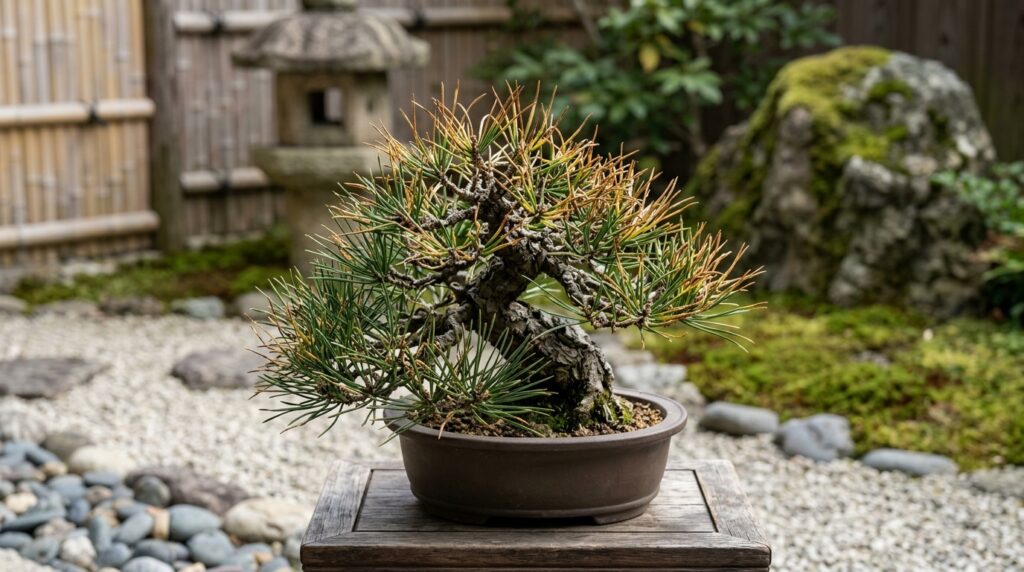
| Pine (Black/White) | Full sun | Moderate to low | Outdoor only | Advanced |
| Jade | Bright light | Low, allow to dry between watering | Indoor | Very easy |
Common Problems and How to Address Them
Yellowing Leaves
Often indicates overwatering or poor drainage. Check soil moisture and ensure drainage holes are clear. If soil stays wet for days, repot in proper bonsai soil.
Leaf Drop
Can result from sudden environmental changes, underwatering, or moving an outdoor tree indoors. Maintain consistent conditions and match care to the species’ needs.
Pests
Aphids, spider mites, and scale insects occasionally appear. Spray with neem oil spray or insecticidal soap. Check trees regularly to catch infestations early.
Weak Growth
Usually means insufficient light or nutrients. Move the tree to a brighter location and resume regular feeding during the growing season.
Frequently Asked Questions
How often should I water my bonsai tree?
There is no fixed schedule. Check the soil daily and water when the top half-inch feels dry. In summer, this may be daily or twice daily. In winter, it may be once weekly. The soil dictates frequency, not the calendar.
Can I keep my bonsai tree indoors?
Only if it’s a tropical or subtropical species (ficus, jade, Chinese elm, schefflera). Most bonsai are temperate outdoor trees — junipers, maples, pines — that require seasonal dormancy and will die indoors. Match the species to your environment.
How long does it take to grow a bonsai tree?
A bonsai is not “grown” from seed to finished form in a few years. Most practitioners start with nursery stock (young trees 2-5 years old) and develop them over 5-10 years into refined bonsai. Growing from seed adds another 3-5 years before you even begin training. Patience is essential.
Do I need special tools to care for bonsai?
Basic tools make care easier and safer for the tree: bonsai shears, wire cutters, a watering can with a fine rose, and root scissors for repotting. You can start with household scissors and upgrade as you develop skill, but proper tools produce cleaner cuts and better results.
When is the best time to repot a bonsai?
Repot in early spring just before the buds begin to swell. This timing gives the tree the entire growing season to recover and establish new roots. Tropical species can be repotted in late spring or early summer. Never repot during active growth or dormancy.