I see this mistake in beginners because bonsai invites action before it teaches patience. If a bonsai tree gets too little sunlight, it does not usually fail all at once. It weakens by degrees: growth stretches, leaves enlarge, color dulls, watering becomes harder to judge, and the tree slowly loses the compact character we work so carefully to build.
I have seen this more times than I can count, especially with indoor growers who are attentive in every way except light. They water carefully, prune gently, even rotate the pot with good intentions, but the tree is living in a room that is simply too dim. Bonsai can tolerate many small mistakes for a time. Chronic low light is not a small mistake.
The good news is that the symptoms are readable, and in many cases the tree can recover if you correct the light before the roots and branches lose too much strength. The first step is to understand what low light actually does to a bonsai, and why the answer depends very much on species.
What too little sunlight does to a bonsai
Sunlight is not just what keeps a bonsai alive in the general sense. It is what allows the tree to keep short internodes, small leaves or needles, dense budding, healthy root turnover, and a balanced rhythm between top growth and root growth. When light drops below what the species needs, the tree begins conserving itself.
In practical terms, the bonsai will often produce longer, weaker shoots as it reaches toward brighter conditions. Leaves may become larger and thinner because the tree is trying to capture more light. Variegation can fade. Needle density in conifers can loosen. A once-tight silhouette starts to look soft and vague.
With enough time in poor light, the more serious decline begins. Older inner leaves yellow and fall. Back budding decreases. New growth emerges pale or weak. The soil stays wet longer because the tree is using less water, which can invite root trouble if the owner continues watering on the old schedule. The tree then suffers from two problems at once: not enough light above and not enough oxygen below.
One quiet lesson from long practice is that low light often disguises itself as several other problems. Beginners think they have a watering issue, a fertilizer issue, or a pest issue. Sometimes they do. But very often the tree is simply underlit, and every other symptom follows from that.
The early signs most growers miss
The earliest signs of low light are subtle, especially on a tree that still looks green from a distance. I tell students to stop looking at the bonsai as a whole for a moment and look at the shape of the newest growth.
- Longer internodes: The spaces between leaves begin to stretch beyond the tree?s normal habit.
- Larger leaves: Ficus, Chinese elm, and other common indoor species often respond by making noticeably broader leaves.
- Leaning growth: New shoots angle strongly toward a window instead of developing evenly.
- Thinner canopy: Inner growth weakens first because the little light available never reaches inside the tree.
- Slower drying soil: The tree drinks less, so the root zone remains damp longer than it did before.
One of the clearest warning signs is aesthetic rather than dramatic: the bonsai stops looking intentional. The outline becomes lanky. Pads become messy. Ramification seems to pause. To me, that change in character matters because bonsai is not just survival horticulture. We are trying to maintain proportion, rhythm, and restraint. Low light erodes all three.
Species matters more than people expect
Not all bonsai respond to shade in the same way. A tropical tree that can survive indoors near a bright window should not be judged by the same standard as a juniper or pine, which truly belongs outdoors in strong sun and moving air.
If a juniper is kept indoors or in very poor sun, the result is often a delayed decline. It may stay green long enough to mislead the owner, but the foliage weakens, the roots lose vigor, and eventually the tree collapses. By the time the problem is obvious, recovery is much harder. With ficus, the decline is usually slower and more reversible, but the tree still loses density and refinement.
Chinese elm, dwarf jade, Hawaiian umbrella tree, and many ficus varieties are more forgiving of indoor culture than conifers. Forgiving does not mean happy in dimness. It only means they can endure conditions that would quickly ruin a sun-demanding species.
When people ask the related question, ?Which bonsai tree tolerates the lowest light levels indoors?? my honest answer is that no bonsai truly prefers low light. Some merely tolerate it better. Among the common beginner choices, Hawaiian umbrella tree and certain ficus varieties tend to cope best with indoor light that is bright but indirect. Dwarf jade can also do well, though it still wants stronger light than many owners provide. If the room is genuinely dim for most of the day, the better solution is not to search for a miracle species. It is to improve the light.
What low light changes in the design of a bonsai
This part is often overlooked. Poor light does not only weaken health; it changes what kinds of styling are even possible. A bonsai grown in insufficient light cannot hold fine ramification well. It will not respond to pruning with the same tight back budding. Leaf reduction becomes less meaningful because the tree is already compensating by enlarging foliage. The whole design starts drifting away from refinement.
I learned early in my training that strong design depends on strong energy, but not crude energy. We want controlled vigor. In bright, appropriate light, you can prune and redirect growth with confidence because the tree has the strength to answer. In poor light, the same pruning can leave the tree with too little productive foliage, and recovery becomes slow and uneven.
There is also a visual honesty to consider. A shaded ficus may still be alive, but if every shoot is stretching and every leaf is oversized, it no longer expresses age, compression, or calm. It reads as a houseplant struggling to imitate a bonsai. That distinction matters if your goal is more than keeping something green on a shelf.
Indoor species and their low-light tolerance
| Species | Low-light tolerance indoors | What usually happens in too little sun | Better approach |
|---|---|---|---|
| Ficus | Moderate | Long internodes, larger leaves, slower branching | Place in the brightest window possible; supplement with a grow light if needed |
| Hawaiian umbrella tree | Moderately high | Can survive dimmer rooms, but structure becomes loose and coarse | Use for brighter indoor spots, not truly dark corners |
| Chinese elm | Low to moderate | Weak inner growth, legginess, leaf drop if conditions stay poor | Give strong light and seasonal outdoor time where climate allows |
| Dwarf jade | Moderate, but wants brighter light than many expect | Soft growth, pale leaves, weaker trunk character | Use a sunny window or dedicated grow light |
| Juniper or pine | Very poor | Delayed but serious decline, often irreversible if kept indoors | Grow outdoors in full sun with proper seasonal care |
If you want the simplest answer for indoor beginners, start with ficus if you have a bright window, and choose an umbrella tree only if your light is decent but not ideal. If your room is dim enough that you can comfortably read there all day without ever seeing direct sun, that still does not mean it is bright enough for good bonsai culture.
How to tell whether the problem is light, watering, or both
Low light and overwatering often arrive together because one leads to the other. A tree in weak light uses less water, so the soil stays wet longer. The owner, following an old routine, keeps watering at the same frequency. The roots then sit damp and sluggish, which weakens the canopy further.
Look for this pattern: stretched new growth, slow soil drying, and yellowing leaves that start from the interior or older growth. That combination usually points to insufficient light compounded by overwatering. By contrast, a tree with crisp, dry edges and rapid soil drying may be dealing with drought stress, hot sun, or dry air instead.
Another practical clue is timing. If the tree declined after being moved deeper into a room, after winter days shortened, or after a nearby building blocked the window, light is the first thing I would question. During winter teaching sessions, I often see bonsai that were healthy in September and visibly weaker by January simply because the owner did not adjust placement or add supplemental light.
How to fix a bonsai that has been getting too little sunlight
The correction should be steady, not abrupt. If a shade-weakened tropical bonsai has been sitting in a dim corner, do not put it straight into harsh midday summer sun. Increase light in steps so the foliage can adjust.
- Identify the species correctly. This decides whether the tree needs indoor bright light, outdoor sun, or a seasonal transition.
- Move it to the brightest appropriate location. For tropical indoor bonsai, this usually means directly in front of your brightest south- or west-facing window. For outdoor species, it means returning them outdoors if climate and season permit.
- Adjust watering immediately. Water by soil condition, not by the old calendar. A weakened tree in dim light does not use water at the same rate.
- Hold back on heavy pruning. Let the tree rebuild strength before asking it for refinement.
- Use a grow light if natural light is inadequate. This is often the most practical fix for apartment growers.
- Watch the next flush of growth. Healthier, shorter, better-colored new growth is the sign that the change is working.
For indoor setups, a simple dedicated grow light is often more useful than another fertilizer or tonic. If your window is marginal, a small full-spectrum unit above the canopy can make an obvious difference. If you need one, a search for full-spectrum grow lights for bonsai is a practical starting point. I also like keeping a basic digital light meter for plants or a simple bonsai watering can nearby, not because tools solve everything, but because they help you observe more accurately and water more gently once the tree begins recovering.
One thing I tell students often: do not chase recovery with fertilizer before you fix light. Feeding a tree that cannot photosynthesize well enough is like pressing for performance from a tired apprentice who has not been given enough daylight to work.
When recovery is likely, and when it is not
A tropical bonsai that has only recently become leggy usually recovers well. Once light improves, new leaves will often emerge smaller and better spaced, and after some time you can prune back to restore compact structure. Patience matters here. You are waiting for new evidence of vigor, not forcing the tree back into shape immediately.
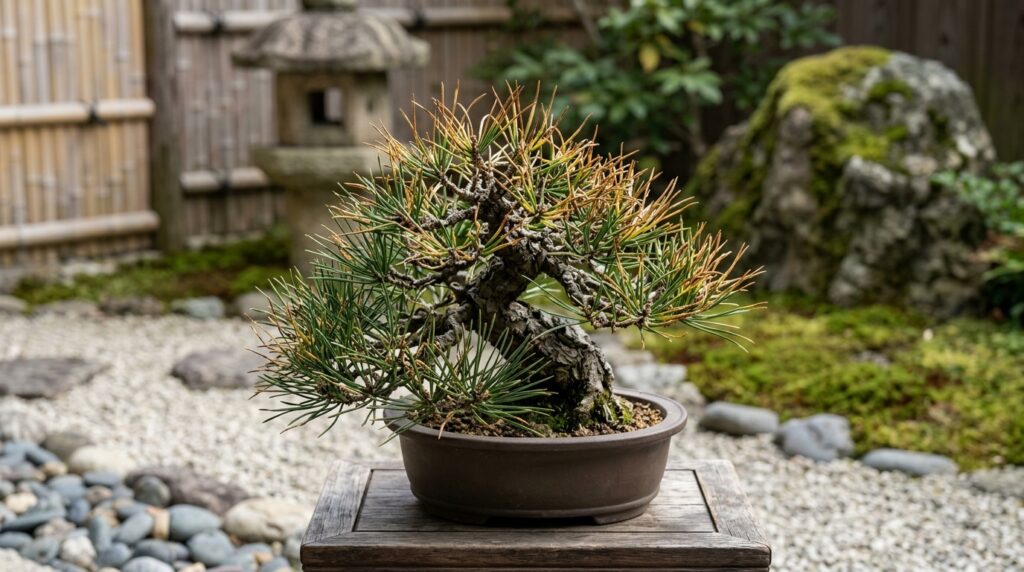
Recovery becomes less certain when low light has lasted for many months and root health has already deteriorated. If branches are drying back, foliage is sparse across the whole tree, or the trunk feels visually stalled year after year, expect a slower rebuilding period. With conifers that have been kept indoors, the outlook is often poor. They may remain superficially green long after their real vigor is gone.
Experience teaches a quiet kind of humility here. Some trees forgive neglect once; very few forgive it repeatedly. The stronger your eye becomes, the earlier you notice the small loss of tension in the canopy, and the less dramatic your corrections need to be.
How much light is enough for an indoor bonsai?
People understandably want an exact number, but the practical answer is still the most useful one: give the tree the brightest position you can, then judge the result by the growth habit. For most indoor bonsai, a few feet back from a dim window is already too far. Glass reduces intensity. Distance reduces it even more.
If you cannot offer several hours of strong natural brightness, use supplemental lighting. This is especially important in winter or in north-facing rooms. A bonsai that lives indoors full time should not be expected to thrive on ambiance. It needs usable light at canopy level for long enough each day to maintain compact, healthy growth.
I do not find this discouraging. It is simply part of honest bonsai culture. Every species asks for something. Your job is to decide whether your home can provide it naturally, whether a grow light will bridge the gap, or whether a different species would be more appropriate.
FAQ
Can a bonsai recover after months of low light?
Often yes, especially tropical species such as ficus, if the roots are still healthy and you improve the light promptly. Recovery is slower if the tree has also been overwatered or has lost significant interior growth.
Will yellow leaves always mean not enough sunlight?
No. Yellow leaves can also come from overwatering, seasonal change, root stress, or pests. But when yellowing appears alongside stretched growth and slow soil drying, low light is a strong suspect.
Which bonsai tree tolerates the lowest light levels indoors?
If I had to choose among common beginner options, I would look first at Hawaiian umbrella tree and then ficus. Even so, neither should be treated as a true low-light bonsai. They tolerate lower light better than many others, but they still perform best in bright conditions.
Should I rotate my bonsai to make the growth even?
Yes, gently and periodically, especially for indoor trees growing toward one window. Just do not let rotation become a substitute for stronger light. A dim room rotated in all directions is still a dim room.
Affiliate disclosure: Some links above are affiliate links, which means I may earn a small commission if you buy through them, at no extra cost to you.