I choose the indoor spot for a ficus bonsai by looking at the light before I look at the furniture. The best place is close to your brightest suitable window, with steady warmth, room around the leaves, and protection from heater blasts and cold drafts.
In a Northern Hemisphere home, I usually assess a south-facing window first, then an unobstructed east- or west-facing window. A handsome shelf across the room rarely provides enough light to maintain the compact growth we want in bonsai. Placement is part of cultivation: it determines what kind of tree you can develop.
What is the best indoor spot for a ficus bonsai?
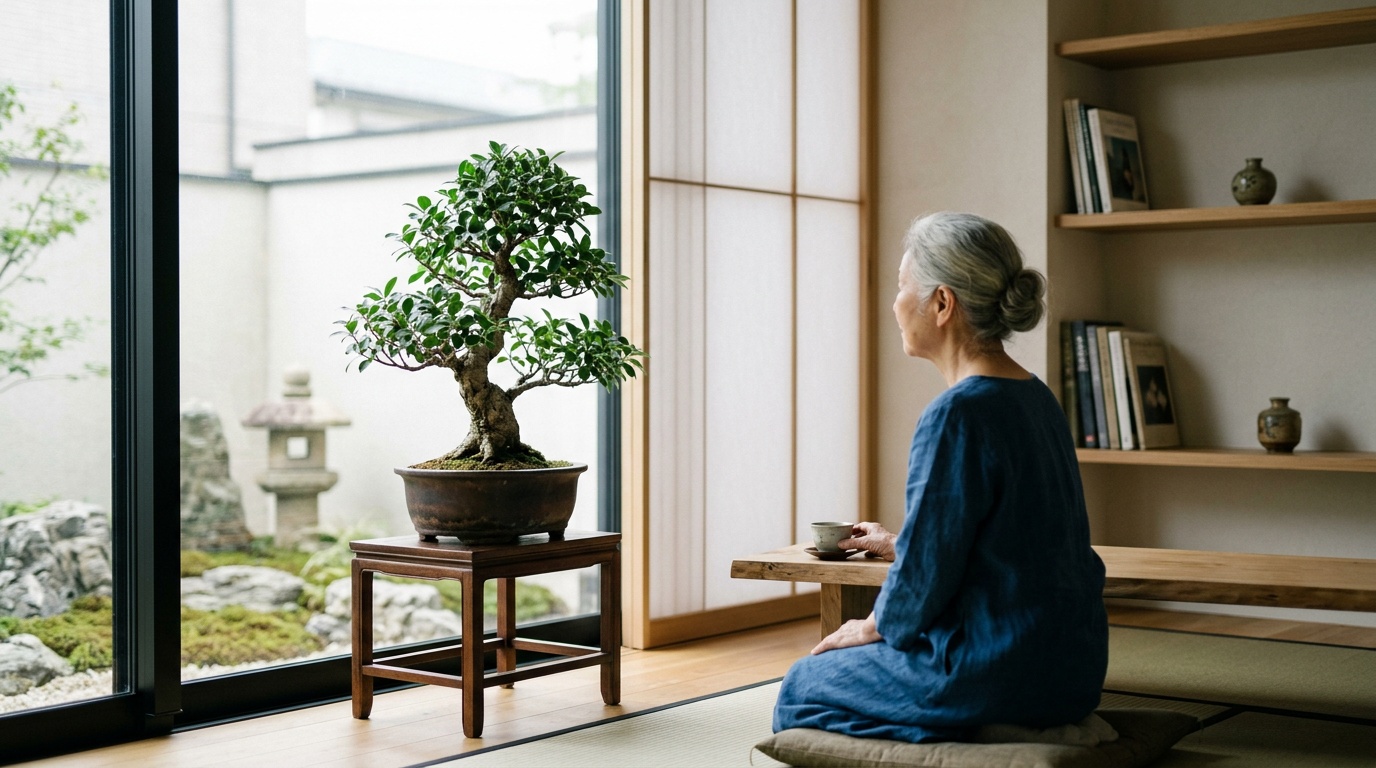
Start with a stable stand immediately beside a bright window, keeping the foliage clear of the glass. Several hours of direct sun can suit an established ficus, provided it has adjusted gradually. If your windows are shaded, supplemental growing light may be necessary even when the room looks bright to you.
For an initial arrangement, I often put the canopy roughly 6–12 inches from the pane, then check for heat, nighttime cold, and shading from the window frame. That distance is a starting point, not a light prescription. Deep overhangs, tinted glazing, nearby buildings, and trees outside can change the result completely.
Before settling on a position, sit where the pot will stand and look outward at leaf height. Can the canopy receive light through the window, or is most of it below the sill? A small rise in stand height can expose lower branches that were sitting in shadow.
In teaching, I have found that “near a window” is one of our least useful descriptions. Two people can mean a few inches or half a room. I ask students to describe what the leaves actually face.
Understand which ficus you are growing
Most compact ficus bonsai sold for homes are forms of Ficus microcarpa, including many plants marketed as ginseng ficus or tiger bark ficus. Labels using “retusa” are common in the trade and do not always identify the plant precisely. Ginseng describes the familiar swollen-root presentation; it does not mean the tree needs a dark, humid corner.
Ficus benjamina, the weeping fig, is also trained as bonsai. Its response to environmental changes can be conspicuous, particularly through leaf shedding. For either species, identify the growing conditions before assuming a falling leaf means the tree needs fertilizer.
These tropical figs can live indoors throughout the year with sufficient light and appropriate care. They do not need the cold winter rest required by temperate bonsai such as Japanese maples. However, “suitable indoors” still asks something of the room.
My aim is healthy replacement growth, with enough strength to recover after pruning. A tree that keeps a few leaves in a dim spot may be surviving without developing. When shoots lengthen toward the window and the interior canopy becomes sparse, I reassess the growing position before shortening every branch again.
Compare windows by actual exposure
The table below assumes a Northern Hemisphere home. In the Southern Hemisphere, north-facing windows generally receive the stronger sun. East still gives morning sun and west afternoon sun; local shade can outweigh any compass direction.
| Indoor position | When I would choose it | What to watch |
|---|---|---|
| South-facing window | First candidate for a light-demanding ficus, especially during winter | Summer heat, hot pots, and sudden exposure of shade-grown leaves |
| East-facing window | A useful starting place with gentle morning sun and an open outlook | Insufficient total light if trees or buildings shade the morning |
| West-facing window | A strong option where afternoon light reaches the whole canopy | Rapid drying and heat during summer afternoons |
| North-facing window | Worth evaluating if large and unobstructed, often with supplemental light | Weak winter growth and prolonged soil moisture |
| Desk or shelf far from windows | A growing position only when a suitable plant light supplies the missing light | Ordinary room lighting being mistaken for adequate growing light |
Check the window at different times
Visit each candidate position in the morning, around midday, and late afternoon. Notice where the sun actually lands. A window can be sunny while the bonsai beneath it remains shaded by the sill. Open daytime blinds and move objects that intercept the light before deciding you need more equipment.
A phone light-meter app can help compare two positions when used consistently, but I would not treat its reading as a calibrated measurement of plant-usable light. The practical question is whether one placement gives the entire canopy substantially better exposure.
Let stronger sunlight become familiar
Do not move a ficus from a dim shop straight into an intensely sunny window for a full afternoon. Begin with gentler exposure, then increase it over roughly one to two weeks, watching the foliage and soil. A sheer curtain can soften the strongest period while the tree adjusts.
Direct sun is not automatically harmful to ficus. Bonsai Empire’s ficus care guide emphasizes its high light requirement and suitability for sunlight. The important distinction is between an acclimated tree and leaves formed under much weaker light.
Keep the growing position warm and workable
I look for ordinary, comfortable room temperatures, roughly 65–80°F (18–27°C), and use 60°F (16°C) as a conservative lower target for the growing spot. These are practical setup targets rather than exact injury thresholds. A cold pane or a draft can expose the tree to conditions quite different from those recorded by a thermostat across the room.
Check the temperature beside the pot
Place a simple minimum–maximum thermometer near the tree for several nights during cold weather. Keep leaves off the glass, and avoid trapping the canopy between a closed curtain and a cold window. A narrow sill above a radiator may combine cold foliage at night with a rapidly drying root ball during heating cycles.
A nearby stand often gives better control than a crowded sill. Leave enough access to lift the pot, inspect the soil, and water without brushing the branches against curtains. Keep the stand stable and protect the furniture with a waterproof tray that can be emptied.
Treat humidity as a supporting condition
A bright bathroom can work if it stays warm and has a genuinely useful window. A windowless bathroom does not become a suitable growing space because showers make it humid. Similarly, I avoid putting a ficus directly in the airflow from an air conditioner or heating vent.
Where room air is persistently very dry, a humidifier can improve the surrounding conditions. Misting gives only a brief change, and a pebble tray has limited reach. Neither should distract from choosing good light and managing the moisture inside the pot.
One lesson I carried from training in Osaka and Kyoto is to make daily care physically easy. If checking the soil requires moving a lamp, three ornaments, and another plant, the arrangement needs simplifying.
Match watering and light to the chosen spot
After a change in placement, check moisture daily without automatically watering daily. A brighter, warmer position may dry the pot faster. A darker winter position may leave the same soil damp much longer. Continuing the old schedule can turn a sensible move into a watering problem.
Feel the surface and check just beneath it where accessible. Lift the pot to learn the difference between freshly watered and approaching dry. Coarse bonsai substrate and dense nursery compost behave differently, so one dry-looking grain on top is not enough information.
When the upper layer begins to dry and the root ball is no longer wet, water thoroughly until water exits the drainage holes. Allow it to drain and empty the collecting tray. Avoid repeatedly giving small sips, and do not wait for the entire root ball to become hard and dry.
Add a grow light when the window falls short
If the brightest available window cannot support healthy growth, use an adjustable LED plant light with published coverage and hanging-distance guidance. Choose a fixture that illuminates the whole canopy, including lower branches. A tiny decorative lamp illuminating only the top leaves offers an incomplete solution.
A timer set for approximately 12–14 hours per day is a reasonable starting routine, with darkness overnight. Follow the fixture’s instructions for distance and assess leaf temperature and new growth; there is no universal spacing that works for every lamp. Bonsai Empire includes this lighting duration in its guidance for struggling indoor ficus.
Keep electrical connections away from runoff and make watering easy beneath the fixture. I prefer a simple arrangement I can inspect comfortably over an elaborate one that hides the soil and branches.
If your ficus bonsai is dropping leaves, investigate in order
A few older leaves falling while healthy shoots develop may be ordinary turnover. Rapid shedding, widespread yellowing, or bare branches deserve closer attention. Leaf color alone cannot distinguish every cause: Clemson Cooperative Extension identifies both watering extremes, drafts, and low light among the causes of leaf drop in weeping ficus.
- Check moisture first. A very light pot with dry soil suggests missed watering; persistently wet soil points toward slow drying or poor drainage. Water a dry root ball thoroughly. If it is wet, stop adding water and inspect drainage.
- Review recent changes. Consider delivery, relocation, heating being switched on, or newly closed blinds. An adjustment response is possible, but it should not excuse leaving the tree in inadequate conditions.
- Assess light at the leaves. A dim position can contribute to declining growth and slower soil drying. Improve an unsuitable location once, then observe instead of trying a different room every few days.
- Check cold and heat. Look for an opening exterior door, a nearby vent, contact with glass, or a pot that overheats in afternoon sun.
- Inspect for pests. Examine leaf undersides, stems, and branch junctions for fine webbing, sticky residue, or attached scale insects. Separate an affected tree from other plants while you identify the pest and choose suitable treatment.
During recovery, pause major pruning, defoliation, and routine repotting. Fertilizer cannot compensate for insufficient light or damaged roots. If the soil remains saturated and smells sour, or exposed roots are soft and decaying, investigate the roots promptly; that is different from repotting simply because several leaves fell.
I have seen beginners respond to leaf loss with several changes in one afternoon. It then becomes difficult to know what helped. Correct clear problems, record what you changed, and watch for firm buds and new leaves over the following weeks. Recovery speed depends on the remaining roots, warmth, and light.
Let the display serve the tree
A ficus with a broad crown needs room for light to reach more than its outermost leaves. Avoid squeezing it between tall houseplants or beneath a shelf that shades half the canopy. Negative space around the branches also makes the trunk line easier to appreciate.
Once the tree is settled and growing, a small rotation every week or two can help distribute window light. This is a different scale of change from carrying it between rooms with very different conditions. Observe weaker branches and adjust thoughtfully.
I sometimes bring a healthy tree to a table for an evening of viewing, then return it to its growing position. A temporary display and a permanent home have different demands. Accepting that distinction leaves room for both good cultivation and quiet enjoyment.
Frequently asked questions
Can a ficus bonsai live on my office desk?
Yes, if the desk receives strong window light or has a suitable dedicated grow light. Check what happens on weekends: closed blinds, disabled lighting timers, and reduced heating can change an otherwise promising office setup.
Should I move my ficus away from the window in winter?
Only if the immediate position becomes too cold or drafty. Preserve as much light as possible by using a nearby stand, addressing drafts, or adding growing light. Moving deep into the room may solve one problem while creating another.
Does a ginseng ficus need a different indoor spot?
Its swollen roots do not remove the need for bright light and warmth. Choose the position using the canopy’s exposure, then adjust watering to the actual soil and container. Check that a decorative outer pot is not holding runoff.
How can I tell that I have found the right place?
Look for sustained healthy growth, leaves that persist, and a root ball that dries predictably between thorough waterings. Take a photograph every few weeks from the same angle. The best spot proves itself through the tree’s condition over time.